


TACTICAL ANALYSIS: Morocco edge Nigeria in stalemate defined by midfield control

.jpg)
.jpg)
.jpg)
Reading Time: 5min | Thu. 15.01.26. | 16:06
Morocco advanced, but the match itself stood as a reminder: elite international football is often decided not by dominance, but by whose structure breaks last - and here, neither truly did
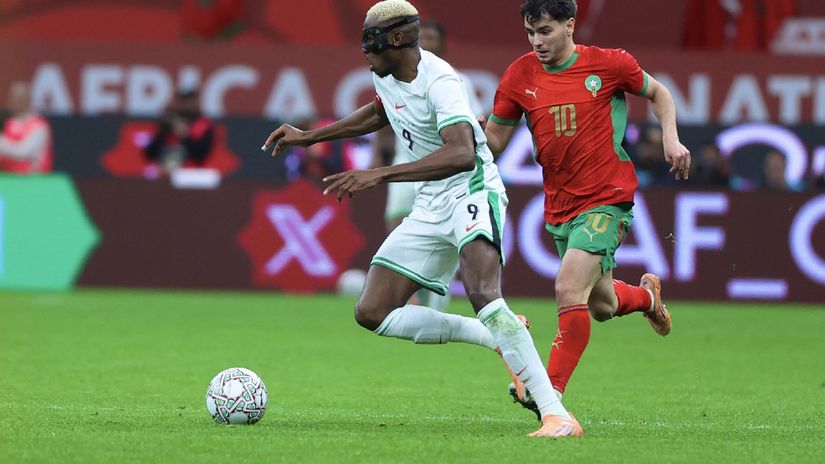
Nigeria and Morocco played out to a 120-minute tactical chess match that finished goalless before the Atlas Lions edged the contest 4-2 on penalties to book a ticket to the final of the 2025 Africa Cup of Nations.
Follow our WhatsApp channel for more news
While the scoreline suggests balance, the match itself was rich in structural detail, pressing battles, and contrasting interpretations of control.
This analysis unpacks why the game unfolded the way it did, focusing on base structures, pressing logic, midfield occupation, wing dynamics, and how both sides repeatedly neutralised each other’s strengths without ever fully solving the puzzle.
This encounter brought together two of Africa’s most tactically mature sides, each with distinct identities.
Nigeria leaned into physicality, transition threat, and aggressive out-of-possession work, while Morocco prioritised circulation, positional play, and right-sided overloads.
What follows examines how Nigeria’s compact 4-4-2 box midfield disrupted Morocco’s build-up, how Morocco’s man-oriented pressing and lane control stifled Nigeria’s creators, and why neither side could fully translate territorial or structural advantages into goals.
Nigeria began in a 4-4-2 box midfield, with Stanley Nwabali in goal, a back four of Bright Osayi-Samuel, Semi Ajayi, Calvin Bassey, and Bruno Onyemeachi.
The midfield structure was key: Raphael Onyedika sat at the base, flanked vertically by Frank Onyeka and Alex Iwobi, while Ademola Lookman operated ahead of them as a free advanced playmaker between the lines.
Up front, the strike pairing was asymmetrical - Akor Adams frequently drifted wide to combine, while Victor Osimhen remained the primary reference point, tasked with pinning centre-backs and attacking the box.
Morocco set up in a 4-1-2-3, with Yassine Bounou behind a back line of Achraf Hakimi, Nayef Aguerd, Adam Masina, and Noussair Mazraoui.
Neil El Aynaoui anchored the midfield, with Bilal El Khannouss and Ismail Saibari as advanced interiors.
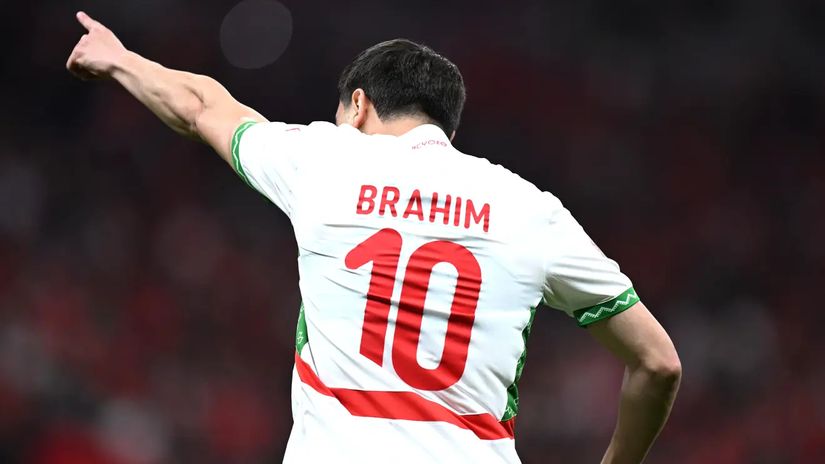
The front three saw Brahim Díaz wide right, Abdessamad Ezzalzouli left, and Ayoub El Kaabi as the central striker.
Crucially, these formations were only starting points. The game’s real story lay in how both teams behaved within and against these shapes.
Nigeria’s defining defensive feature in the first half was an aggressive 4-4-2 out-of-possession press.
Rather than retreat into a passive mid-block, the Super Eagles stepped high early, denying Morocco clean build-up access. Osimhen and Adams split to screen central lanes, while Lookman positioned himself to jump onto El Aynaoui if Morocco attempted to progress centrally.
This press was not purely zonal. It carried strong man-oriented elements, especially against Morocco’s advanced midfielders.

Onyeka and Iwobi were tasked with staying tight to El Khannouss and Saibari, preventing them from receiving on the half-turn. The result was a Morocco build-up that frequently became right-leaning and predictable.
Morocco attempted to bypass this pressure through high diagonal distribution, often from Bounou toward the right flank.
These passes sought to exploit Hakimi’s advanced positioning, but Nigeria’s full-backs were brave and proactive, stepping high to contest second balls and preventing Morocco from sustaining clean territory.
In possession, Morocco’s clearest attacking theme was their right-sided asymmetry.
Hakimi’s role was pivotal. At times, he overlapped aggressively, staying high and wide to stretch the defensive line; at others, he underlapped into the half-space, allowing Díaz to drift inside and attack central corridors.
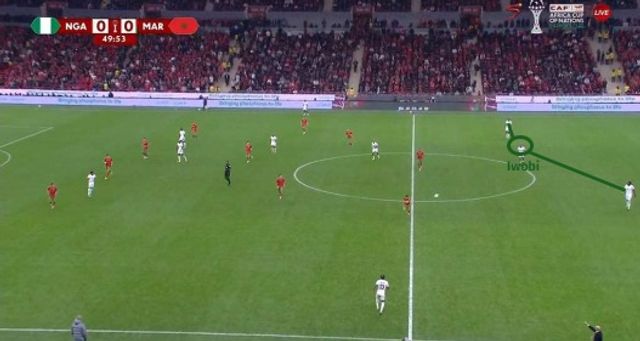
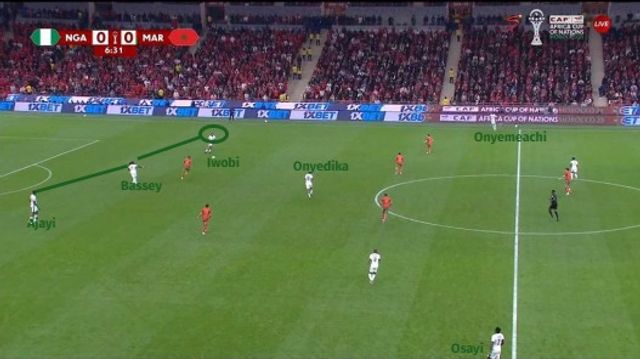 Alex Iwobi dropped alongside the centre-backs to form a temporary back three, enabling the full-backs to push high during Nigeria’s low build-up phase
However, Morocco’s press - organised in a 4-1-4-1 - was highly disciplined.
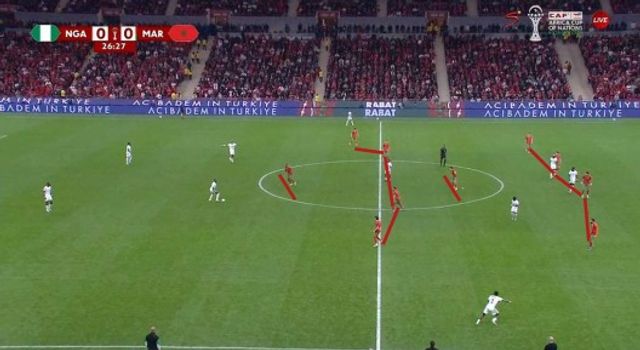
El Aynaoui screened central access superbly, while the wide midfielders stepped aggressively onto Nigeria’s full-backs.
This denied Nigeria time to deliver quality crosses and forced them into longer, riskier passes.
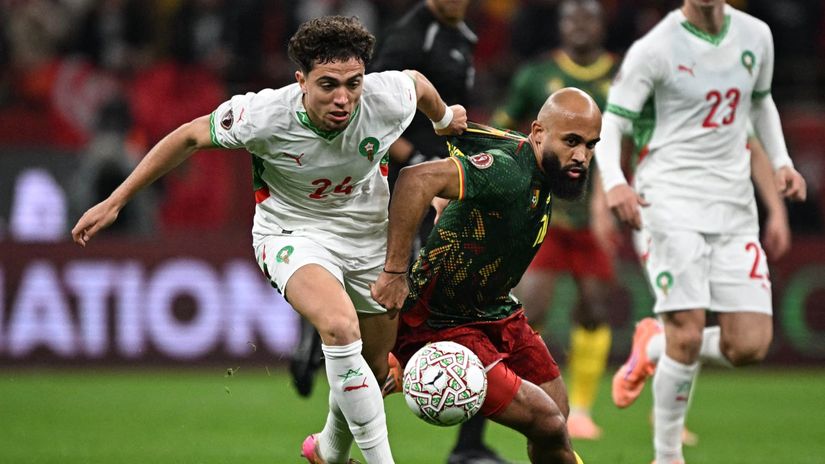
Nigeria’s most dangerous moments came not from sustained possession, but from attacking transitions.
Lookman, in particular, was the primary ball-carrying threat, driving into space immediately after turnovers.
These moments highlighted the contrast in styles: Morocco sought control through structure, Nigeria through disruption and speed.
A central theme of the match was Morocco’s shadow marking of Nigeria’s interior creators.
![Talanta Stadium finally gets Allianz Arena like outer lighting [PHOTOS]](https://cdn3.mozzartsport.co.ke/upload/825x464/News/Image/2026_01/1768457485922_1000779880.jpg)
Onyeka, Iwobi, and Lookman were rarely allowed to receive freely between the lines. Morocco’s midfield triangle constantly adjusted their body orientation to block passing lanes rather than simply chasing the ball.
As the game wore on, El Aynaoui’s influence had grown significantly, consistently stepping out to engage ball carriers and shutting down pockets before Nigeria could turn.
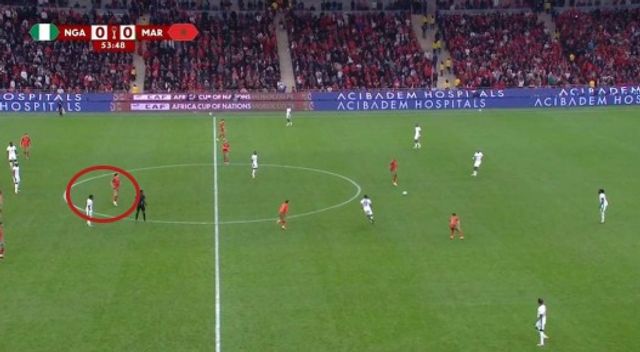 Neil El Aynaoui aggressively stepped out to stay tight on Nigeria’s between-the-lines ball carriers, denying the likes of Ademola Lookman time to receive, turn, and link midfield to attack
This defensive intelligence explained why Nigeria increasingly abandoned central progression in favour of wide, direct play.
The second half saw subtle but important shifts. Nigeria intensified their search for high turnovers, pushing their press slightly higher and looking to counter before Morocco’s block could settle.
Iwobi alternated positions with Onyedika, occasionally dropping between the full-backs to facilitate progression.
Morocco, meanwhile, became more front-footed. Their midfield line stepped higher, and El Kaabi’s runs in behind became more frequent as they sought to stretch Nigeria vertically.
Yet Nigeria’s centre-back pairing held their line well, maintaining compact distances and preventing through balls from becoming decisive.
As the match entered extra time, Nigeria shifted into a 4-3-3 in possession, with Akor Adams right, Moses Simon left, and Osimhen central. This adjustment aimed to improve wing isolation and crossing volume.
Morocco responded by doubling wide zones and continuing to funnel play away from central danger areas.
One reason neither side scored was the quality of rest-defence on display.
Both teams ensured that, after losing the ball, they had sufficient numbers close to the ball to counterpress immediately.
Nigeria’s midfield stayed compact behind attacks, while Morocco’s centre-backs held advanced starting positions to compress space.
This meant transitions were often slowed or stopped at the source. Even when urgency increased late on, clear counterattacking lanes rarely opened.
This was not a match defined by missed chances, but by mutual tactical cancellation.
Nigeria’s aggression, physical duels, and transition threat prevented Morocco from establishing rhythm, while Morocco’s positional discipline, pressing structure, and midfield intelligence neutralised Nigeria’s creative core.
Over 120 minutes, both sides repeatedly exposed potential weaknesses but lacked the final precision to exploit them.
The penalty shootout ultimately separated them, but from a tactical standpoint, this was a study in balance - two well-coached teams executing their principles at a high level, neither able to land a decisive blow in open play.
Morocco advanced, but the match itself stood as a reminder: elite international football is often decided not by dominance, but by whose structure breaks last - and here, neither truly did.