


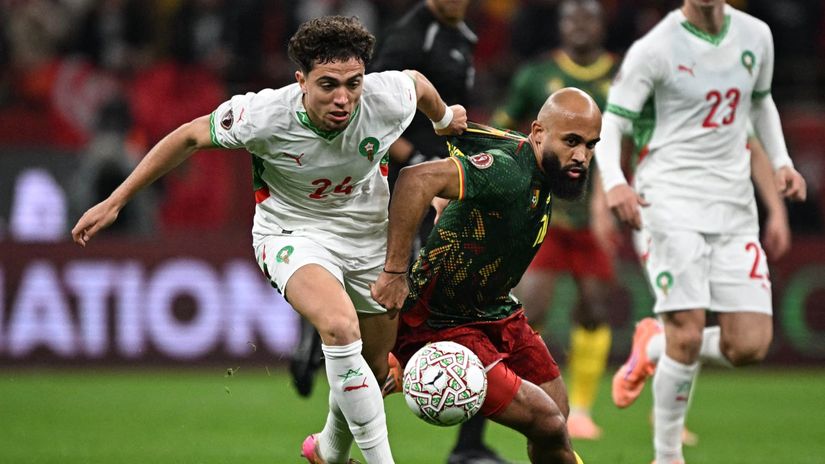
TACTICAL ANALYSIS: How Morocco shut down Baleba, Mbeumo to book AFCON semis spot against Cameroon









Reading Time: 6min | Sun. 11.01.26. | 20:12
This analysis explores the starting structures, defensive schemes, build-up and pressing mechanisms, key zone control, and the in-game adjustments that allowed Morocco to consistently stay one step ahead
Morocco secured a controlled 2-0 victory over Cameroon in a 2025 Africa Cup of Nations match defined less by moments of chaos and more by sustained tactical clarity across all phases.
Follow our WhatsApp channel for more news
While the scoreline reflects a comfortable win, the underlying story was one of structural dominance, pressing efficiency, and game-state management rather than pure attacking volume.
From Morocco’s ability to disrupt Cameroon’s build-up early, to their calm evolution into a compact low block late on, the contest illustrated the growing tactical maturity of Walid Regragui’s side.
This analysis explores the starting structures, defensive schemes, build-up and pressing mechanisms, key zone control, and the in-game adjustments that allowed Morocco to consistently stay one step ahead.
Cameroon began the match in a flexible 3-4-2-1 that often resembled a 3-4-3 in possession.
Devis Epassy was protected by a back three of Che Malone Junior, Kotto Samuel, and Nohou Tolo, with Baptiste Tchamadeu and Nagida operating as wing-backs tasked with both width and defensive recovery.
In midfield, Baleba Carlos and Avom Arthur formed a double pivot, while Bryan Mbeumo and Daniel Namaso occupied the half-spaces as advanced interiors behind Christian Kofane, who led the line.
The structure suggested an intention to play through Morocco’s midfield with numerical superiority between the lines.
Morocco, however, countered with a clearly defined 4-1-2-3. Yassine Bounou was in goal behind a back four of: Achraf Hakimi, Adam Masina, Nayef Aguerd, and Noussair Mazraoui, with El Aynaoui as the single pivot.
Ahead of him, Bilal El Khannous and Ismael Saibari operated as advanced eights, while Brahim Díaz and Abdelsammad Ezzalzouli stretched the pitch wide in support of Ayoub El Kaabi up front.
Out of possession, Cameroon dropped into a 5-3-2 low block when pressed back, with the wing-backs retreating to form a back five.
This scheme aimed to protect central zones and defend crosses aggressively, particularly with Kofane assisting at the near post due to his aerial ability, especially in defending set pieces.
Morocco, by contrast, adopted a proactive 4-1-4-1 high press.
El Kaabi led the first line, curving his runs to force Cameroon’s centre-backs wide, while the wingers jumped aggressively onto the outer centre-backs.
This pressing orientation immediately established Morocco’s core defensive principle: deny central progression and suffocate the first phase.
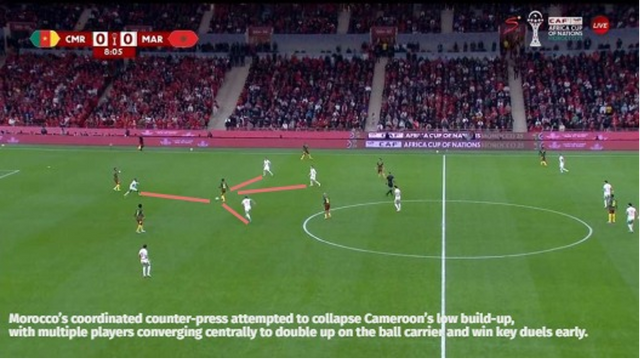
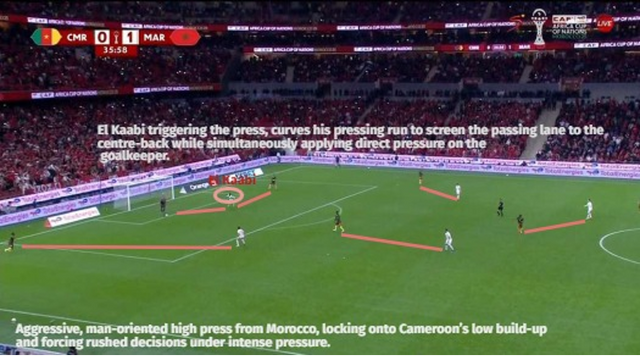
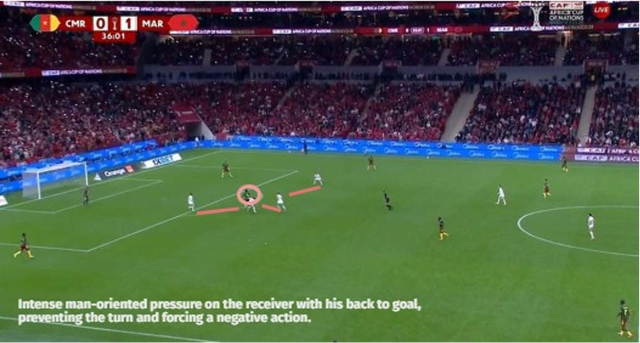
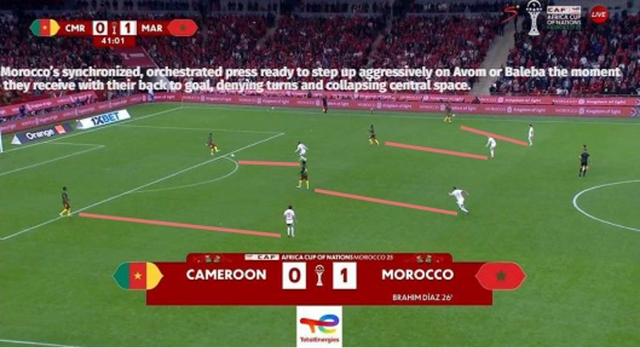
Morocco’s pressing was not merely about intensity but about direction.
By using angled runs from El Kaabi and Díaz, Cameroon’s build-up was consistently funnelled away from Baleba, the most press-resistant midfielder, and towards longer, riskier passes.
Saibari played a crucial role here, tracking Baleba closely whenever Cameroon attempted to construct play through the pivot.
As a result, Cameroon’s early low build-up became increasingly ineffective.
After roughly ten minutes, they were forced into long restarts, bypassing midfield entirely.
This was not an adjustment of choice but of necessity, and it played directly into Morocco’s structural strengths in aerial duels and second-ball control.
With possession secured, Morocco’s attacking approach was clear and repeatable.
They prioritised width to stretch Cameroon’s back five before accelerating the tempo with early deliveries into the box.
Hakimi and Ezzalzouli were particularly important in this respect, holding wide positions to pin the wing-backs and create interior access for Saibari and El Khannous.
The attacking rhythm often followed a simple but effective sequence: circulate wide with verticality, force lateral defensive movement, then deliver quickly into the penalty area for El Kaabi.
This pattern was not reckless crossing, but a calculated exploitation of Cameroon’s deep defensive line and slow shifting across the box.
The opening goal in the 26th minute served as a case study of Morocco’s territorial pressure rather than an isolated event.
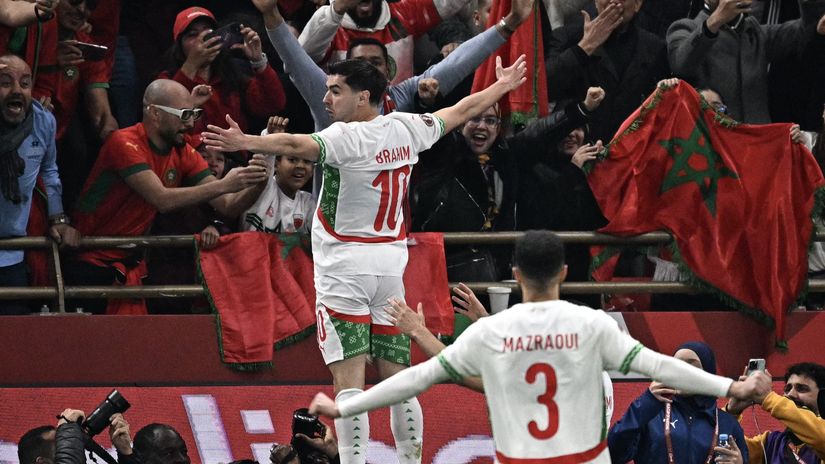
From a corner delivered by Hakimi, El Kaabi’s aerial presence forced defensive instability through a header, with Díaz reacting quickest to deflect the loose ball into the net.
The goal reflected Morocco’s sustained pressure, territorial dominance, and superiority in dead-ball execution.
Crucially, the response after scoring revealed even more about Morocco’s tactical intent.
Instead of dropping off, they immediately engaged an aggressive counter-press, suffocating Cameroon’s attempts to transition and ensuring the game remained locked in the same territorial pattern.
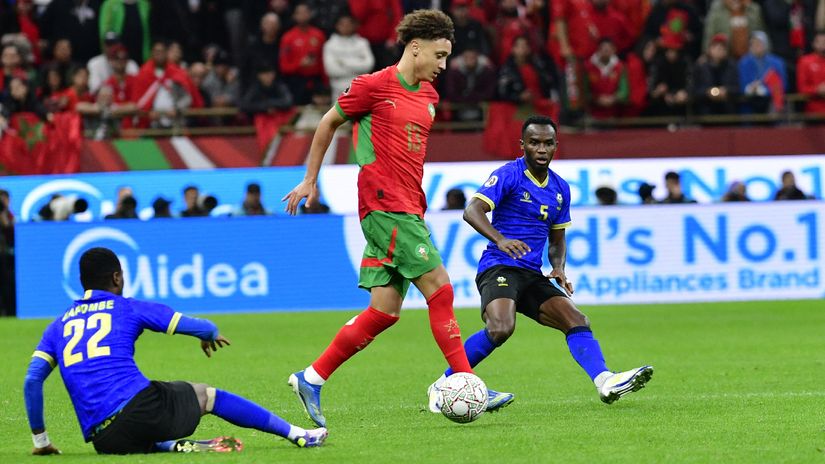
Cameroon attempted to adapt by stepping higher when the ball was played to Morocco’s full-backs, aggressively jumping to prevent wide progression.
However, this only increased their vulnerability in central and half-space areas.
Morocco consistently doubled up on Mbeumo whenever he received between-the-lines passes from long balls, denying him the ability to turn and drive forward.
Baleba, meanwhile, continued to struggle under pressure, often receiving with his back to goal and immediately confronted by Saibari or El Aynaoui.
By halftime, Morocco had controlled 57% possession, generated an xG of 0.88 and limited Cameroon to a negligible 0.05 xG with no shots on target.
The second half began with a structural shift from Cameroon, who morphed into a 4-2-3-1 in possession.
Dina Ebimbe moved to the left wing, Nagida switched to a fullback role on the right, and Cameroon attempted a higher, more aggressive press.
This adjustment briefly increased their territorial presence, but it came at the cost of midfield stability.
Morocco responded intelligently, allowing Cameroon to have sterile possession while maintaining compactness between the lines.
Avom dropped deeper in Cameroon’s build-up to assist circulation, but this only reduced their presence higher up the pitch.
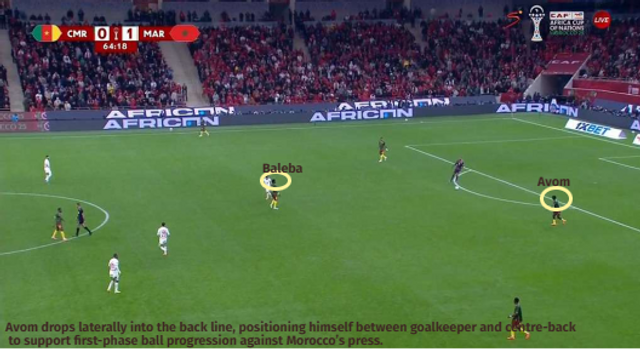
Morocco’s own adjustments were subtle yet decisive.
Hakimi increased the frequency of his overlapping runs, creating overloads on the right and enabling late arrivals from Saibari into the box.
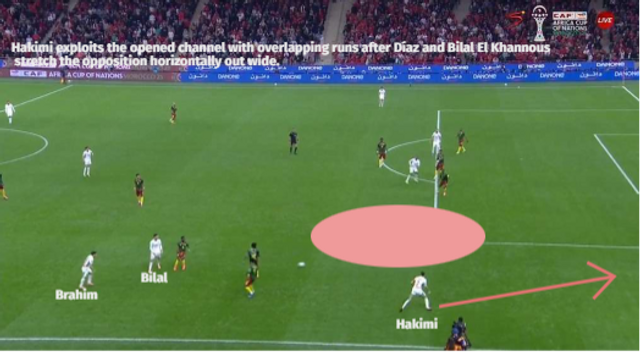
The substitutions of Youseff En-Nesyri and Noordin Amrabat further reinforced Morocco’s control.
En-Nesyri added aerial dominance to defend Cameroon’s long balls, while Amrabat provided positional discipline and screening in front of the back line.
Structurally, Morocco settled into a compact 4-1-4-1 mid-block, closing interior channels and forcing Cameroon wide without allowing penetration.
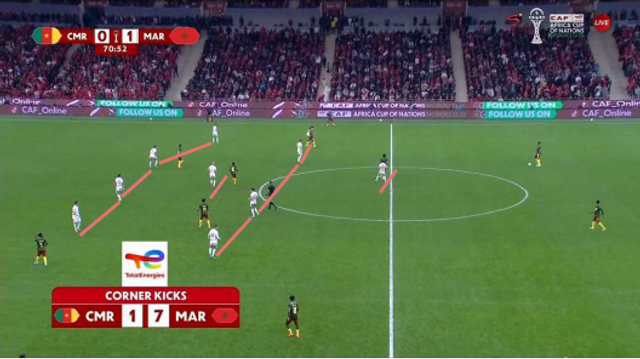
The second goal in the 74th minute encapsulated Morocco’s dominance of key zones.
Following a free-kick from Ezzalzouli, the ball ricocheted inside the box, where Saibari reacted with composure, keeping his finish low and precise.
Once again, the goal emerged from sustained territorial pressure and superior box occupation rather than an isolated moment of brilliance.
It was also a direct consequence of Morocco’s ability to keep Cameroon penned in, denying them clean chances and second-ball access.
Chasing the game, Cameroon sacrificed midfield control entirely, introducing multiple attacking players in search of a goal.
Morocco responded by dropping into a disciplined 5-4-1 low block for the final ten minutes, prioritising compactness and vertical distances.
This was rest-defence at its purest: limiting space between units, slowing the tempo, and eliminating transitional risk.
Cameroon’s late possession lacked structure and penetration, a testament to Morocco’s control of spacing and defensive consistency.
In conclusion, this match was a clear demonstration of Morocco’s tactical superiority rather than simply their individual quality.
By identifying and repeatedly exploiting Cameroon’s build-up weaknesses, controlling key zones through pressing and positional discipline, and adapting intelligently to game-state changes, Morocco dictated every phase of the contest.
The statistical dominance - 59% possession, multiple chance creations from Hakimi, and minimal concession of xG - supported what was evident tactically throughout.
Cameroon showed moments of resistance, but without a coherent solution to Morocco’s pressing and spatial control, they were gradually suffocated.
Ultimately, this was a victory built on structure, clarity, and control - hallmarks of a side with a deep understanding of modern international tournament football.