


TACTICAL ANALYSIS: McCarthy's masterclass that propelled Harambee Stars to victory over DR Congo
.jpg)
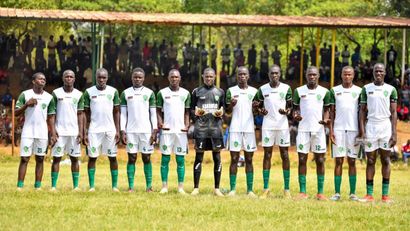
Reading Time: 5min | Mon. 04.08.25. | 12:09
The tactician had to embrace different formations in order to win and at the same time, stop Congo from finding the back of the net
Harambee Stars made their long-awaited CHAN tournament debut at the revamped Moi International Stadium, Kasarani, on Sunday.
In the glare of the whole nation and carrying expectations of millions, Stars stepped out to face the two-time champions, the Democratic Republic of Congo.
Follow our WhatsApp channel for more news
In this tactical analysis piece, Mozzart Sport tries to understand how coach Benni McCarthy set out his charges and how individual quality, coupled with steely determination, saw Kenya come out 1-0 winners.
The lineup raised a lot of eyebrows, with valid concerns, as the team had gone through a rather tumultuous preparation.
From key players getting injured, to a botched preparation tournament, and the lack of proper test matches to build up, summed up the team's pre-tournament activities.
However, that did little to stop Stars from shining in their first match in the tournament.
Coach McCarthy opted for his usual 1-4-2-3-1 formation.
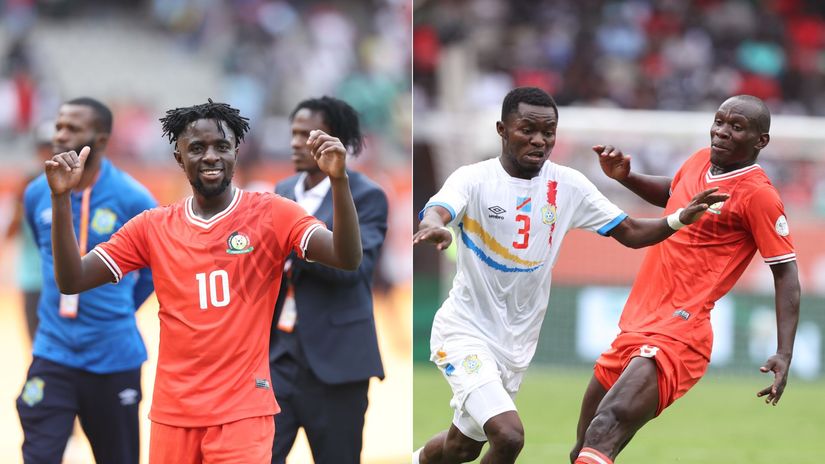
In goal was Byrne Omondi, a man who had not been in action for months at his club, Bandari, due to fitness issues and competition for game time.
However, his quality, in between the sticks, has never been in doubt.
The backline consisted of; Daniel Sakari and Aboud Omar in the fullback positions, with Gor Mahia duo of Sylvester Owino and Alphonse Omija at the heart of it.
In central midfield, the double pivot consisted of Gor Mahia man Alpha Onyango and KCB player Manzur Suleiman Okwaro.
The inclusion of Okwaro raised concerns as he is primarily a left centre back or left back, thus using the youngster in midfield in a game of such magnitude was a bold call from the manager.
The three-man line behind the striker consisted of Bandari speedster David Sakwa and Tusker hitman Ryan Ogam, with Austin Odhiambo tasked with the creative duties. The experienced Masoud Juma led the line.
DRC Congo looked to set up in a 1-4-2-3-1 formation with AS Maniema man, Japhte Kitambala, leading the line and supported by the explosive Ibrahim Matobo and Liz Ntumba on the flanks.
Basiala Amongo occasionally joined Kitambala in attack.
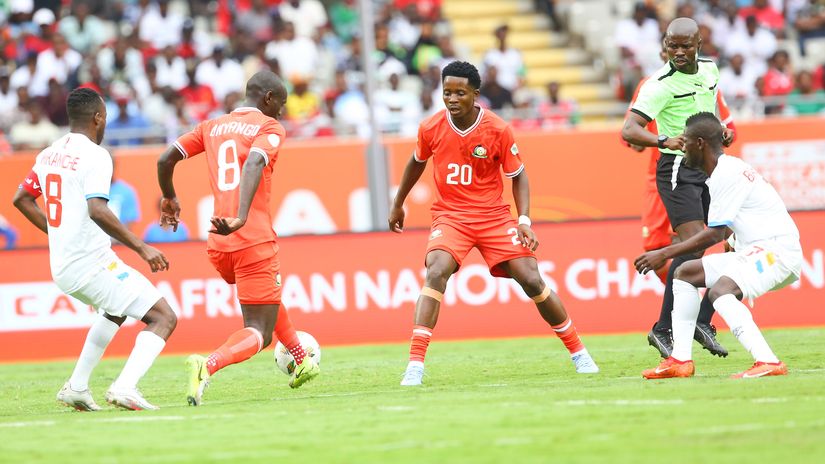
Kenya looked to build up in a 1- 4-3-3 structure, with the centre backs split on either side of the goalkeeper.
The fullbacks were on the lower, while the midfield of three had Austin occupying the right half space, Alpha the left half space, and Manzur Okwaro acting as the deep-lying playmaker. The frontline was used to pin the DR Congo backline.
DR Congo did not look to apply an aggressive high block. They looked to settle in a midblock, going man for man against the Kenyans in the central areas.
They were aggressive, with DR Congo Central midfielder Bisamuna Mbiyeye getting warnings for making bad tackles consistently.
With the midblock structure, Kenya initially struggled to progress, alternating between a 2-4-4 and a 4-3-3.
In the 2-4-4 Kenya looked to play directly into the wingers or Masoud Juma, who would play intelligently on the shoulder of the centre back.
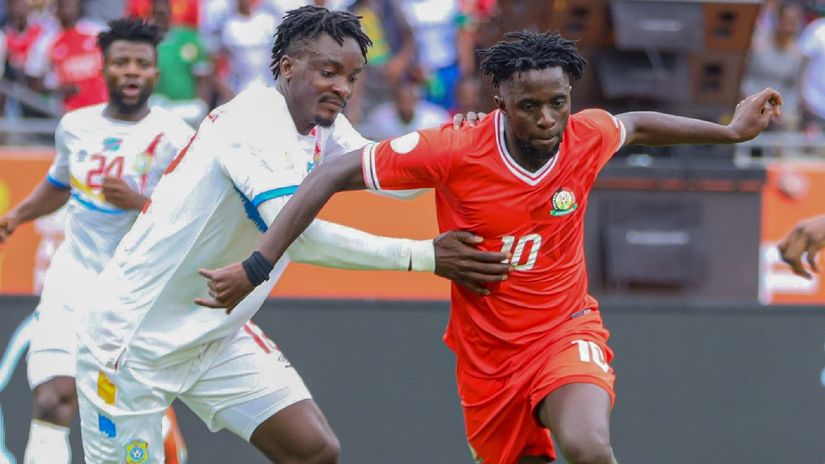
DR Congo started well, stifling Kenya's progression, winning the ball in the central areas and releasing Ibrahim Matobo down the left to run at Sakari.
A role Matobo took with aplomb, running rings around the Kenyan right back in the early stages and getting his side into dangerous situations.
This was majorly due to Sakari being isolated 1v1 against Matobo, however, when Ogam started coming to help and creating 2v1s, it became less of an issue.
With little joy now down the left flank, DR Congo resorted to going long into Kitambala and feeding off the second balls to take shots at goal.
With the man-to-man mode in midfield, Kenya was struggling to create meaningful chances. The initial ray of light came from good work down the right by Austin and Ogam.
Encourage fullbacks and Alpha to carry the ball more, dragging DRC players out and creating more space for Austin to receive free , he can single handedly win this game for us.
— Josh (@Joshangatia) August 3, 2025
Coach McCarthy had insisted on having Austin always higher up the pitch to influence the game more, and in this match, it was evident as he had limited time in his own half.
Kenya resorted to rotations in the centre of the field, a shift that created space for the fullbacks to progress when played into.
Instances of progressive carrying from Aboud created space, as a DR Congo midfielder had to commit, opening up room for Austin to receive freely and impact the game creatively.
Taking that extra dribble, holding onto the ball longer, appeared to be the key for Kenya.
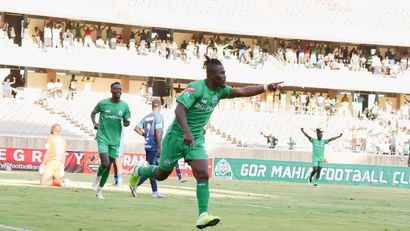
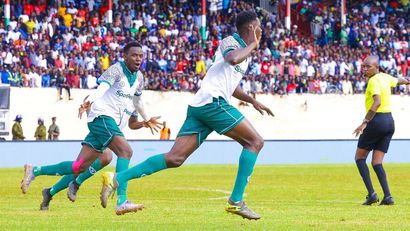
This action resulted in Kenya's goal. Sakari managed to bulldoze his way up the pitch, causing DR Congo players to gravitate towards him.
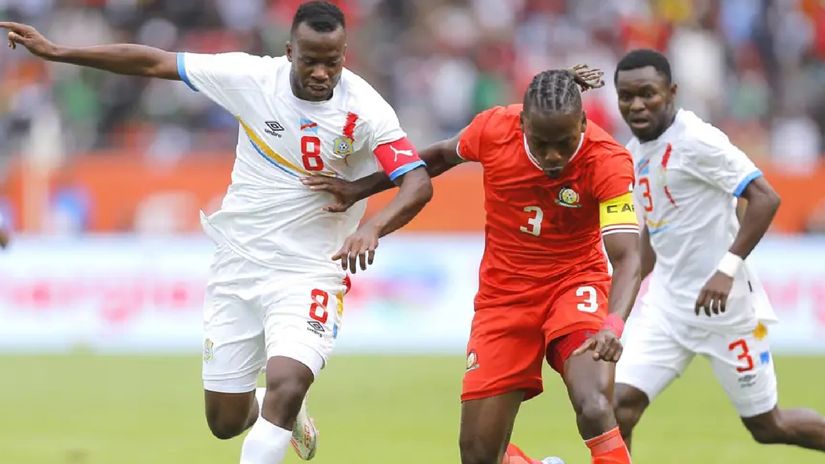
He played the ball into Sakwa, who, with a first-time touch, slotted it into the path of unmarked Austin, who beat his man and slotted it into the net.
As the game dragged on, McCarthy rang the changes, with some players stretchered off and others looking tired. The coach shifted into a 1-5-2-3 formation.
This had Aboud and Sakari at wingback. Owino, second-half substitute Mike Kibwage, and Omija formed the central partnerships.
Marvin Nabwire and Chrispine Erambo formed the double pivot, with Boniface Muchiri and Austin playing behind Ben Stanley Omondi.
.jpg)
In this phase, Kenya were desperate to see out the match, soaking in relentless pressure, and at the same time, looking to hurt DR Congo in the counterattack.
The final whistle came with relief as the side had secured a historic win.
As Kenya looks to face Angola in the next group game, it will be key in understanding how the team will improve in defending set-pieces, an area they really struggled in, and getting the right balance out of possession.