


TACTICAL ANALYSIS: How Ivory Coast's tactical discipline collapsed against Norway



Reading Time: 7min | Thu. 02.07.26. | 03:19
Norway now advance with growing belief, having become the first European nation since Ukraine in 2006 to win their maiden World Cup knockout match. If they are to trouble Brazil in the Round of 16, they will require another display of tactical organisation and clinical efficienc
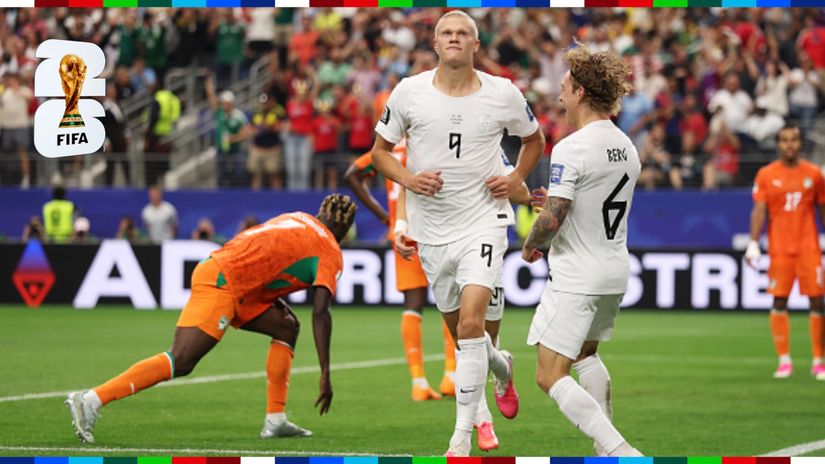
Norway booked their place in the FIFA World Cup Round of 16 for the first time in their history after edging Ivory Coast 2-1 in a dramatic Round of 32 encounter at Dallas Stadium.
Download our MozzartSport App For More News
Ståle Solbakken's side showed patience and tactical discipline before Erling Haaland's 86th-minute winner secured a historic victory and set up a blockbuster meeting with Brazil.
While Antonio Nusa's first-half strike gave Norway the advantage, Amad Diallo's moment of individual brilliance appeared to have rescued the Elephants before Haaland extended his remarkable international scoring streak to 13 consecutive matches.
Although the result was ultimately decided by two moments of attacking quality, the tactical battle told a much deeper story. Ivory Coast produced more shots (14 to Norway's nine) and forced an astonishing 14 corners, yet failed to convert territorial pressure into decisive opportunities.

Norway, meanwhile, remained structurally compact throughout, absorbing pressure before exploiting the spaces that gradually emerged in Ivory Coast's defensive shape.
Ivory Coast lined up with Yahia Fofana behind a back four of Guéla Doué, Emmanuel Agbadou, Odilon Kossounou and Ghislain Konan.
Ibrahim Sangaré anchored midfield alongside Franck Kessié and Christ Oulai, while Nicolas Pépé and Yan Diomande flanked Ange-Yoan Bonny in attack.
Norway mirrored the shape with Ørjan Nyland in goal, Holmgren Pedersen, Kristoffer Ajer, Torbjørn Heggem and Møller Wolfe across the back, Patrick Berg operating as the deepest midfielder, Sander Berge and Martin Ødegaard ahead of him, while Antonio Nusa, Alexander Sørloth and Erling Haaland formed the front three.
Norway remained remarkably faithful to their positional structure throughout possession phases, whereas Ivory Coast frequently altered their attacking spacing depending on where possession was circulated.
Out of possession, Norway alternated intelligently between a 4-1-4-1 mid-block and a deeper 4-5-1.
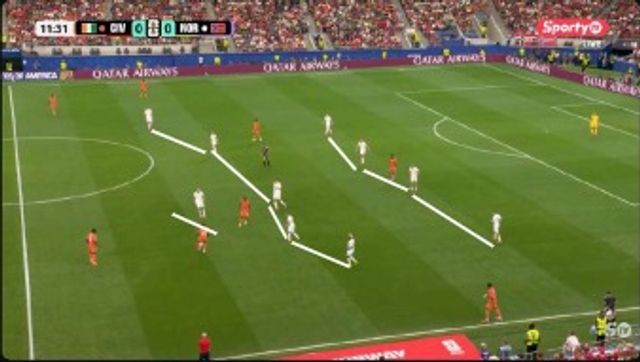
Patrick Berg screened central spaces in front of the defence, allowing Ødegaard and Berge to jump aggressively when pressing passing lanes into midfield.
When pressing higher, Norway often transformed into a narrow 4-4-2, with Ødegaard stepping alongside Haaland to initiate the first line of pressure. Their diamond-oriented press attempted to funnel Ivory Coast into wide areas before collapsing around the ball with numerical superiority.
Ivory Coast adopted a far more passive defensive strategy.
Their compact 4-4-2 mid-block frequently became a cautious 4-5-1 when defending deeper, prioritising central compactness over aggressive ball pressure.
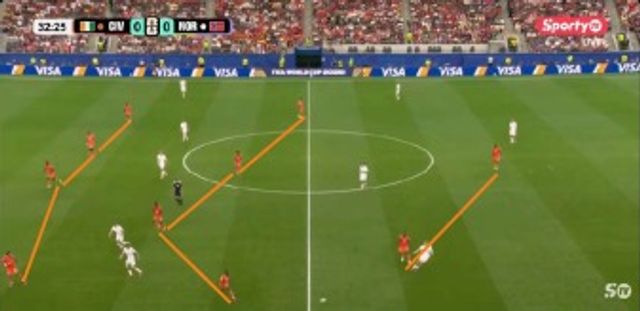
While this initially denied Norway central progression, it also allowed Norway's defenders and midfielders extended periods of uncontested possession to patiently recycle the ball until openings eventually appeared.
With possession, Ivory Coast arguably displayed greater attacking fluidity than Norway. Their primary attacking mechanism revolved around switches of play designed to isolate Pépé and Diomande against Norway's full-backs.
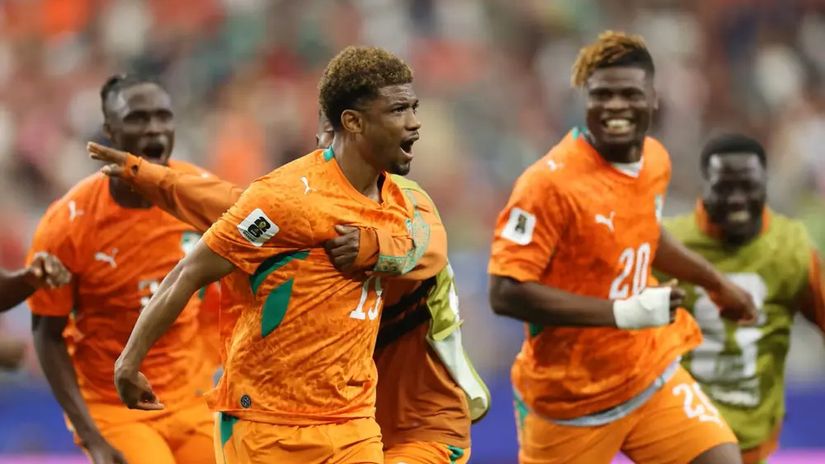
Both Konan and Doué consistently advanced high, alternating between overlapping and underlapping movements to create numerical superiority on the flanks.
Christ Oulai frequently drifted into the left half-space, especially in the second half, almost functioning as a temporary auxiliary left-back, creating triangular combinations alongside Konan and Diomande.
These rotations enabled Ivory Coast to stretch Norway horizontally before attacking through individual quality out wide. Their transitions were equally dangerous. Whenever Norway's full-backs advanced selectively,
Ivory Coast looked to release their pacey wingers immediately into the spaces left behind before Norway could restore their defensive block. Much of Ivory Coast's threat originated from these direct transitional moments rather than prolonged positional attacks.
Norway's attacking structure contrasted sharply. Rather than employing frequent positional rotations, Solbakken's side largely maintained their 4-3-3 throughout all phases of possession. Ødegaard repeatedly dropped from advanced positions into deeper build-up zones to dictate tempo, while Patrick Berg increasingly became involved alongside him during first-phase construction.
This created a stable double platform that allowed Sander Berge to occupy higher positions between Ivory Coast's midfield and defensive lines.
Keeping Berg deeper on the left also created one of Norway's key tactical mechanisms. With Berg securing rest defence behind possession, Antonio Nusa remained isolated against his direct defender in wide one-versus-one situations.
The positioning simultaneously opened a clean passing lane from Ødegaard into Nusa, bypassing Ivory Coast's midfield block.
That exact combination produced Norway's opening goal.
Receiving from Ødegaard near the left touchline in the 39th minute, Nusa attacked his marker aggressively before cutting inside onto his stronger right foot and curling an outstanding finish beyond Fofana into the far corner.
The move perfectly illustrated Norway's attacking intentions: create isolation, trust Nusa's individual quality and allow technically gifted players to decide situations in space.
Norway's build-up lacked extensive positional rotations, but the quality of their spacing compensated. Their midfield functioned with greater freedom precisely because both full-backs remained relatively conservative.
Rather than constantly overlapping, Norway's full-backs advanced selectively, ensuring sufficient numbers remained behind the ball. This provided excellent rest defence while simultaneously allowing Berg, Berge and Ødegaard greater licence to manipulate central spaces.
Patrick Berg, in particular, embodied Norway's tactical balance. His intelligence under pressure, elegant distribution, composure and timing transformed him into the team's metronome. Whether controlling tempo during slower possessions or recognising moments to accelerate attacks vertically, Berg consistently made optimal decisions.
His deeper positioning also proved decisive defensively, enabling Norway to counter-press immediately after losing possession while preventing Ivory Coast's dangerous transitions.
Ivory Coast remained dangerous despite trailing. Sangaré's outstanding recovery block denied Haaland shortly after Nusa's opener following Sørloth's knockdown from an Ødegaard delivery, illustrating Norway's continued preference for early crosses targeting their physically dominant striker.
Haaland himself endured long spells without involvement, registering only eight touches and completing just a single pass during the opening half. Yet his limited involvement never diminished his threat. His movement continually occupied Ivory Coast's centre-backs, creating additional space for Nusa and Ødegaard between the lines.
The second half introduced the contest's decisive tactical shift.
Seeking greater attacking impetus, Ivory Coast introduced Amad Diallo and Elye Wahi around the hour mark, withdrawing Oulai and Bonny. The substitutions immediately increased verticality. Amad's direct dribbling repeatedly destabilised Norway's defensive block, while Wahi provided greater mobility across the frontline.
The equaliser in the 75th minute epitomised Amad's qualities. After exchanging an intelligent one-two with Pépé, he slalomed through multiple defenders before finishing emphatically beyond Nyland. It was an outstanding individual goal, but tactically it also reflected Ivory Coast's increased willingness to attack central spaces directly rather than relying exclusively on wide combinations.
Ironically, the equaliser also marked the beginning of Ivory Coast's downfall.
Rather than consolidating their structure following the leveller, their defensive intensity noticeably declined. Pressing became less coordinated, recovery runs slowed and distances between defensive lines expanded considerably.
Most significantly, the gap between the left-back and left centre-back became increasingly exposed, allowing Norway repeated access into the inside-right and right half-space channels.
The front four also struggled to recover behind the ball quickly enough during defensive transitions. While the midfield pair and back line generally regained shape, the advanced players often remained disconnected, leaving Norway numerical superiority during build-up.
Norway recognised these structural weaknesses immediately.
.jpg)
Oscar Bobb's introduction added greater vertical penetration between the lines, and his defence-splitting pass into Patrick Berg perfectly exploited the enlarged gap between Ivory Coast's full-back and centre-back. Berg's calm square pass left Haaland with the simplest of finishes in the 86th minute.
The move looked effortless because Ivory Coast's defensive compactness had disappeared. Entry into the right half-space was far too easy, the centre-backs had become stretched and recovery pressure was virtually non-existent. Norway simply punished the structural imbalance.
Game-state management thereafter further highlighted the contrasting tactical maturity of both sides. Norway retreated into a compact defensive block, protecting central zones while inviting crosses from deeper positions.
Ivory Coast naturally committed more players forward, yet surprisingly failed to sufficiently occupy Norway's penalty area.
Even during a promising crossing opportunity in the 91st minute, Elye Wahi remained the only genuine target inside the box while teammates lingered around the edge of the area. For a side chasing elimination, the lack of penalty-box occupation severely limited the effectiveness of their late attacks despite accumulating 14 corners throughout the match.
Ultimately, this contest demonstrated that tactical discipline often outweighs statistical dominance. Ivory Coast generated more shots, more corners and arguably produced the greater attacking variety, yet their inability to maintain defensive organisation after equalising proved fatal.
Norway now advance with growing belief, having become the first European nation since Ukraine in 2006 to win their maiden World Cup knockout match. If they are to trouble Brazil in the Round of 16, they will require another display of tactical organisation and clinical efficiency. Against Ivory Coast, patience, balance and structure proved enough to make history.