


PLAYER ANALYSIS: Metrics that make Shabana's Kevin Omundi a midfield gem


.jpg)
.jpg)
.jpg)

Reading Time: 6min | Wed. 11.02.26. | 08:41
In many ways, his role mirrors that of top-level midfielders who value rhythm, connection, and tactical timing over constant verticality
Shabana FC's Kevin Omundi profiles as a modern interpretation of the classic number 8 - a midfielder defined less by raw athletic dominance and more by timing, intelligence, and tactical clarity.
Follow our WhatsApp channel for more news
For Tore Bobe, he has emerged in recent matches as the connective hub of the midfield, a player who links phases of play rather than merely occupying zones.
His influence is subtle but decisive, driven by how well he understands where and when to appear on the pitch.
Operating primarily as a hybrid central midfielder, Omundi thrives in the half-spaces, moving between the central corridor and the flank with a freedom that reflects both trust from the coaching staff and a high level of game intelligence.
Rather than starting high and staying there, Omundi’s game is built around delayed arrival.
He begins deeper, supports the first and second phases of build-up, and only later arrives in advanced zones when defensive structures are already stretched.
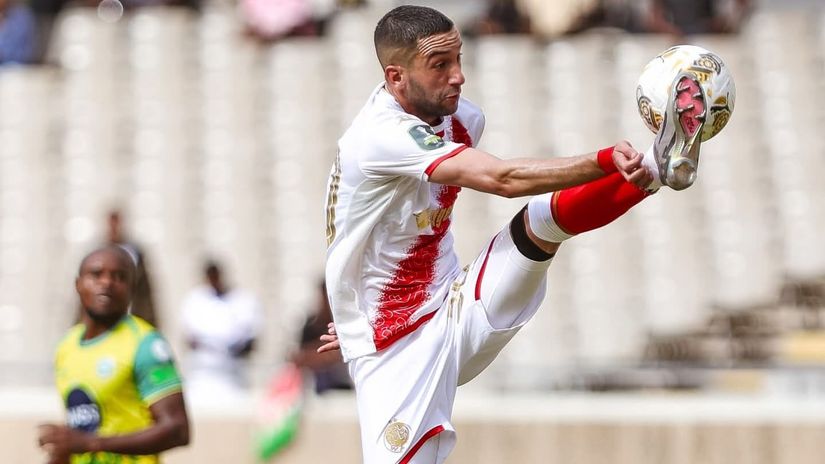
This positional sequencing makes him difficult to track and allows Shabana to maintain balance while still adding numbers forward.
In many ways, his role mirrors that of top-level midfielders who value rhythm, connection, and tactical timing over constant verticality.

Tactically, Omundi is one of Shabana’s most flexible midfielders. His primary value lies in how he interprets space relative to his fellow midfielders, constantly adjusting his position to maintain structural balance in both attack and defence.
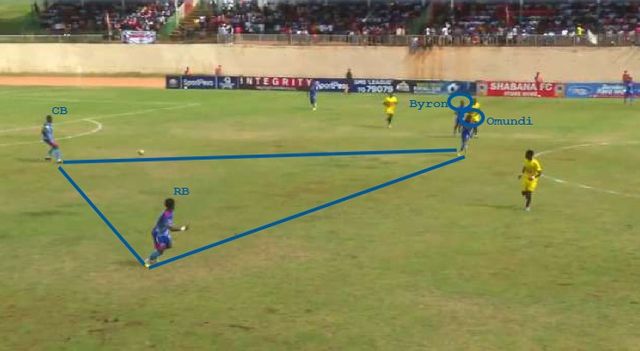
In settled possession, he often drops closer to the holding midfielder during early build-up, forming a temporary double pivot.
This creates a low build-up shape, where Omundi and the pivot, Byron Otieno (often used there), form triangles with the centre-backs and full-backs, offering multiple passing angles to bypass pressure.
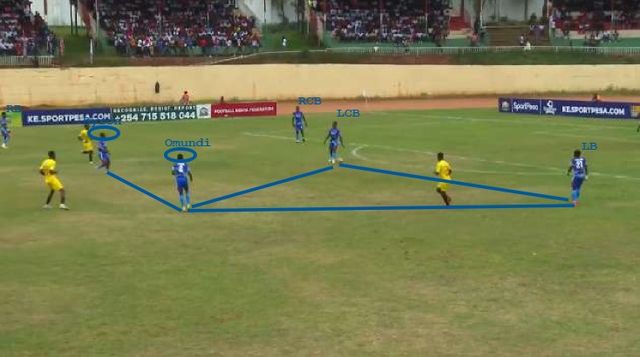
What separates him from many midfielders in similar roles is his understanding of when to leave this deeper position.
Once the ball progresses into wider or higher zones, Omundi advances intelligently, positioning himself between the opposition midfield and forward lines.
He does not simply drift forward; he scans constantly, adjusting his body shape to receive on the half-turn, enabling quick progression or combination play in tight spaces.
Out of possession, his tactical discipline becomes even more evident. Omundi is highly effective at shutting passing lanes, often angling his body to block access into dangerous central zones.
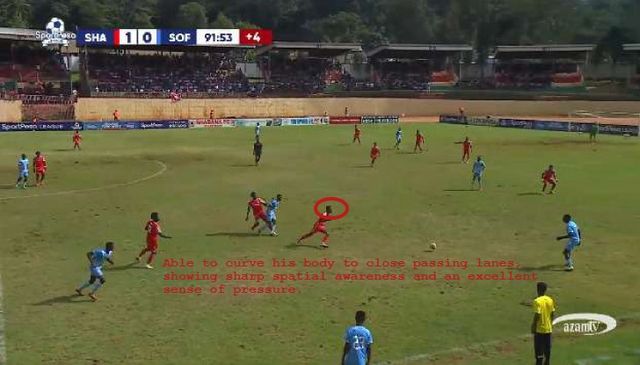
He demonstrates a strong sense of anticipation, knowing when to step out aggressively to press and when to hold his position to protect the back line.
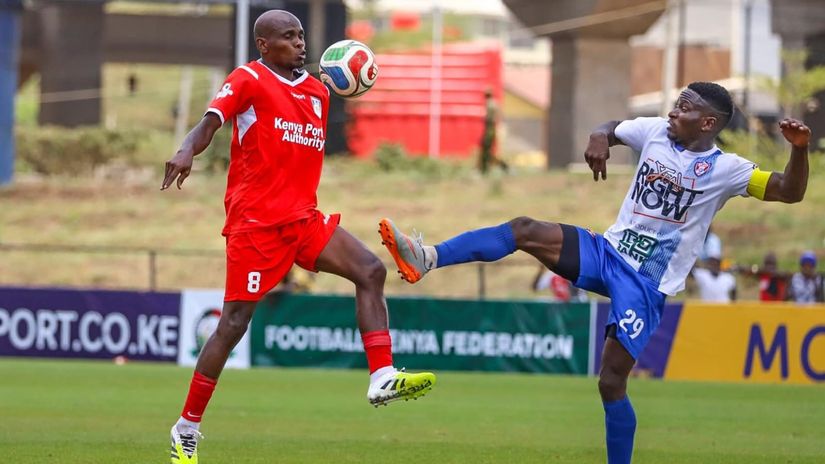
This balance between proactivity and restraint is a hallmark of elite midfield understanding.
In possession, Omundi plays as a facilitator and accelerator. He is comfortable receiving under pressure and has the technical quality to play in tight spaces, often setting up teammates with short, sharp passes that maintain tempo.
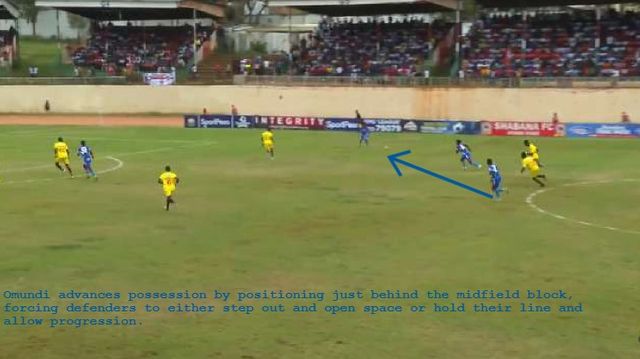
His scanning ability - driven by excellent spatial awareness allows him to play quickly and decisively, reducing the time opponents have to reorganise defensively.
One of his standout technical traits is ball carrying. When space opens up, particularly in transitional moments, Omundi can drive forward through the centre or half-spaces, breaking opposition press lines with controlled bursts.
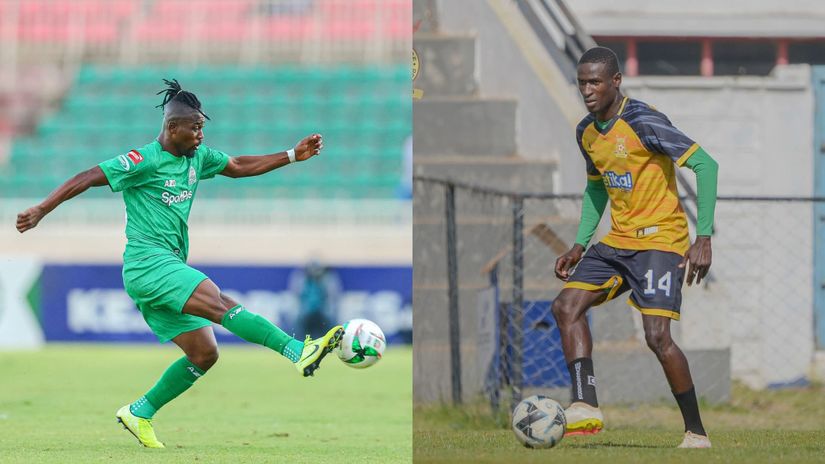
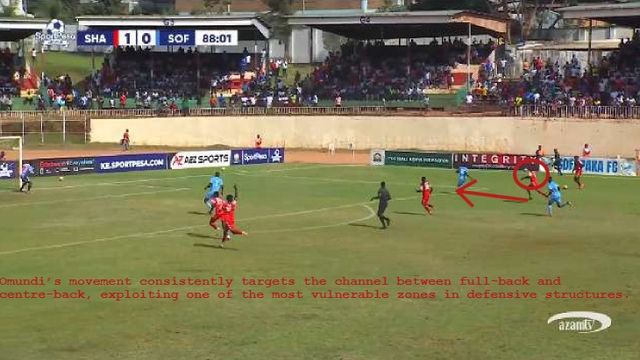
This ability to progress the ball through space, rather than relying solely on passing, adds an important vertical dimension to Shabana’s play.
In advanced phases, Omundi frequently positions himself just outside the box, timing late arrivals rather than making early, easily tracked runs.
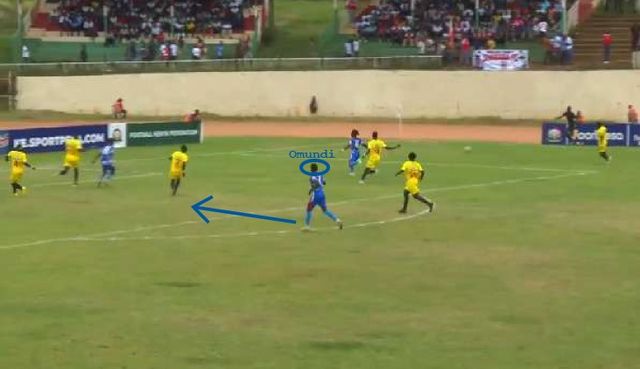
This movement pattern allows him to attack second balls, combine around the edge of the area, or arrive unmarked for cutbacks.
.jpg)
His contribution in these moments is not about volume shooting, but about intelligent occupation of high-value zones.
Defensively, Omundi offers far more than positional presence. He is a high-volume recovery runner, consistently sprinting back to protect the back line when possession is lost.
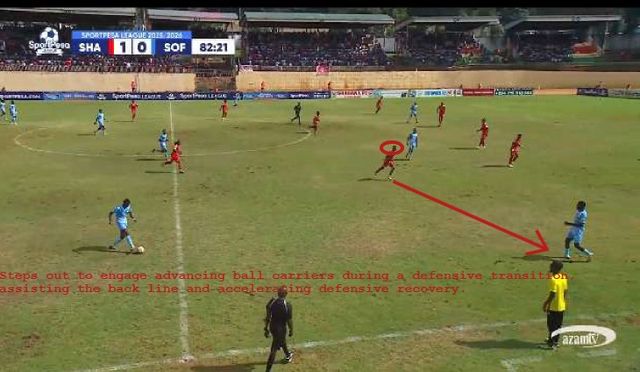
His willingness to defend large spaces in transition is crucial for a team that commits midfielders forward.
Rather than chasing blindly, he defends with intelligence. He closes passing lanes, shepherds opponents into less dangerous areas, and supports wide defenders when they step out to engage ball carriers.
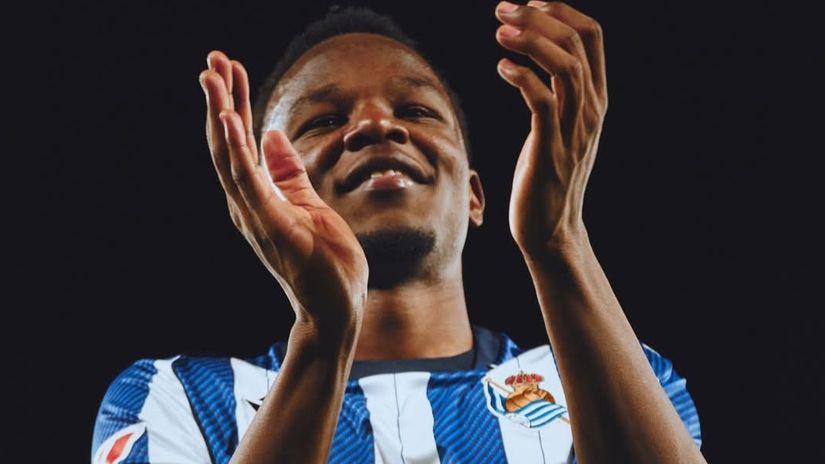
His duel strength allows him to compete effectively in central areas, while his anticipation helps him win second balls and intercept passes.
A key aspect of his defensive work is how seamlessly it links with Shabana’s overall defensive structure.
By adjusting his positioning relative to the other midfielders, Omundi ensures that the team remains compact, especially during moments of defensive transition.
His ability to recognise danger early often prevents situations from escalating into direct threats on the back four.
Transitions are arguably where Omundi’s skill set shines brightest. In defensive transition, he reacts instantly, sprinting back to engage opponents and delay attacks.
His capacity to cover ground and defend open spaces buys time for teammates to recover and reorganise.
In offensive transition, his instincts flip instantly. He accelerates into space, adds an extra body in the attacking third, and often becomes the free man arriving late at the edge of the box.
His ball-carrying ability in these moments allows Shabana to turn turnovers into structured attacks rather than rushed counter-attacks.
This dual transitional value makes him a pivotal figure in how Shabana approaches games tactically. His presence allows the team to commit forward with confidence, knowing there is intelligence and energy covering behind the ball.
Physically, Omundi may not be defined by brute power, but his engine, balance, and agility are outstanding. He combines stamina with sharp bursts of pace, particularly effective when attacking space late or recovering defensively.
His strength in duels adds another layer to his effectiveness, enabling him to compete against more physically imposing midfielders.
Technically, his standout differentials include his scanning frequency, body orientation when receiving, and ability to operate efficiently in congested areas.
These are traits often seen in high-level central midfielders who dictate tempo rather than merely react to it. Omundi separates himself through decision-making speed and positional awareness, not just execution.
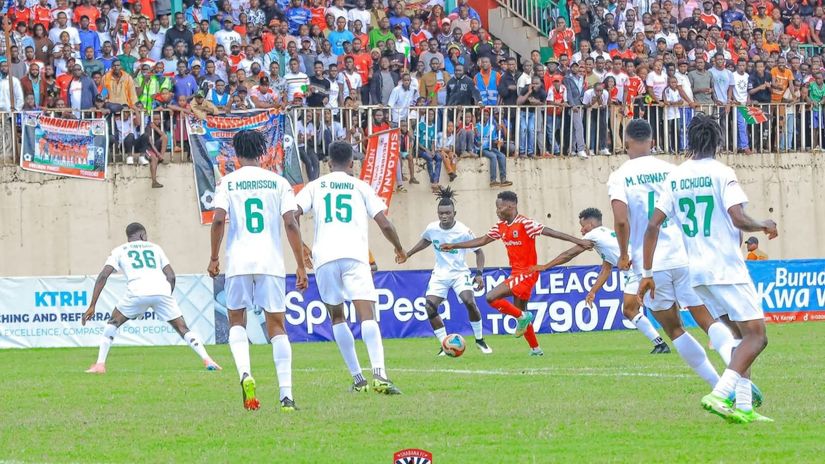
His influence was particularly evident against Gor Mahia and in Shabana’s 1-0 victory over Bidco United.
In that match, Omundi dominated the middle of the park, creating two chances, completing 88% of his short passes, and winning the ball an impressive twenty times.
These numbers reflect not just activity, but efficiency - a midfielder impacting both ends of the pitch without compromising structure.
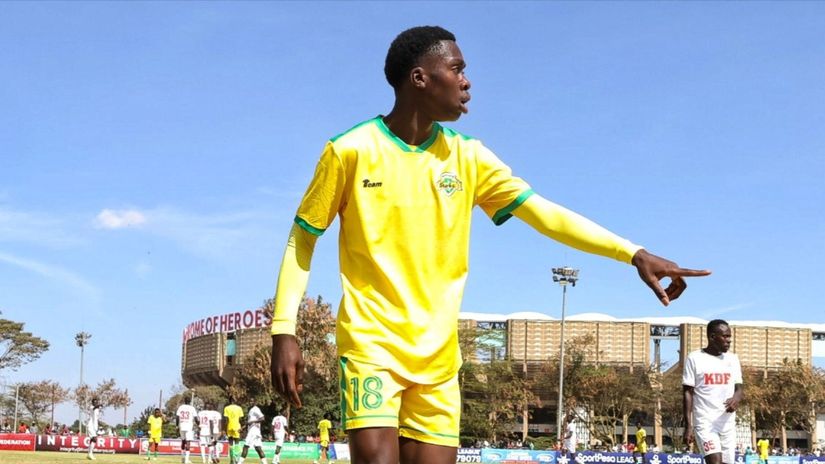
Kevin Omundi is a tactically intelligent, technically secure, and physically reliable central midfielder whose value lies in how he connects the game’s phases.
He embodies the modern number 8: disciplined yet creative, dynamic yet controlled. His understanding of space, timing, and balance elevates Shabana’s overall approach, allowing the team to play with structure in possession and resilience without the ball.
As his influence continues to grow, Omundi looks less like a supporting piece and more like a midfield reference point - a player whose intelligence shapes how his team plays, defends, and transitions.