



TACTICAL ANALYSIS: How Wydad broke down a resolute Nairobi United defence



.jpg)
.jpg)
.jpg)

Reading Time: 5min | Mon. 09.02.26. | 21:03
This analysis explains how Wydad solved Nairobi’s defensive puzzle, why Nairobi’s transitional plan eventually faltered, and what the game reveals about both sides’ tactical identities
Wydad Casablanca’s narrow 1-0 win over Nairobi United in the CAF Confederation Cup was not a story of domination by scoreline, but of cumulative structural pressure, positional intelligence, and late-game exploitation of widening defensive gaps.
Follow our WhatsApp channel for more news
On paper, the result looks harsh on a Nairobi United side that competed aggressively and disrupted rhythm for long spells. In reality, the match unfolded as a prolonged tactical examination.
Wydad patiently probing a compact opponent, absorbing transitional threats, and waiting for structural weaknesses to emerge as game-state fatigue and substitutions altered spacing.
This analysis explains how Wydad solved Nairobi’s defensive puzzle, why the Kenyan representatives' transitional plan eventually faltered, and what the game reveals about both sides’ tactical identities.
Nairobi United began in a 4-3-3 that was fluid rather than fixed. Kevin Oduor operated behind a back four of Yusuf Mainge, Mustapha Kizza, and centre-backs Lennox Oguttu and Steve Biko.

In midfield, Lesley Owino and Brian Mzee formed a double pivot responsible for first-phase build-up and defensive screening, while Shami Mwinyi operated as the advanced interior.
Out wide, Duncan Omala and Gideon Otieno provided width, with Benson Omala leading the line.
Out of possession, this structure collapsed quickly into a 4-4-2 mid-block, and in deeper phases, a 5-3-2, with a winger dropping into the back line to protect wide zones.
The intention was clear: compact central lanes, delay progression, and invite Wydad wide before engaging.

Wydad Casablanca set up in a 4-1-2-3. El Mehdi Benabid started in goal, protected by centre-backs Salah Moussadak and Aboulfath Amine, with Mohamed Bouchouari and Ayoub Boucheta as aggressive full-backs.
Naim Byar anchored midfield as the single pivot, while Hakim Ziyech and Ramiro Vaca played as advanced interiors.
The front three featured Nordin Amrabat on the right, Moises Paniagua on the left, and Hamza Hannouri as the central striker.
In possession, Wydad regularly morphed into a 3-2-5, with Byar dropping between or alongside centre-backs, both full-backs pushing high to overload wide zones.
Nairobi’s primary defensive idea was compact zonal defending with aggressive situational pressing.
They denied central access by narrowing distances between midfield and defence and forcing Wydad's circulation wide. Their block height fluctuated, but the trigger to jump was clear: lateral passes toward the touchline.
This scheme posed a structural problem for Wydad early on. With Nairobi maintaining horizontal compactness and crowding the half-spaces, direct progression through midfield was restricted.
The effect was clear in the first half: Wydad enjoyed possession but were initially limited to crosses and shots from distance, despite their territorial dominance.

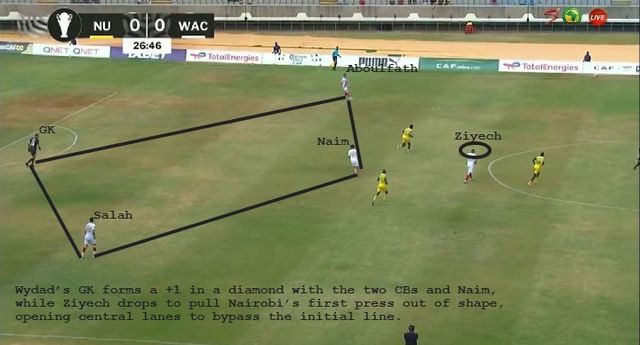
To dismantle this block, Wydad relied on rotational build-up patterns rather than speed. Byar consistently dropped to form a back three, allowing one centre-back to step forward with the ball.
This movement pulled Nairobi’s first line out and created a numerical superiority in the first phase.
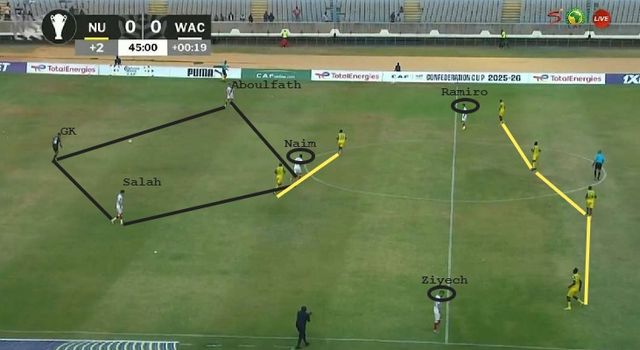
Crucially, Wydad layered this with right-side rotations. Amrabat frequently dropped into midfield or the half-space, dragging Nairobi’s left-sided defenders inward.
This created space for Bouchouari and Ziyech to advance aggressively on the overlap.
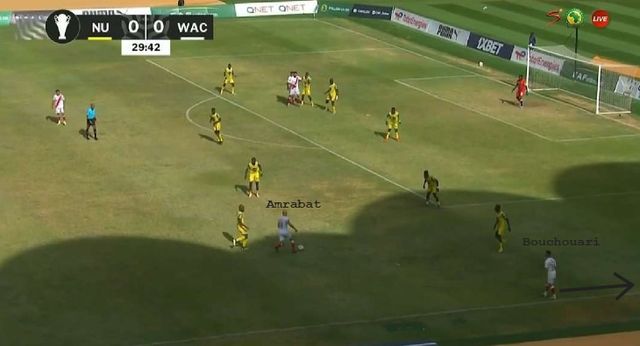
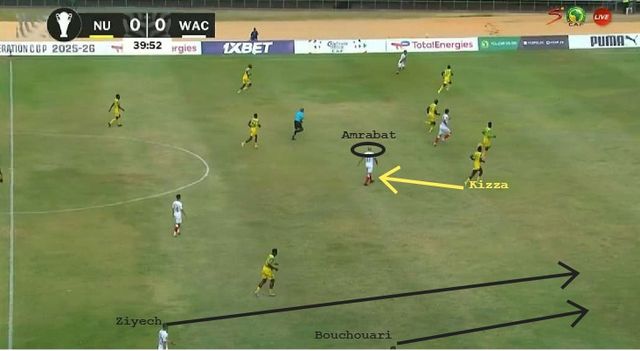
The cause-effect sequence was repeated: Amrabat’s inward movement collapsed the block, Bouchouari’s width stretched it, and Wydad gained crossing access.
Rather than producing immediate chances, these patterns accumulated pressure. Nairobi’s back line was repeatedly forced into lateral shifts, increasing physical and cognitive load.
The late winning goal was not an isolated event but the logical outcome of sustained flank dominance

The decisive moment in the 89th minute followed a familiar structure: Nairobi’s wide coverage broke down after repeated transitions, Nassi exploited the right channel with a direct carry, and Ben Yedder attacked the six-yard box - an area Wydad had consistently targeted with five-man occupation.
Wydad’s most valuable access came from half-spaces rather than central corridors. Nairobi successfully protected Zone 14 for most of the match, but this forced defenders to narrow excessively.
As fatigue set in, half-space access opened up, especially on Nairobi’s left.
Ziyech and later Nassi operated between full-back and centre-back, receiving on the half-turn. This spacing allowed Wydad to generate cut-backs statistically, the highest-value chance creation method, rather than hopeful crosses.
Wydad’s pressing system was directional and situational. They pressed in a 4-1-4-1 shape, using the touchline as a pressing trap.
Triggers included backward passes to Nairobi’s centre-backs or wide passes under pressure.
.jpg)
Behind this press, Wydad’s rest-defence was elite. Byar remained positioned centrally, flanked by two centre-backs, ensuring Nairobi’s long balls into channels were either delayed or recovered.
This structure limited Nairobi’s transitional threat despite their intent to attack space early.
The second half saw Nairobi drop deeper, with double pivots combining in low build-up to bypass pressure.
The introduction of Ssematimba briefly improved central progression, nearly capitalising on a goalkeeper error.
Wydad responded with attacking substitutions, increasing verticality and energy. The risk increased - more players committed forward - but the reward came as Nairobi’s block lost its compactness.

Without possession, Wydad maintained a compact mid-block, stepping aggressively when passes entered the half-space.
Recovery runs were immediate, and fouls were used intelligently to reset structure. Nairobi’s red card to Steve Biko late on was a direct result of being stretched vertically after chasing the game.
This match was decided by structural patience over transitional urgency.
Nairobi United executed their defensive plan with discipline but lacked sustained control once transitions slowed. Wydad, by contrast, trusted their positional play, rest-defence, and rotations to erode resistance.
The data supports the narrative: 61% possession, 25 shots, 10 corners, and repeated half-space access eventually produced the breakthrough.
For Wydad, this performance reflects a mature, tournament-ready identity. For Nairobi, it was a competitive showing - but one that revealed the fine margins between resistance and control at elite level.