


Gor Mahia and AFC Leopards tensions that derailed Harambee Stars at AFCON 1988
Reading Time: 7min | Tue. 23.09.25. | 19:05
To prepare for the Nations Cup, Kenya embarked on a historic tour of Brazil, facing giants such as Botafogo and Fluminense.
When Kenya finally qualified for the 1988 Africa Cup of Nations (AFCON) after a 16-year absence, optimism was sky-high.
Follow our WhatsApp channel for more news
The late 1980s had been a golden period for Kenyan football. Just a year earlier, Harambee Stars had reached the final of the All-Africa Games in Nairobi, only narrowly missing out on the gold medal.
At club level, Gor Mahia had stunned the continent by winning the Africa Cup Winners’ Cup in 1987—still the only time a Kenyan club has lifted a continental trophy.
From that victorious K’Ogalo side, no fewer than 10 players were called into the national team, reinforcing the belief that Kenya would finally stand tall on Africa’s biggest stage.
On paper, this was a squad full of quality. The defense featured experienced campaigners such as Wycliffe Anyangu, Hassan Juma, Mickey Weche, Tobias Ocholla, and Austin Oduor.
Midfield had the steel and creativity of Charles Otieno “Engine,” David Odhiambo, John “Zangi” Okello, Douglas Mutua, and George Nyangi.
The attack blended pace and power with Wilberforce Mulamba, Ambrose Ayoyi, Sammy Onyango, and the towering striker Peter Dawo—a player fresh from terrorising defences across Africa.
Between the posts, the team had Washington Muhanji and David Ochieng, two highly capable shot-stoppers.
The Brazil tour
To prepare for the Nations Cup, Kenya embarked on a historic tour of Brazil, facing giants such as Botafogo and Fluminense, losing 4-1 and 3-0, respectively.
While the results were lopsided defeats, the experience was invaluable. Brazilian journalists even singled out John Okello “Zangi” as the standout Kenyan player.
The Brazilian FA seconded Danilo Alves to the Stars as a technical advisor, a sign of how seriously Kenya’s preparations were being taken.
Yet behind the scenes, cracks were beginning to show. The withdrawal of Gor Mahia players from the 1987 CECAFA Cup, citing fatigue, had angered federation officials and created bad blood with AFC Leopards’ contingent.
During the Brazil camp, tensions between the two rival camps boiled over. Midfield dynamo Abbas Magongo, a vocal advocate for player rights, was accused of stoking divisions and was dramatically expelled from the squad before AFCON.
He returned to Nairobi as the team departed for Morocco. However, there are conflicting reports of the exact reason he was shown the door.
Coaching and leadership turmoil
Another major setback was the loss of Reinhard Fabisch, the German coach who had masterminded Kenya’s qualification.
Disagreements with the federation saw him dismissed, with officials dismissively remarking, “Coaches come in dozens.” In his place came Chris Makokha, a respected youth coach but one lacking pedigree at the senior international level.
Assisted by James Sianga, with Joe Kadenge as team manager, the bench itself was divided. Reports later suggested that tribal balancing between the Luo and Luhya communities, rather than pure merit, influenced squad selection—further undermining unity.
Harsh Lessons in Morocco
Drawn in Group B, Kenya faced a baptism of fire against Nigeria, Egypt, and Cameroon—three of Africa’s heavyweights.
Match 1: Kenya 0–3 Nigeria (14 March 1988)
Kenya began brightly, their Brazilian influence visible in neat passing patterns, but they lacked cutting edge. Goalkeeper Washington Muhanji endured a nightmare, gifting Nigeria two goals.
By halftime, the Stars were 3–0 down. In the second half, substitute Peter Dawo troubled Nigeria’s defense, but Kenya could not find the net.
Criticism followed: why was the in-form keeper, David Ochieng, benched? Why was Mulamba played out of position? Why was Charles Otieno, Kenya’s best central midfielder, left unused?
.jpg)
Match 2: Kenya 0–3 Egypt (17 March 1988)
Makokha made changes, most notably starting Ochieng in goal, but the outcome was the same. Egypt struck early and added two more after the break. Kenya’s inexperience showed as defensive lapses were punished ruthlessly.
Match 3: Kenya 0–0 Cameroon (20 March 1988)
Already eliminated, Stars played for pride against the reigning African champions. To everyone’s surprise, they stood firm. A massive Egyptian crowd even cheered Kenya on, hoping they could stop Cameroon from advancing.
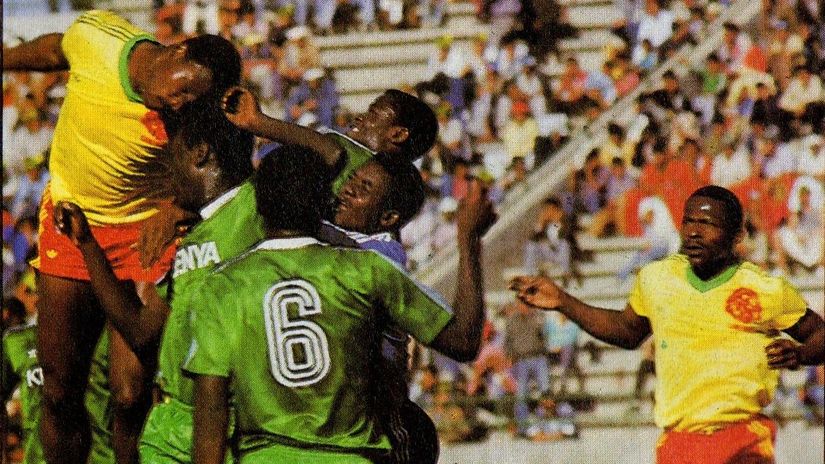
Peter Dawo led the line superbly, and Austin Oduor’s last-ditch clearance off the line from a Roger Milla strike became the enduring highlight of Kenya’s campaign. The 0–0 draw salvaged some dignity but could not erase the disappointment of failing to score a single goal in Morocco.
Voices from the team
Reflecting on the tournament decades later, striker James Nandwa, then playing for Kenya Textile Mills (KTM) Thika, recalled how fierce club rivalries spilt into the national setup:
“Before AFCON, things were different for players who played for smaller clubs like me. To earn a place in the national team, you had to score against Gor Mahia and AFC Leopards.
It was very difficult to outshine players from those two clubs. Alois Otieno used to push himself, and whenever he scored against them, it gave him a chance to be considered for the national team," he said.
He further admits that the rivalry between Gor Mahia and Leopards players was very visible in the team.
"The rivalry between Gor and AFC was intense. The push and pull were always there, and you could even feel it in camp. It was tense, sometimes uncomfortable, because the two clubs were serious rivals. At least now things are better, the players are friendlier with each other".
"Our preparation was fine, the team was solid, but I think we were just unlucky. Remember, we were a side that had reached the All-Africa Games final.”
Midfielder Douglas Mutua, then at Kenya Breweries (now Tusker FC), offered a different but equally insightful perspective:
.jpg)
“We had a good preparation for the tournament, if I am to be honest. We camped in Brazil and prepared well, and I think in terms of preparations ahead of a major tournament, it was one of the best," he said.
"We also had one of the best squads. It was a successful spell for Kenyan football because Kenya had just reached the All-Africa Games final, Gor Mahia had won the Mandela Cup, and in terms of quality, to make it to the squad even without playing was such a major thing because competition for places was at an all-time high.
We had the likes of Mulamba (Wilberforce), Weche (Mickey), Abbas Magongo—and these are not your ordinary players, they were players of the highest quality. Rubbing shoulders with them was such a big honour, this was an elite team".
He also weighed in on the decision to exclude George Fundi and Abbas Magongo from the team that travelled to Morocco.
"It was not a disciplinary issue, if I can remember well. They underwent medical tests in Brazil, and it was found that they had injuries and were released as we left for Morocco. It was not about instigating the players against the management".
Mutua also reflected on why Kenya failed to build on the success of the All-Africa Games and AFCON squads, attributing it to poor planning and the absence of continuity structures, unlike countries such as Brazil.
"I think we do not prepare well for succession, and that is why we have short successful spells followed by long periods without success.
Let me give an example of Brazil: when we trained there in 1988, we played a young team that had the likes of Bebeto and Jorginho.
The Brazilian coaches told us they were preparing them to play in the 1994 World Cup. And years later, they were in the team that won the championship. That is how football should be run—you prepare long-term.”
Promise Unfulfilled
Kenya returned home with just one point, no goals, and two heavy defeats. The campaign was undone by inexperience, poor leadership, and internal divisions. For legends like Mulamba and Ayoyi, AFCON 1988 was their swan song. The golden generation had shone brightly but briefly.
The tournament underlined a painful reality: while Kenya had the talent, it lacked the unity, vision, and structures to sustain success. It remains a bittersweet memory—a team good enough to dream but undone by politics and missed opportunities.
Harambee Stars 1998 AFCON quad
Washington Muhanji (Kenya Scarlet), David Ochieng (Gor Mahia), Wycliffe Anyangu (AFC Leopards), Hassan Juma (AFC Leopards), Tobias Ochola (Gor Mahia), Austin Oduor (Gor Mahia), Gabriel Olang (Volcano), Micky Weche (AFC Leopards), George Adembo (Gor Mahia), Wilberforce Mulamba (AFC Leopards), Douglas Mutua (Kenya Breweries), Paul Ochieng (Gor Mahia), John Okelo (Gor Mahia), George Onyango (Gor Mahia), Sammy Onyango (Gor Mahia), Ambrose Ayoyi (Scarlet FC), Peter Dawo (Gor Mahia), Henry Motego (Shabana), David Odhiambo (Gor Mahia)