


.jpg)
Tu-Chel-sea - Road to greatness paved with obsession
.jpg)

Reading Time: 7min | Tue. 01.06.21. | 12:55
How Thomas Tuchel learned and earned the greatest medal of his career
Thomas Tuchel is quite a character. Known for his combustibility, even before taking over Chelsea and PSG, it was obvious he is not just a standard bland employee of the footballing industry. He is much more than that - he is a servant of football who pretty much gifts almost all of his time and thought to the beautiful game.
Jacob Steinberg of The Guardian collected impressive examples and experiences of Tuchel's obssession towards the game. Stories came from Tuchel's friends and acquaintances, former and current.
Gotta love this man! #tacticalgenius #tuchel #ChampionsLeaguefinal2021 pic.twitter.com/kb0o0tQY9T
— Will Dalton (@WillDalton01) May 29, 2021
Tuchel’s obsessive attention to detail is summed up in funny story shared by Mainz’s sporting director Christian Heidel.
“We were in a training camp in Austria and had a match against Olympiakos,” Heidel says.
“Thomas was looking closely at the lawn. He was measuring the height, sniffing the grass. He was so thrilled about this pitch that he wanted me to transfer the groundsman to Mainz. The next day the groundsman called me and said: ‘I heard that we’re going to have some talks about a contract.’ The deal didn’t happen but it shows what a perfectionist he is.”
.jpg) Tuchel at his first game in chege at Chelsea (©AFP)
Tuchel at his first game in chege at Chelsea (©AFP)Heidel describes Tuchel as a “footballaholic” and says he knows no one with a better understanding of the game.
“It’s important for Thomas to be part of all the decisions. “He’s not the type of coach where you can give him 10 to 12 players and say: ‘Roll with that.’
"Everybody is lucky that he usually wins more games than he loses. If there is a loss, it’s almost like physical pain. He’s very emotional. He can blow up at players because he’s so eager to win. But he’s also someone who will hug them afterwards.” “He thinks about football 24-7,” Heidel added. “Every training has to be perfect. He plays the game in his head beforehand. He needs everything to go according to plan, especially tactical discipline – where the players are standing, where they have to go. This makes it very hard to play against teams coached by Thomas.”
.jpg) Tuchel with Neymar and Mbappe at PSG (©AFP)
Tuchel with Neymar and Mbappe at PSG (©AFP)Stories of Tuchel's talent for tactics date way back - to the high school days.
“You could see it when he swapped the players on his team around during a volleyball lesson in order to win,” says Hans Komm, physical education teacher at Tuchel's high school.
“He showed great discipline when there was an important goal to achieve. I never saw him drink alcohol. He was very friendly. But he sometimes talked to his friends in the last row or had to be told off when he juggled the volleyball with his foot.”
A chronic knee injury that forced Tuchel to retire at the age of 25 so his idea of becoming a manager now had more room to grow.
Tuchel met Ralf Rangnick, the father of modern German football, in 1994 and he opened Tuchel’s eyes to positional play.
Chelsea have now played Man City three times since Thomas Tuchel took over as manager:
— Squawka Football (@Squawka) May 29, 2021
◉ FA Cup: Chelsea 1-0 Man City
◉ PL: Chelsea 2-1 Man City
◉ UCL: Chelsea 1-0 Man City
A treble over Pep Guardiola in just four months. ???? pic.twitter.com/mw0G120T2Z
Thomas had to juggle his time and footballing ambitions as he was studying for a business administration degree and worked as a barman in Stuttgart along the way.
Augsburg’s sporting director Andreas Rettig talked of Tuchel and him being “100% convinced” in his views of the sport.
When being let off by Stuttgart Tuchel accepted the news with a pragmatic approach.
“He was clever enough to say: ‘I will do this for poor money, but you have to support me in my education as a coach,’” Rettig says.
“He did not have the full UEFA licence. We made an agreement. It was six and a half months in Cologne. It was very demanding on him, but he wanted to invest in his education.”
“He had problems with referees,” Rettig mentions. “After we got penalties for his behaviour from the Bavarian Football Association, I told him he had to pay the fines himself. He said: ‘OK, I am responsible for my behaviour.’ It was not a question of money for him. It was a question of ambition. He wanted to win. He did not think about saving a few Euros by being calmer.”
 (1).jpg) Tuchel at Mainz (©AFP)
Tuchel at Mainz (©AFP)Andreas Beck, former Germany international, played under Tuchel in his early footballing days in Sttutgart.
“He built a very tight relationship with the players,” Beck says. “It felt like not just a player-coach relationship. We were like brothers. Other players felt it – Mario Gómez, Sami Khedira, Adam Szalai.
“He appreciates people who are willing to suffer. Then he feeds you with information and energy. You don’t get sweets from him just because you are nice. You have to do something for compliments. He once said: ‘The moment I don’t criticise you, you know something is wrong.”
“Thomas has a very funny side,” Beck added. “He is a family man and he has a warm side. He is very intelligent. But when you have something very warm inside you, you have something very cold too. You need both sides.”
.jpg)
Erich Rutemöller, former head of training for aspiring coaches at the German Football Association taught Tuchel some tricks of the trade.
“He understood the science of training, sports medicine, physiology and psychology,” Rutemöller says.
“He was already a very good student. He was pretty quiet. He was watching and listening. And he was smart. He knew what to do and how to get along with different participants. But he was not the big guy in the lectures.”
Thomas #TUCHEL pre-final Training
— Albin Sheqiri (@albinsheqiri) May 28, 2021
( #Chelsea vs #ManCity #Guardiola )
Positional Play Game 7v7+7
- Change to initial build-up zone, with GKs included in the positional play game#ChampionsLeagueFinal pic.twitter.com/QF5RFHmtmA
Even back then, Tuchel was an innovator. He decided that players would stop grappling opponents if they held tennis balls at training. He has cut the corners off the training pitch to improve passing and movement.
Mainz team, which he propelled to Bundesliga, beaten Bayern and managed to qualify for the Europa League in 2011, punched above their weight with Tuchel behind the wheel.
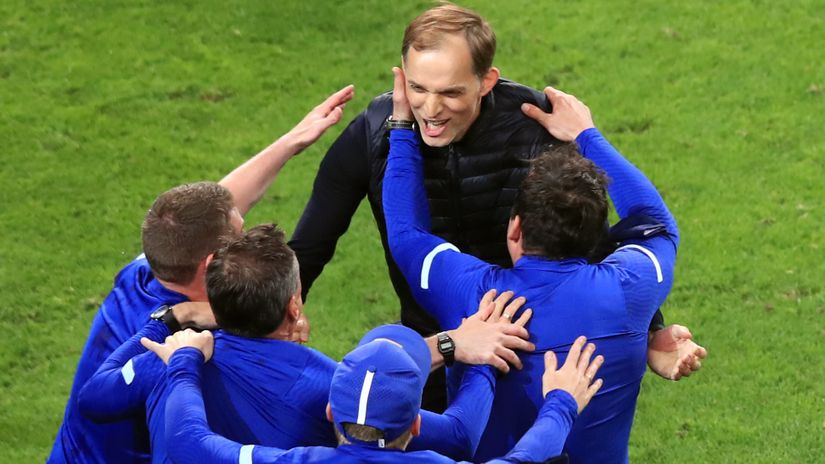
Mainz became one of the few teams capable of disrupting Pep Guardiola’s Bayern.
“We were once on the bus and there was a documentary about Guardiola,” Heidel says. “They showed a map that looked like some sort of knitting pattern. But it was a pass pattern of Guardiola’s players and Thomas studied it for two hours. He was obsessed with learning this pattern.”
Jurgen Klopp’s exit from Dortmund opened new doors for Tuchel in 2015.
A friendship between Pep and Thomas blossomed while the rivalry between Bayern and Dortmund grew. Tuchel even had an intense tactical chat with Guardiola over dinner in a Munich restaurant.
.jpg) Tuchel at Borussia Dortmund (©Reuters/Gallo Images)
Tuchel at Borussia Dortmund (©Reuters/Gallo Images)However, Dortmund were unable to keep their best players and Tuchel failed to hide his frustration, tiring his players.
Relations with the board became more strained - Hans-Joachim Watzke, Dortmund’s chief executive, has since called the manager “a difficult person”.
Despite what is thought of him being cold and too rigid, he knows how to connect with people. He motivated Neymar and Kylian Mbappé in Paris - with those two on board, PSG reached the Champions League final last season before losing to his 'nemesis' Bayern Munich.
Expectedly, Bayern wanted to sign the next big German coach in 2018 but Tuchel turned them down before joining PSG.
Eventually, he was not good enough for PSG either. But - one man's trash is another man's treasure. PSG’s loss has been Chelsea’s gain.
After 1 year
— Kaifi (@Kaifi__imam) May 30, 2021
Thomas Tuchel & Thiago Silva
Together in defeat for PSG. Together in victory????????????#Chelsea #Tuchel pic.twitter.com/Fu5Z2rhQxD
Since replacing Frank Lampard, Tuchel has turned Chelsea into a cohesive unit and has carried them to greatness by winning the Champions League and beating Pep Guardiola three times in six weeks time.
Slowly but steadily, Tuchel has earned his name as one of the greats in the sea of big managers.