


TACTICAL ANALYSIS: Mexico's tactical masterclass that left Bafana Bafana reeling

.jpg)

.png)

Reading Time: 6min | Sat. 13.06.26. | 07:15
Javier Aguirre’s side controlled every phase of the game through intelligent positional play, coordinated pressing, and fluid attacking rotations
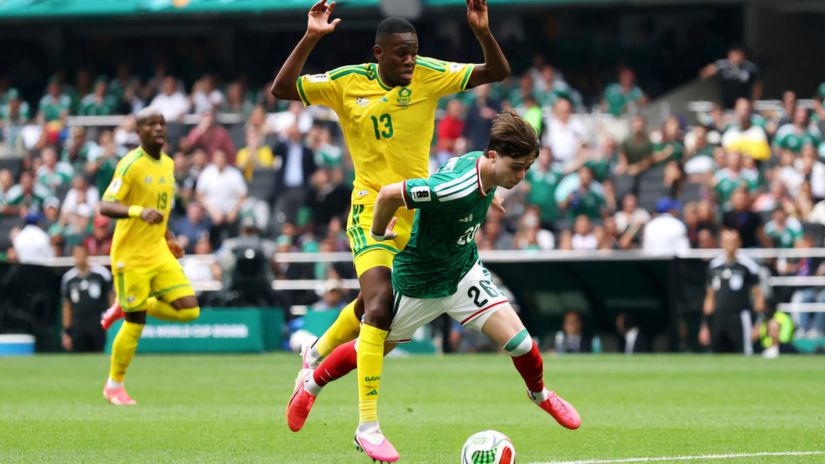
Mexico ended their long-standing World Cup opening-match struggles with a commanding 2-0 victory over South Africa, but the result was shaped far more by tactical superiority than by the three red cards that dominated the headlines.
Javier Aguirre’s side controlled every phase of the game through intelligent positional play, coordinated pressing, and fluid attacking rotations.
Download Our MozzartSport App For more News
Julián Quiñones capitalized on an early South African error to open the scoring before Raúl Jiménez sealed the win with a second-half header.
While the match became increasingly physical and chaotic, the decisive factor was Mexico’s ability to systematically dismantle Hugo Broos’ defensive structure and prevent South Africa from establishing any rhythm in possession.
Mexico lined up in a fluid 4-3-3 that frequently transformed into a 4-1-2-3 during possession.
Raúl Rangel operated behind a central defensive pairing of Johan Vázquez and César Montes, while Israel Reyes and Jesús Gallardo provided aggressive width from fullback.
Érik Lira anchored midfield as the lone pivot behind advanced interiors Brian Gutiérrez and Álvaro Fidalgo.
In attack, Roberto Alvarado occupied the right flank, Quiñones started from the left but constantly drifted inside, and Raul Jiménez served as the central reference point.
South Africa responded with a compact 5-3-2 designed to protect central spaces and frustrate Mexico between the lines.
Ronwen Williams was protected by a back five featuring Khuliso Mudau and Aubrey Modiba as wingbacks, while Nkosinathi Sibisi, Ime Okon, and Mbekezeli Mbokazi formed the central defensive trio.
The midfield three of Sphephelo Sithole, Jayden Adams, and Teboho Mokoena operated narrowly behind forwards Iqram Rayners and Lyle Foster.
Out of possession, South Africa’s priority was central compactness. Their midfield shifted laterally as a unit to deny Fidalgo and Gutiérrez space between the lines and encourage Mexico toward harmless circulation.
However, the system contained a significant weakness: the wingbacks remained extremely conservative.
Mudau and Modiba were reluctant to step out and engage Mexico’s advancing fullbacks, preferring instead to protect the channels around the center-backs. This caution created constant access to wide areas, particularly when Mexico switched play quickly from one flank to the other.
The issue became even more pronounced due to Quiñones’ movement. Rather than remaining isolated on the touchline, he repeatedly drifted into the left half-space, dragging Sibisi into uncomfortable decisions. Whenever the right-sided center-back followed him inside, spaces emerged behind the defensive line.
If Sibisi stayed in position, Quiñones received freely between midfield and defense. South Africa struggled to resolve this dilemma throughout the match, and Mexico continually exploited the uncertainty.
South Africa attempted to build possession courageously despite the hostile atmosphere. During goal kicks, Williams split his center-backs extremely wide while Mbokazi advanced into a temporary left-back role.
Sithole dropped into a single-pivot position ahead of the defensive line, creating a flexible four-man base intended to bypass Mexico’s first line of pressure. The concept was ambitious but ultimately proved unsustainable against Mexico’s coordinated pressing structure.
Mexico pressed aggressively in a 4-3-1-2 shape whenever South Africa attempted to build from deep.
The front line blocked passing lanes into midfield while supporting players aggressively jumped onto receiving targets. The first goal perfectly illustrated the effectiveness of these pressing triggers. Williams played a short pass into Sithole near his own penalty area.
Under immediate pressure, Sithole took a heavy touch while attempting to turn. Lira instantly stepped forward to compress the space, allowing Quiñones to pounce on the loose ball and finish clinically through Williams’ legs. T
he goal highlighted both Mexico’s pressing intelligence and South Africa’s inability to execute under pressure.
Beyond the opening goal, Mexico’s possession structure consistently provided numerical superiority during build-up. Rangel and his center-backs formed a stable foundation while Lira positioned himself ahead of them as a distributor.
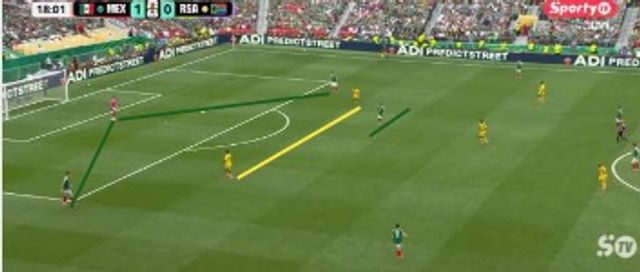
South Africa’s front two were unable to cover the available passing angles, allowing Mexico to progress comfortably into midfield. Once established in the middle third, Aguirre’s side focused on creating interior overloads through constant positional rotations.
Gallardo’s aggressive overlaps were particularly important. His forward runs pinned Mudau deep, freeing Quiñones to move centrally as an additional playmaker. Simultaneously, Jiménez frequently dropped into the space between midfield and defense to receive vertical passes.
His ability to protect possession and link play became a crucial mechanism for destabilizing South Africa’s shape. Whenever Jiménez dropped deep, Okon was often tempted to follow him out of the defensive line, creating gaps for Fidalgo and Gutiérrez to attack with late third-man runs.
These combinations formed the foundation of Mexico’s attacking strategy. South Africa’s midfield was repeatedly forced to collapse inward to track Jiménez and Quiñones, leaving the flanks vulnerable.
When defenders shifted wider to compensate, central lanes opened for runners arriving from deeper positions. Mexico consistently manipulated these defensive reactions, stretching the compact 5-3-2 until it lost its structural integrity.
The pivotal moment of the second half emerged directly from this pattern. Jiménez dropped into midfield to receive a pass from Lira before immediately laying the ball off to the advancing Gutiérrez.
The midfielder burst through the center of South Africa’s shape, exploiting the space created by Jiménez’s movement. Unable to recover, Sithole committed a desperate foul from behind just outside the penalty area and received a straight red card.
The dismissal was not merely an isolated mistake but the consequence of Mexico’s repeated success in creating central overloads and vertical running opportunities.
Defensively, Mexico demonstrated equal control. During the first half they maintained an intense high press designed to force South Africa into long, low-percentage clearances.
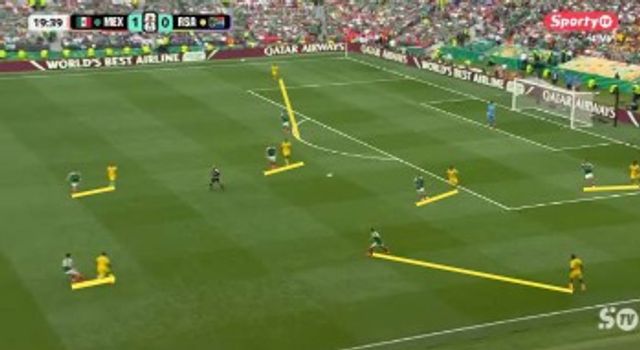
When South Africa occasionally progressed toward the wings, Mexico’s wingers recovered diligently to close down the wingbacks and prevent dangerous deliveries into the box.
After the cooling break, South Africa attempted to alter the dynamic by pressing higher, with Foster curving his runs toward Rangel to force direct distribution. Mexico responded intelligently by dropping into a more compact 4-2-3-1 mid-block.
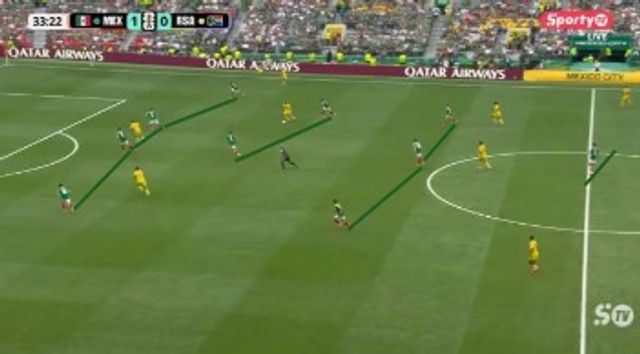
Rather than pressing relentlessly, they prioritized control and rest-defense. Lira and Reyes remained disciplined behind the ball, ensuring that South Africa had virtually no opportunities to counterattack. The effectiveness of this approach was reflected in South Africa’s attacking output: only three shots and a negligible expected-goals figure throughout the match.
Reduced to ten men after Sithole’s dismissal, South Africa abandoned their original system and reorganized into a defensive 4-4-1. Mudau and Modiba dropped into traditional fullback roles while Mokoena shielded the center-backs.
The objective was simple: limit further damage and congest central areas.
Mexico immediately recognized the new weakness. With South Africa lacking numbers to defend wide zones effectively, Aguirre’s side shifted their attacks toward the flanks.
The adjustment paid off in the 67th minute when Alvarado, given time and space on the right, delivered an accurate cross toward the far post. Jiménez overpowered his marker and headed home from close range to secure the victory.
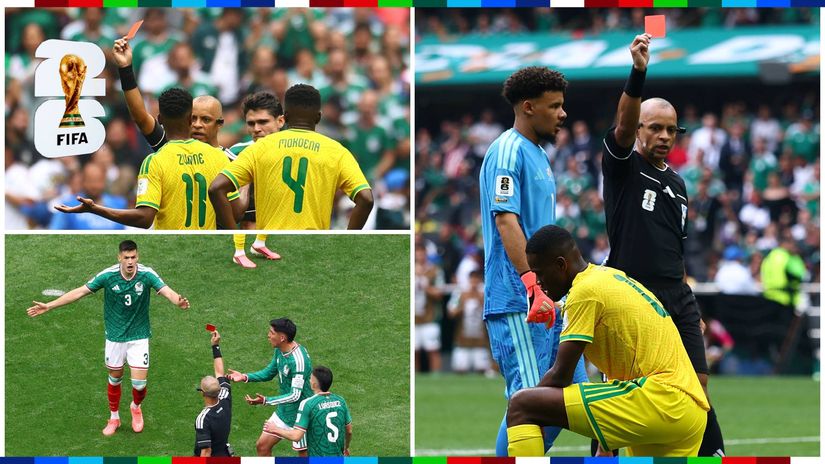
The closing stages descended into disciplinary chaos, with Themba Zwane and César Montes both dismissed, but by then the contest had already been decided. Mexico’s victory was built on a comprehensive tactical performance that exposed every weakness in South Africa’s game plan. Broos’ commitment to short build-up sequences from a deep 5-3-2 lacked the technical security and structural flexibility needed to withstand Mexico’s pressing.
The resulting turnovers, defensive disorganization, and eventual dismissals stemmed from sustained tactical pressure rather than isolated incidents.
For Mexico, the match served as an impressive demonstration of tactical maturity. Overlapping fullbacks, interior rotations from Quiñones and runs from Brian Guiterez, intelligent link play from Jiménez, and disciplined rest-defense combined to create a complete performance.
By stretching South Africa horizontally, overloading central areas, and suffocating transitions, Aguirre’s side controlled the match from start to finish, offering an early statement of their ambitions on home soil.