


.png)
The unsung Nairobi United heroine capturing heartbeat of every win, loss and emotions
.png)

Reading Time: 5min | Fri. 12.06.26. | 21:31
Her passion for photography began in childhood and has grown into her career today
When supporters stream into Nyayo National Stadium or Kasarani Annex, noise greets them first.
The chants, the drums, the flags, the rush of expectation.
Download our Mozzart Sport App for more news
Photographers are easier to miss. They stand at the edges, almost like flies on a wall, already thinking several moments ahead: where the light will fall, which background will frame the club crest, how an image can connect a team to its supporters long after the final whistle.
For Happy Aunda, Nairobi United's photographer, that work begins before a ball is kicked.
"The first thing I notice is the quality and direction of light," she says. "I need to find the right spot and background."
That answer sounds technical, but it reveals the core of her job. Football photography is not simply reacting to action. It is anticipating it.
A derby warm-up, the way shadows stretch across the pitch, the angle of a celebration, the split second before a striker shoots, all of it becomes part of the calculation.
Aunda learned that way of seeing long before she stood on the touchline.
As a child, she was mesmerized by photographs.
Images fascinated her: the idea that a single frame could preserve emotion, movement and memory.
She later enrolled in a broadcast journalism course, expecting to follow a more conventional media path, but eventually chose to major in photography because, in her words, she wanted to follow her heart.
That decision placed her in a profession that remains heavily male-dominated in Kenya. Touchlines, media tribunes and equipment discussions are still often male spaces.
Yet Aunda carved out a place for herself through consistency, professionalism and an eye for storytelling.
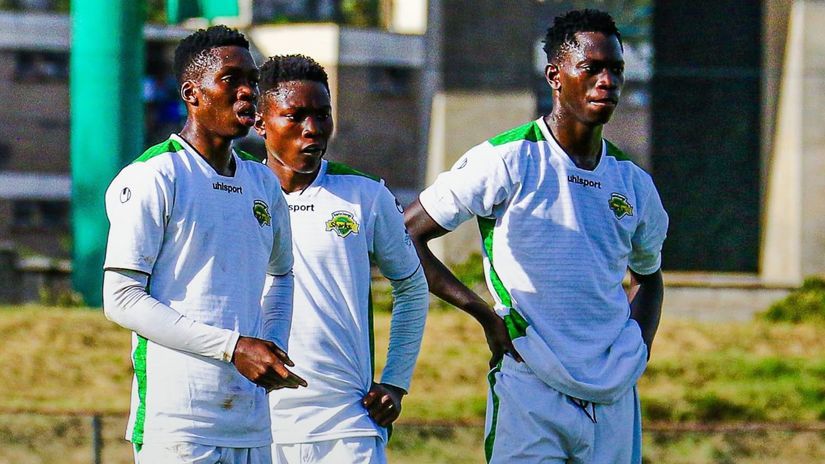
Her work gained even more visibility when Nairobi United won a pulsating Mozzart Bet Cup final last year and qualified for the CAF Confederation Cup, opening doors to travel across Africa with the club.
The travel expanded her world. Stadiums changed, crowds changed, languages changed, but the challenge remained the same: arrive early, study the light, understand the rhythm of the match, and be ready when the decisive moment arrives.
Sometimes that moment disappears before the camera can lock onto it.
One of the most chaotic situations she describes is a sudden switch of play, when the ball is moved quickly from one end of the pitch to the other.
In those seconds, a photographer can lose focus, lose positioning, and lose the shot entirely.
Fans remember the goal. Photographers remember the fraction of a second that determined whether the image was captured.
She has also developed instincts that only come from repetition. By studying how a team plays, she says, she can often sense when a player is about to pass, shoot, draw a foul or create danger.

The camera becomes less a machine and more an extension of pattern recognition.
Not every position is equally photogenic. Attackers are easier because they operate near the goal line where photographers usually sit.
Midfielders, especially defensive midfielders, are harder. Their actions happen in traffic, surrounded by bodies that can block the frame at any moment.
For Aunda, the hardest thing to photograph is not movement. It is emotion.
"The mental aspect," she says. "The hidden fear of the athlete and what people expect from him or her."
Football is public, but many of its emotions are private. A player can score and still be carrying doubt.
A goalkeeper can stand alone after a mistake while thousands watch. A photographer sees those moments from unusually close range.
Aunda admits there are evenings when she goes home emotionally affected, especially after defeats that leave players in tears.
Respect in that environment is earned gradually. For her, it becomes real when players recognize her work and the club trusts her professionalism.
That trust reached an unexpected peak after Nairobi United held its gala dinner. The players organized a surprise event specifically to appreciate the work she had done documenting their journey.
In a profession where photographers often remain invisible, being celebrated by the subjects themselves was a rare acknowledgment.

People outside football often imagine the job is glamorous. They see travel, access and published images.
Aunda sees the long editing sessions, the deadlines, the brainstorming before matches, the spare batteries, memory cards, lenses and backups that travel everywhere with her.
One of her most painful experiences came when a memory card failed, a nightmare scenario for any photographer because it threatens the loss of irreplaceable moments.
The financial reality is equally unforgiving. Professional equipment is expensive, and opportunities can disappear if a photographer lacks the gear required for a particular assignment.
In her view, equipment has become a significant barrier in the industry. Talent matters, but so does having the tools that allow talent to be seen.
Still, she keeps returning to the touchline.
"What if today I capture a moment that will be remembered for years?" she says. "You never know which photo will capture people's attention."
That possibility, the chance that one frame could outlive the match, is what drives her through the early arrivals, the travel, the editing, the pressure and the uncertainty.
.jpg)
And when the stadium finally empties and the cameras are packed away, Aunda returns to a quieter identity.
She is someone who values family deeply and describes herself as being deeply committed to her relationship.
Football, she says, is a big part of her life, but it does not define all of it. The person on the touchline and the person at home are not exactly the same.
What remains constant is the instinct to notice what others overlook.
Fans watch the game. Happy Aunda watches the moments that become history.