


TACTICAL ANALYSIS : Mamelodi Sundowns' structured game plan that downed Esperance



.jpg)
Reading Time: 7min | Tue. 14.04.26. | 21:12
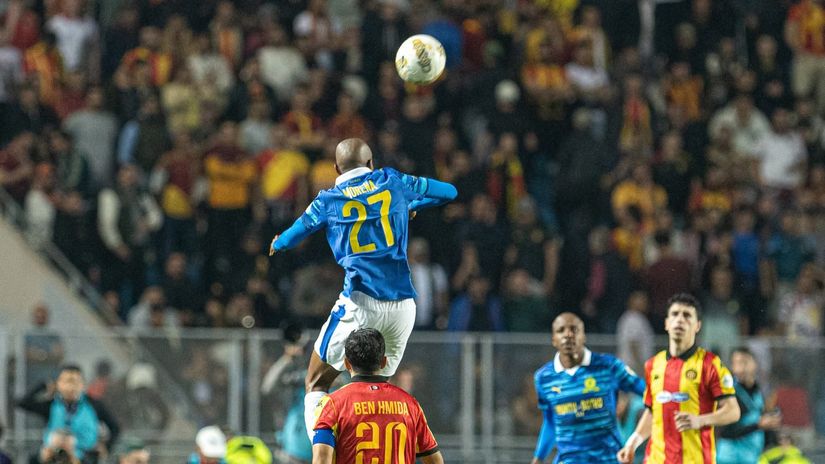
Esperance’s traditional Tunisian intensity against came up against Sundowns’ methodical South African possession game.
In the high-stakes arena of the CAF Champions League semi-final first leg, Esperance de Tunis hosted Mamelodi Sundowns with continental ambition, where a narrow victory could tilt the balance toward the final and secure bragging rights in African club football’s premier competition.
Download our MozzartSport App For More News
The narrative framed this as a clash of styles: Esperance’s traditional Tunisian intensity against Sundowns’ methodical South African possession game.
What unfolded was a closely contested encounter rather than a one-sided affair, with Sundowns ultimately prevailing 1-0 through clinical execution in transition and moments.
Esperance created clear openings but faltered in the final third, underscoring the tactical intrigue of a match decided by fine margins in build-up control and defensive resilience.
Both teams deployed distinct starting structures that shaped the early tactical battle.
Esperance lined up in a 4-1-4-1, with Ben Said in goal shielded by a back four of Ibrahima Keita at right-back, Ben Hamida at left-back, and central defenders Tougai Mohamed alongside Hamza Jelassi.
Ogbelu Onuche anchored as the deep-lying holding midfielder, flanked by central midfielders Abdelrahman Konate and Houssem Teka, while Yan Sasse and Boualia operated as right and left wingers respectively, feeding lone striker Florian Danho.
This setup allowed fluidity between a high 4-1-4-1 in-possession and a more compact 4-4-2 out-of-possession.
In contrast, Mamelodi Sundowns adopted a more asymmetric base, with Ronwen Williams in goal protected by a back three of Khuliso Mudau, Keanu Cupido, and Grant Kekana.

Jayden Adams began as the holding midfielder alongside Teboho Mokoena in central midfield, Arthur Sales played in the No.10 role linking play between the lines, and Marcelo Allende occupied the other central midfield slot.
Divine Lunga started as left wing-back, Thapelo Morena as the wide right winger, and Bryan Leon led the line as nominal striker. Sundowns’ in-possession shape evolved into a 3-2-2-3 build-up, frequently incorporating the goalkeeper as an extra outfielder to facilitate progression.
The defensive scheme of Esperance de Tunis, primarily operating in a 4-4-2 mid-block out of possession with switches to a high 4-1-4-1 or 4-1-3-2 when pressing, revealed clear strengths and vulnerabilities.
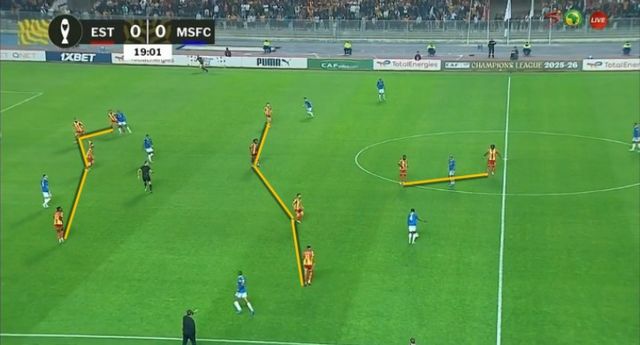
Their compactness between the defensive blocks proved a formidable barrier, denying Sundowns easy access through the midfield and between the lines by keeping spaces tightly shut.
This structure excelled in coordinated pressing, with Danho and Konate advancing forward to harass Sundowns’ wide centre-backs and goalkeeper, one player curving runs to block return passes while the other marked the dropping deep pivot.
However, weaknesses emerged in their reluctance to engage instantly on certain triggers, allowing Sundowns to retain possession and invite pressure, which occasionally forced them into longer, riskier balls.
Sundowns’ own defensive scheme in the first half complemented their high press, but their real strength lay in the 4-4-2 mid-block adopted early in the second half, where Adams occasionally slotted into the backline to form a temporary five-at-the-back when forced deep, enhancing lateral compactness.
Build-up structures and rotational mechanisms defined much of the in-possession intrigue. Sundowns orchestrated progression from the back in their 1-3-2-2-3 shape, leveraging the goalkeeper’s distribution to create numerical superiority in the first phase.
Key to their rotations were dropping movements from striker Bryan Leon, who frequently dropped into midfield to link play, execute bounce passes, and facilitate third-man runs that pulled Esperance’s markers out of position.

Around the 20th minute, Marcelo Allende’s deep drops into congested midfield areas created interior overloads, freeing Teboho Mokoena to venture forward and occupy dangerous spaces between the lines, setting the stage for attacks.
These mechanisms generated interior overloads in central zones, though Esperance’s disciplined block largely prevented sustained exploitation of Zone 14.
Instead, Sundowns found more joy in the channels and half-spaces on the flanks, using Sales’ and Allende’s positioning to support wide combinations.
Esperance, by contrast, built more directly in transitions, relying on quick verticality after regains rather than elaborate rotations, with their shape allowing Ogbelu Onuche to screen while wingers provided width.
Sundowns struggled to penetrate Zone 14 or the central half-spaces consistently, as Esperance’s mid-block maintained tight connections between lines, forcing play toward the channels.
The South African champions adapted by targeting the wide channels, particularly the left flank where Divine Lunga operated in isolation for width-and-depth combinations, and the right, where midfield passes sought runners in behind Esperance’s defence.
Esperance, meanwhile, dominated transitional half-spaces through Florian Danho’s intelligent runs in behind, exploiting gaps behind Sundowns’ left-back with support from Ibrahima Keita’s overlapping right-back surges and precise through-balls or crosses aimed at stretching the opposition.
These runs created overloads in the wide attacking channels, though Sundowns’ rest-defence limited prolonged occupation.
Pressing and build-up disruption strategies further illuminated the contest. Sundowns employed a proactive high press triggered specifically when Esperance played a back pass to a midfielder facing their own goal, forcing turnovers or rushed long balls and compelling Esperance into direct restarts.
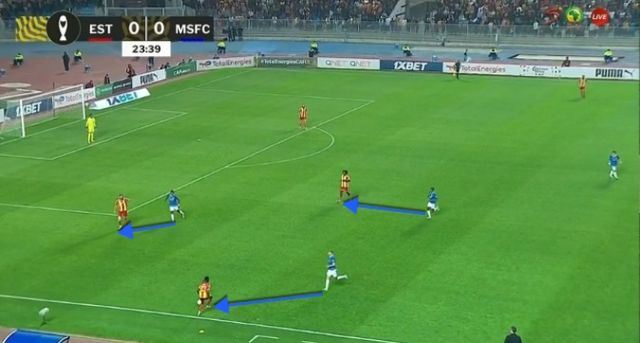
This shape disrupted Esperance’s rhythm effectively in the opening phases, with outcomes including frequent invitations for Esperance to press high, only for Sundowns to hold possession calmly before releasing.
Esperance’s pressing, while structured and forward-oriented with Danho and Konate coordinating against the back three and the pivot, lacked immediate intensity on every trigger, allowing Sundowns breathing room.
Outcomes favoured Sundowns’ disruption early, as Esperance were repeatedly forced long, yet the hosts’ ability to regain and counter quickly in wide areas maintained balance.
Rest-defence and counterpressure played pivotal roles in controlling transitions.
Sundowns’ approach of holding the ball to invite pressure exemplified disciplined rest-defence, ensuring that even when out of possession momentarily, their shape remained compact enough to launch immediate counterpresses and prevent Esperance from exploiting open spaces.
Esperance countered with high-tempo transitions after winning the ball, surging through wide areas with rapid vertical passes to exploit any momentary disorganisation in Sundowns’ rest-defence.
This dynamic kept the game in a state of controlled tension, with neither side fully dominating transitions until late adjustments.
In the second half, Sundowns shifted to a 4-4-2 out-of-possession mid-block, with Jayden Adams slotting into the backline to form a five-at-the-back when defending deep, prioritising compactness.
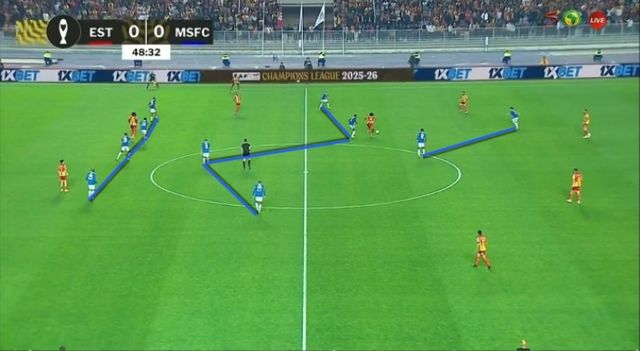
More crosses from wide areas, especially the left through Divine Lunga targeting Bryan Leon, combined with width and depth to stretch Esperance.
The deadlock was broken in the 50th minute when Thapelo Morena’s first-time cross from the right wing allowed Leon to sneak between the two centre-backs for a header.
Esperance responded with double changes on the 62nd minute, introducing Aboubakar Diakite and Jack Diarra for wingers Yan Sasse and Boualia to inject fresh attacking impetus.
.jpg)
Momentum swung briefly in the 65th minute when Diakite tapped in following a goalkeeper collision on a free-kick cross, only for VAR to overturn it due to Tougai’s elbow on Ronwen Williams.
Esperance elevated their wide crosses around the 70th minute, but Sundowns countered with a 72nd-minute substitution of Tashreeq Mathews for Arthur Sales.
Facing mounting pressure, Sundowns transitioned to a 5-4-1\4-1-4-1 out-of-possession shape to blunt Esperance's firepower.
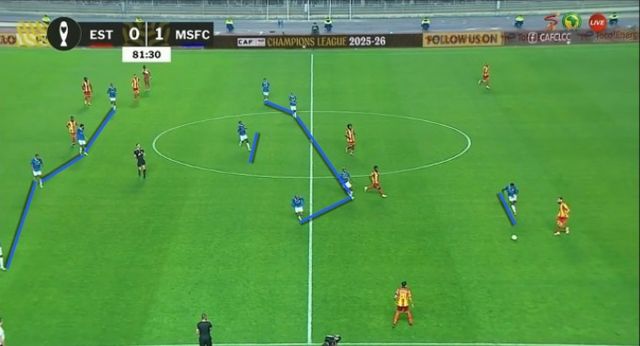
The 84th-minute straight red card to Grant Kekana for a high boot on Danho’s face forced further adaptation, with defensive substitutes Mdunyelwa and Khulumani Ndamane replacing Thapelo Morena and Bryan Leon in the 86th minute to safeguard the lead in a depleted setup.
In the defensive phase without the ball, both teams demonstrated varying degrees of compactness and recovery discipline. Esperance’s 4-4-2 mid-block remained structurally sound.
Stopping triggers from the front two forcing Sundowns wide rather than allowing central penetration, though recovery runs occasionally lagged when Sundowns switched play rapidly.
Sundowns’ deep low block, especially after adjustments, featured tight horizontal and vertical compactness, with centre-backs and full-backs executing disciplined recovery runs to cover channels.
These defensive traits prevented Esperance from converting their territorial pressure into an equaliser despite late momentum.
Tactically, the match underscored Sundowns’ superior game management and adaptability as the defining themes.
Their build-up rotations, pressing triggers, and late defensive reshaping allowed them to absorb pressure, exploit wide channels for the decisive goal, and see out the result even with ten men after Kekana’s red card.

Esperance’s pressing coordination and transitional threat created genuine danger - exemplified by Danho’s 32nd-minute one-on-one that struck the woodwork and the flurry of second-half crosses - but their inability to breach the mid-block or capitalise on numerical advantages post-red card exposed limitations in final-third execution.
Sundowns’ strategy of inviting pressure to go long, combined with Leon’s link-up play and wide overloads, proved more effective in a closely contested semi-final leg, earning them a slender yet tactically merited advantage heading into the return fixture.
The 1-0 scoreline reflected not dominance but disciplined execution of a flexible build-up to attacks evolving into resilient out-of-possession structures, leaving Esperance to rue missed opportunities in a game where small rotational edges and transition control dictated the outcome.