


TACTICAL ANALYSIS: How Sweden Overwhelmed Tunisia 5-1





.png)
Reading Time: 6min | Tue. 16.06.26. | 01:16
Tunisia's technical errors under pressing pressure proved fatal.
Sweden secured a commanding 5-1 victory over Tunisia in a fixture defined by the Scandinavian side's superior attacking transitional play, positional rotations, and devastating dual-striker mechanisms.
Despite brief periods of Tunisian resistance and second-half structural adjustments, Sweden’s ability to manipulate spatial zones and exploit defensive errors proved insurmountable.
Download our MozzartSport App For More News
Both managers opted for variations of three-at-the-back systems, establishing highly dynamic baseline frameworks that evolved dramatically based on game states.
Sweden lined up nominally in a 3-4-3 configuration. Kristoffer Nordfeldt started in goal, shielded by a back three of Gustaf Lagerbielke, Isak Hien, and Victor Lindelöf.
The midfield width was provided by Alexander Bernhardsson as the right wing-back and Gabriel Gudmundson on the left. In the engine room, Yasin Ayari partnered Jesper Karlström, while Benjamin Nygren operated as an advanced playmaker stationed directly behind the dangerous striking duo of Viktor Gyökeres and Alexander Isak.
Tunisia deployed a baseline 3-5-2 structure. Abdelmouhib Chamakh started between the posts, protected by central defenders Omar Rekik, Montassar Talbi, and Amine Ben Hamida. Yan Valery (right) and Ali Abdi (left) acted as the wing-backs providing width.
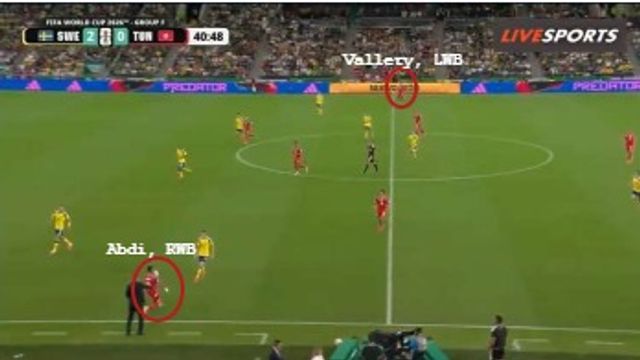
The midfield trio consisted of Elyes Skhiri as the deep anchor, flanked by Rani Khedira and Hannibal Mejbri, while Anis Slimane and Elias Saad led the line as the two forward outlets.
Out of possession (OOP), Tunisia dropped into a structured 5-3-2 low-to-mid block, prioritizing central compactness to deny Nygren space between the lines. However, the African side displayed a notably lethargic press during the opening 25 minutes of the match.
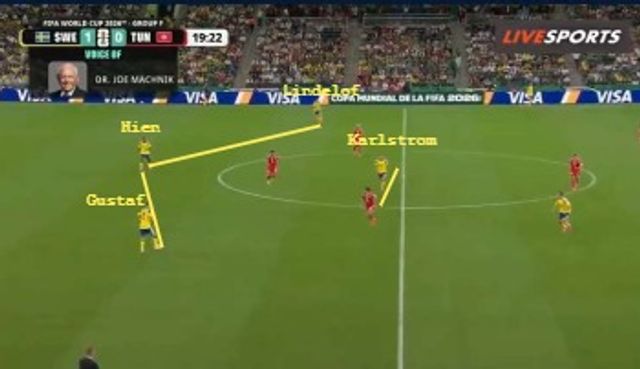
Instead of stepping out aggressively to trigger high-intensity traps, Tunisia allowed Sweden’s wide center-backs - particularly Lindelöf - significant time and space on the ball.
This lack of vertical pressure meant that Sweden's midfield pivot could circulate possession horizontally without facing immediate contact, leaving Tunisia vulnerable to sudden structural shifts and direct balls over the top.
When progressing the ball, Sweden shifted into an expansive 3-2-5 in-possession shape.
The back three remained deep, while Ayari and Karlström formed a double-pivot to pull Tunisia's midfield trio forward. Bernhardsson and Gudmundson pushed high and wide into the final third, pinning Tunisia’s wing-backs and creating a five-man attacking frontline.
The core rotational mechanism relied on the complementary movements of Gyökeres and Isak. Gyökeres consistently dropped deep into the half-spaces to act as a target man, dragging the Tunisian center-backs out of the defensive line.
Simultaneously, Isak utilized his explosive pace to make diagonal runs in depth into the vacated channels.
This continuous vertical stretching forced severe decision-making dilemmas for Tunisia's back three, who struggled to pass off marking assignments.
Sweden exploited Tunisia's passive defensive stance through rapid wide distributions and cross-field overloads. Gudmundson was heavily involved on the left flank, delivering dangerous crosses aimed at the physical mismatches created by Isak and Gyökeres inside the penalty box.

The opening goal in the 7th minute perfectly illustrated Sweden’s dominance in attacking transitions. Lindelöf exposed Tunisia’s lack of forward pressure by launching a precise ball over the top for Isak’s run in depth.
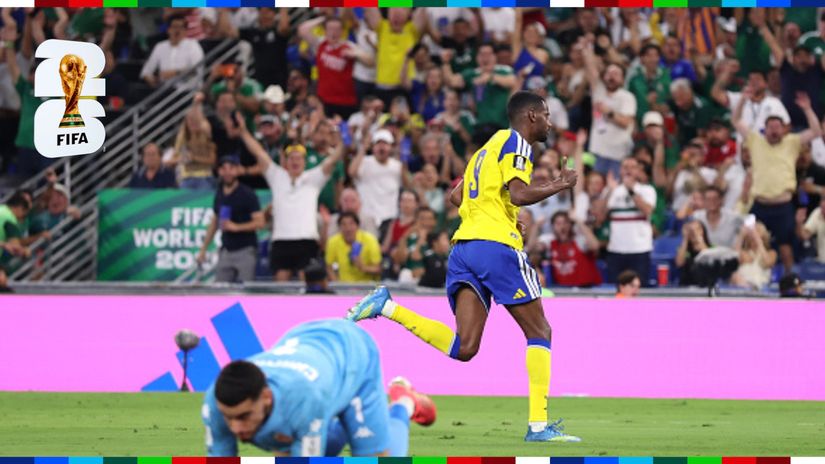
After Gyökeres’s subsequent shot was desperately saved off the line by a defender, the ball broke to the edge of the box. Ayari, capitalizing on Tunisia’s collapsed defensive lines, smashed a powerful long-range strike into the back of the net.
In the 29th minute, Sweden punished Tunisia's structural flaws again.
A rapid transition saw Gyökeres pick up possession and slide a pass to Isak in the wide left channel. Isak drove forward, cut sharply inside toward the edge of the box against a backing-off defense, and curled a precise finish past Chamakh to make it 2-0.
Sweden managed transitions through a highly effective 3-1 rest-defense framework. While building up in their 3-2-5, one central midfielder (frequently Karlström) remained strictly disciplined alongside the three center-backs.
This four-man structure suffocated early Tunisian counter-attacks, forcing the away side to look for direct transitions via wing-backs Abdi and Valery.
As halftime approached, Tunisia altered their game state. Hannibal Mejbri began dropping deep into the first line of build-up to help bypass Sweden’s frontline.
Tunisia also utilized quick restarts directly from goalkeeper Chamakh to catch Sweden off guard, releasing Saad and Slimane into advanced channels.

This aggressive push shifted the momentum pendulum. In the 43rd minute, a long throw-in was recycled on the right wing. Hannibal picked up the second ball and delivered an outswinging cross into the six-yard box.
Omar Rekik timed his run perfectly to the near post, converting a glancing header past Nordfeldt to make it 2-1. Encouraged by the goal, Tunisia pinned Sweden into a deep defensive block just before the whistle, though the hosts held their lead into the break.
Tunisia emerged in the second half with a distinct tactical adjustment, changing their defensive structure from a 5-3-2 to a bolder 5-2-3.
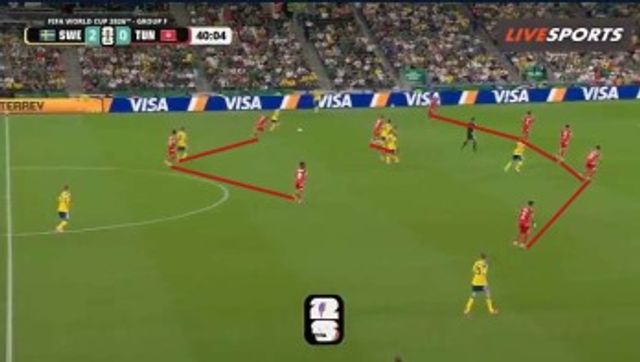
Hannibal was pushed higher up on the right flank, while Saad dropped into a midfield role alongside Skhiri to coordinate central distribution. This structure aimed to allow Hannibal to create overloads on the right wing alongside Valery, while matching Sweden's backline during build-up phases.
Tunisia also established a 3-1 rest-defense of their own, anchoring Skhiri just ahead of the three central defenders.
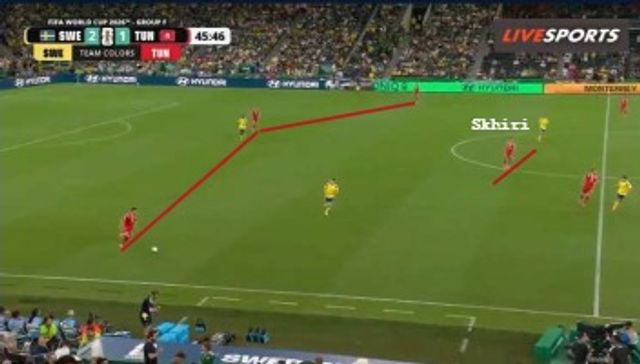
However, Sweden countered this high-risk strategy through aggressive counter-pressing. In the 60th minute, Sweden’s high press triggered a catastrophic error. Chamakh played a short pass out to Skhiri, who showed lethargy in possession. Isak immediately triggered a pressing run, dispossessing the Tunisian anchor. Gyökeres seized the loose ball and slotted home the simplest of finishes into an unprotected net to make it 3-1.
After Sweden scored their third goal, both managers made substitutions in an effort to influence the final stages of the match. In the 64th minute, Sweden replaced Nygren and Gudmundson with Bergvall and Stroud, introducing fresh legs in midfield and adding energetic defensive cover on the flanks.
Tunisia responded in the 70th minute with a triple substitution, bringing on Mahmoud, Tounekti, and Ashouri for Skhiri, Valery, and Saad to inject new energy and attacking momentum into the team.
Later, in the 83rd minute, Tunisia made two further changes, replacing Slimane and Mejbri with Chaouat and Gharbi in a final attempt to refresh the forward line and find a late goal.
By the 80th minute, Sweden shifted away from explosive transitions into a low-risk game-management phase. They executed patient, horizontal circulation of possession across the back line, choosing only to progress vertically when clear passing lanes emerged through Tunisia's tired lines.
This patience paid off handsomely in the 84th minute. Having just entered the pitch, substitute Mattias Svanberg made an instant impact. Sweden earned a free-kick on the right flank; the cross was delivered toward the near post, where Isak executed a subtle flick-on, allowing Svanberg to convert from close range to make it 4-1.

In the final minutes of added time, Tunisia attempted to probe for a consolation goal, throwing bodies forward into the final third. Sweden dropped comfortably into a compact low block, showing defensive discipline across all phases. The Swedish defenders defended their box cleanly, tracking runners and clearing wide deliveries with ease.
The final exclamation mark arrived in the dying seconds of the match. With Tunisia completely stretched, Sweden progressed the ball efficiently into the attacking third. Yasin Ayari picked up possession outside the penalty box and unleashed a spectacular, venomous long-range shot that flew past Chamakh, sealing his brace and a resounding 5-1 victory.
The match provided a textbook demonstration of how a dynamic dual-striker system can systematically dismantle a three-at-the-back defensive block.
While Tunisia showed tactical flexibility by adjusting to a 5-2-3 in the second half, their technical errors under pressing pressure proved fatal. Sweden’s flawless execution of their 3-2-5 attacking shape, paired with an organized 3-1 rest-defense, ensured they controlled both the half-spaces and the transitional phases of the game from start to finish.