


TACTICAL ANALYSIS: How smart adaptations defined Brazil vs Morocco's intense draw



Reading Time: 7min | Mon. 15.06.26. | 18:03
Ancelloti's men struggled in the initial stages due to being unable to control possession in the progression phase
Brazil and Morocco played out to a captivating 1-1 draw in a match characterised by distinct tactical approaches, structural evolutions, and intense out-of-possession systems.
Download our MozzartSport App For More News
The final statistical landscape underscored the balance of the encounter: Brazil shaded possession control with 48% to Morocco's 45% (with 7% remaining in contest), completing 457 passes against Morocco's 433.
While Morocco edged total attempts at goal 14 to 13 and produced a superior expected goals metric of 1.07 xG compared to Brazil’s 0.83 xG, Brazil proved slightly more accurate with 5 attempts on target against Morocco's 4.
This tactical analysis piece explores the structural frameworks, pressing mechanisms, and positional adjustments that shaped this closely fought international exhibition.
Brazil set up nominally in a 4-2-4 formation designed to optimise structural width and interior technical dynamics.
Alisson Becker started in goal behind a back four consisting of Roger Ibañez at right-back, Douglas Santos at left-back, and a central defensive pairing of Marquinhos and Gabriel Magalhães.
The midfield duo featured Casemiro operating as the deep anchor, flanked by the energetic box-to-box presence of Bruno Guimarães.
Up front, Igor Thiago occupied the central striker role as a traditional target man, supported by Vinicius Junior, with Raphinha on the left wing and Lucas Paqueta on the right wing.
Morocco countered with a fluid 4-2-3-1 base structure that prioritised lateral overloads and a highly aggressive defensive posture. Yassine Bounou guarded the net behind a central defensive axis of Issa Diop and Chadi Riad.
Noussair Mazraoui assumed the left-back role, while Achraf Hakimi operated as a highly aggressive, marauding right-back.
The double pivot consisted of Ayyoub Bouaddi and Reda El Aynaoui, providing structural stability below Azzedine Ounahi, who pulled the strings as the advanced playmaker.
In the forward line, Brahim Díaz started on the right wing, Bilal El Khannouss occupied the left wing, and Ismael Saibari was deployed as a nominal, mobile striker.
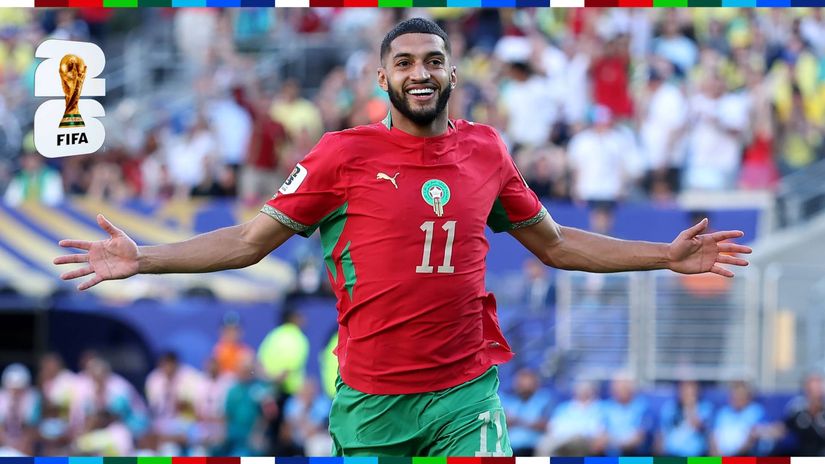
Out of possession, Morocco’s defensive game plan was predicated on aggressive forward jumping and structural compactness to disrupt Brazil's rhythm.
In the initial phases, Morocco deployed a high man-oriented press designed to force Brazil away from central progression lanes and dictate long-ball distributions.
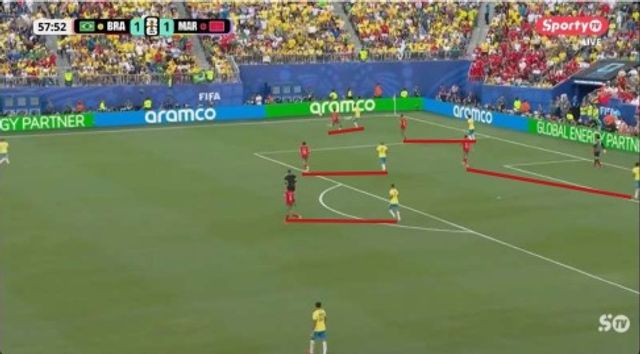
When Brazil managed to breach this first line of pressure, Morocco seamlessly dropped into a compact 4-4-2 mid-block.
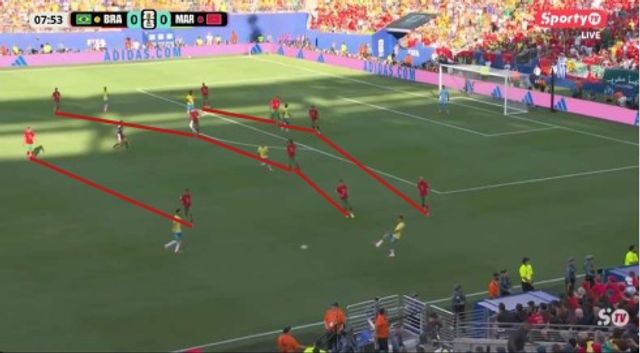
This system relied heavily on impeccable timing; Morocco's midfielders and defenders aggressively timed their jumps onto Brazil's back-to-facing midfielders whenever the ball was circulated from the Seleção's backline.
By anticipating these backward passes, Morocco forced frequent high-value turnovers in the opening periods of the match, completely stifling Brazil's central progression.
In the low build-up phase earlier on in the match, Brazil utilised a strict 4-2 base structure, attempting to construct play cleanly from the back through their centre-backs, full-backs and double-pivot.
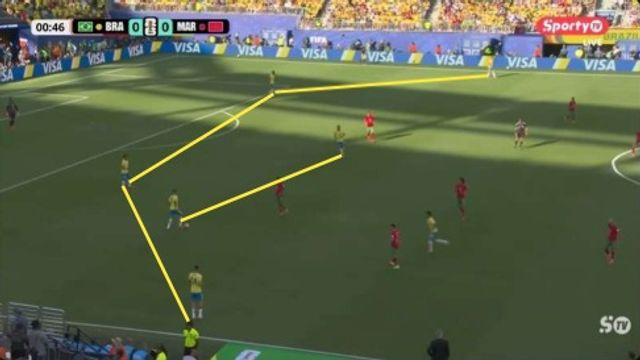
Ancelotti's men struggled in the initial stages due to being unable to control possession in the progression phase. Brazil looked to create a box midfield with Paqueta coming in and Ibanez pushing high.
Vinicius pushed wide left from his initial second striker role to the left-hand side, and Raphinha occupied the left half space. They, however, struggled due to the midfielders' inability to retain possession.
To bypass Morocco's aggressive jumping press, Brazil implemented distinct structural rotations. Raphinha, who now switched to the right wing, frequently dropped deep from his natural right-wing position to link play, which triggered Roger Ibañez to push high up the flank.
.jpg)
This movement allowed Raphinha to tuck into the right half-space and even the left half-space sometimes, dragging his marker out of position.
Simultaneously, on the left flank, Lucas Paquetá and Bruno Guimarães executed intricate combinations to pull Moroccan defensive markers away from the touchline, creating an isolated, high-value 1v1 avenue for Vinícius Júnior.
As the half progressed, Brazil’s forward line became increasingly fluid, with Paquetá drifting out to the wide left, Vinícius tucking inside the left half-space to allow the left-back Douglas Santos push high in attacks, and Raphinha hovering centrally around the box to support Igor Thiago.
Morocco’s primary attacking strategy revolved around orchestrating massive overloads on the flanks, particularly down their right-hand side.
Achraf Hakimi was instructed to push incredibly high and wide, effectively acting as a winger, which allowed Brahim Díaz to tuck inside into the right half-space.
Joined by either Saibari or Ounahi, Morocco created lethal passing triangles that constantly threatened Brazil’s left flank.
However, this extreme structural aggression introduced a severe vulnerability: the space vacated behind Hakimi. Brazil ruthlessly exploited this structural weakness in transition.
By capitalising on Hakimi’s advanced positioning, Brazil utilised third-man combinations on their left-hand side involving Raphinha, Douglas Santos, Vini and the drifting Paquetá/Guimares to counter-attack into the open spaces left by the Moroccan fullback.
The tactical battle frequently crystallised in specific zones of the pitch, where individual quality was required to break structural deadlocks.
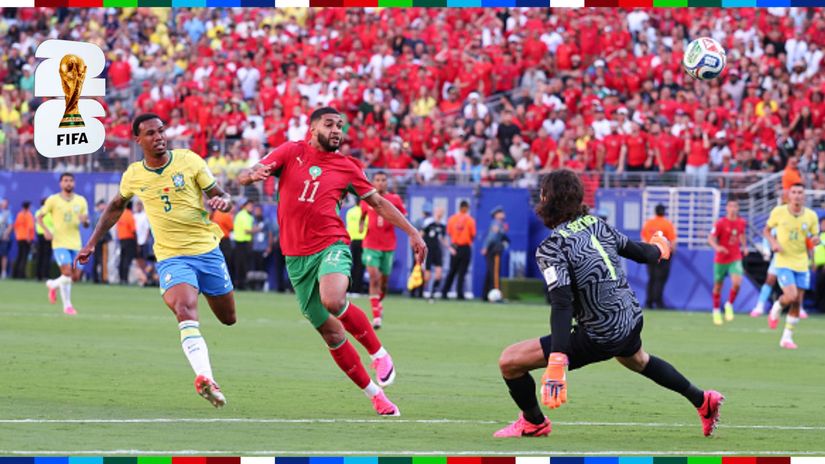
In the 21st minute, Morocco’s aggressive off-the-ball hunting yielded the opening goal. A vertical pass through the central midfield lane from Brahim Díaz sliced directly into Zone 14, finding Ismael Saibari running between Gabriel Magalhães and Marquinhos.
Capitalising on a momentary lapse in central compactness, Saibari anticipated Alisson coming off his line and executed a delicate chip over the goalkeeper.
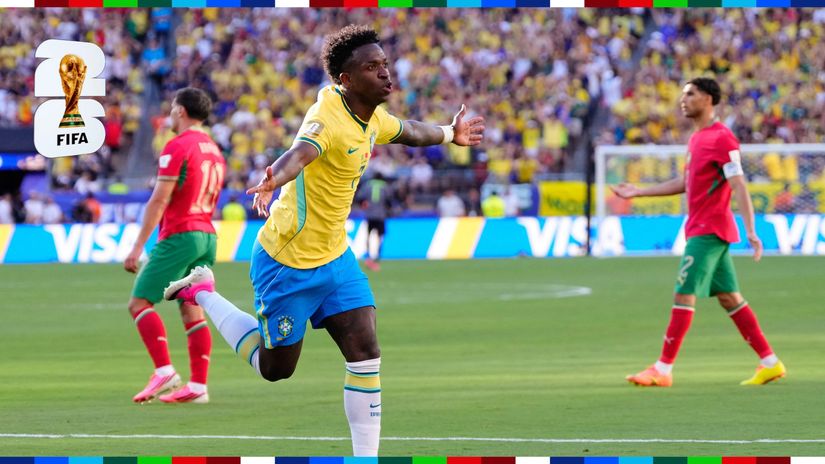
Brazil answered in the 31st minute by dominating the wide left channel. After Paquetá and Guimarães successfully dragged Moroccan markers out of position, Vinícius Júnior received the ball near the byline.
Displaying immense individual brilliance, Vinícius cut inside past El Aynaoui and unleashed a precise, powerful shot past Yassine Bounou to equalise, demonstrating how wide-area isolation could undo a compact defensive block.
Brazil counteracted Morocco’s possession phases by implementing a high 4-1-3-2 pressing shape.
This structure aimed to pin Morocco deep inside their own territory and disrupt their short passing lanes. In response, Morocco refused to abandon their principles early on, initiating low build-up sequences from Bounou out through El Aynaoui.
Brazil's high press triggered aggressively whenever the ball was directed wide toward Morocco's fullbacks or wingers.
This coordinated pressure closed down the lateral passing lanes, suffocating Morocco's options and forcing them into defensive turnovers or low-percentage long balls down the channels.
Despite Morocco’s capacity to launch fast breaks through Hakimi, Brazil's structural rest-defense proved robust for the majority of the encounter.
Brazil's counterpressure upon losing possession was highly organised, with the defensive midfielders maintaining optimal distances behind the ball to immediately smother vertical transitional passes. This defensive security allowed Brazil to weather Morocco's quick restarts from Bounou.
Both teams exhibited elite intensity in retrieving the ball, with Morocco averaging a 15-second ball recovery time and Brazil following closely at 16 seconds. This frantic defensive workload ensured that neither team could completely dominate the game via prolonged counter-attacks.
The second half prompted immediate tactical interventions from Brazil's bench, with Fabinho and Danilo introduced in place of Casemiro and Ibañez. These adjustments provided Brazil with significantly more control over the tempo, limiting Morocco's transitional opportunities.
Brazil began suffocating Morocco’s low build-up phase, trapping them deep in their own box through patient, circulating possession.
In the 61st minute, Brazil shifted to an ultra-offensive four-man front line, bringing on Matheus Cunha and Luiz Henrique for Paquetá and Igor Thiago.
Cunha and Raphinha occupied central areas, while Vinícius and Henrique locked down the wide flanks.
Morocco responded in the 63rd minute by replacing Brahim Díaz and Azzedine Ounahi with El Mourabet and Chemsdine Talbi, altering their defensive pressing shape into a bold high man-to-man 4-2-4.
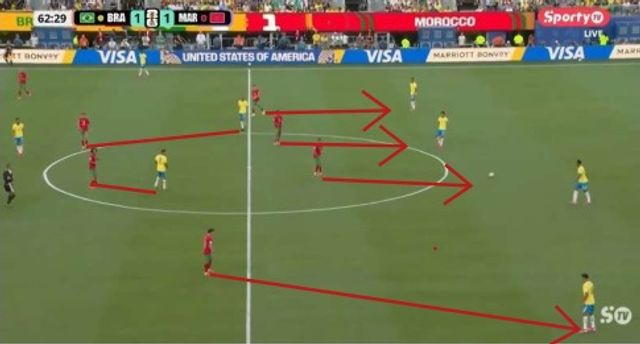
This change rejuvenated Morocco, allowing them to establish passing triangles on the right flank once again. Further personnel changes occurred in the 79th minute, as Morocco brought on Anass Salah-Eddine and Amaimouni for Mazraoui and El Khannouss, while Brazil introduced Danilo Santos for Guimarães.
As the match entered its final phases, the structural integrity of both teams was severely tested. Morocco were increasingly forced to commit tactical fouls to disrupt Brazil's rapid attacking transitions before the Seleção could exploit spaces behind their defensive line.
Brazil's deep block remained resolute, aided by crucial blocks from their central defenders. In the 77th minute, Brazil bypassed Morocco's shape, resulting in an excellent opportunity where Raphinha fired a shot on goal from a Vinícius Júnior cutback.
Late in the match, Morocco were forced to abandon short build-ups, opting for direct long-ball restarts in the 82nd minute.
Brazil nearly capitalised on a loose touch from Issa Diop, but Bounou reacted rapidly to clear the danger. In stoppage time, Brazil generated consecutive corners and circulated the ball efficiently, but Bounou produced vital saves to preserve the scoreline.
The 1-1 draw stands as a fair reflection of a highly sophisticated tactical chess match. Morocco’s aggressive out-of-possession jumping and flank overloads gave them early superiority and a deserved opening goal.
However, Brazil's structural flexibility, highlighted by fluid frontline rotations and the individual brilliance of Vinícius Júnior, exposed the natural spaces left behind Morocco’s adventurous fullbacks.
The second-half adjustments saw Brazil exert greater territorial dominance, yet Morocco's shift to a 4-2-4 press ensured they remained a threat.
Ultimately, both teams demonstrated elite-level rest-defense and recovery metrics, proving that structural discipline and transitional organisation can neutralise even the most potent offensive systems.