

TACTICAL ANALYSIS: How Harambee Stars' CHAN defensive approach differs from the rest

.jpg)
.jpg)
.jpg)


Reading Time: 6min | Mon. 18.08.25. | 15:42
What CHAN 2024 has shown so far is that there’s no one-size-fits-all approach to getting enough points for advancing to the next round
One of the most compelling tactical battles at the 2024 African Nations Championship (CHAN) has not been about who has the ball, but rather, what teams do without it.
The tournament has offered a fascinating lens into two sharply contrasting defensive strategies: high pressing versus low blocks.
While both are designed to neutralise opponents, they represent entirely different philosophies of space, risk, and control.
Follow Our WhatsApp Channel For More News
At its core, this divide is about where a team chooses to defend and how they look to regain possession. Do you chase the ball high up the pitch, pressing opponents aggressively in their own half? Or do you sit deep, remain compact, and invite pressure to strike on the counter?
Each comes with distinct rewards and very dire consequences.
.jpg)
High Pressing: Relentless Pressure, Instant Threat
For teams like Senegal, South Africa, Angola, and Nigeria (before their early exit), high pressing has been a defining feature of their tactical identity.
These sides have deployed a front-foot approach, pressing in coordinated waves from the front line and suffocating opponents in their defensive third.
Take Senegal, for example. Their match against Nigeria showed how a well-executed press can be. From the opening whistle, Senegal’s forwards and attacking midfielders hunted the ball with intent.
Every pass from Nigeria’s centre-backs was met with immediate pressure. The goal was clear: force errors, disrupt the rhythm, and pounce on loose touches.
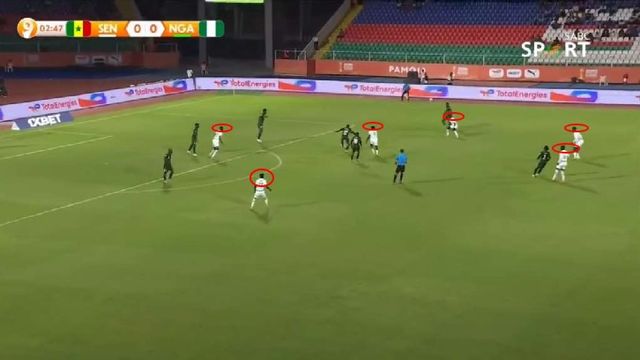 Senegal’s high press upfront with them swarming high with numbers to suffocate Nigeria’s backline circulation and disrupt their build-up play.
South Africa’s 1-1 draw with Algeria provided a textbook case of high pressing in action. Their attackers initiated pressure smartly, using curved pressing runs to close off passing lanes to the full-backs while forcing the ball inside, where central midfielders stepped up to intercept.
On multiple occasions, this led to turnovers within a couple of metres from the goal. Though they failed to convert many of those chances, the system itself functioned well and exposed Algeria’s vulnerability under pressure.
 .........Diagram visualization of South Africa’s high press against Algeria, which trapped them deep, with coordinated curved runs cutting off short options and forcing the goalkeeper long.
Their line of engagement was not static - it moved as a unit, pressing triggers activated by passes into predictable zones. The back line, meanwhile, pushed up in support, ensuring tight compression of space.
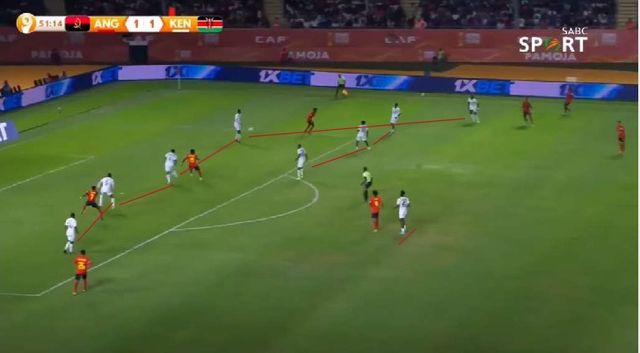
In a decisive moment of Angola’s high press against Kenya, their front line executed a well-coordinated and tactically astute press that exposed Kenya’s disorganised buildup.
As Kenya’s defenders hesitated and their pivot failed to drop in time, Angola’s pressing unit - led by the left half-space roamer(hybrid winger) and striker Paciencia - shut down all passing lanes with precise positioning.
The pressure was intensified by support from the opposite roamer and an advancing central midfielder, who capitalised on the sluggish Kenyan pivot.
The sequence ended with a desperate foul by Kenya, resulting in a red card and highlighting how Angola’s press not only disrupted play but also created a clear goal-scoring opportunity through collective, intelligent pressure.
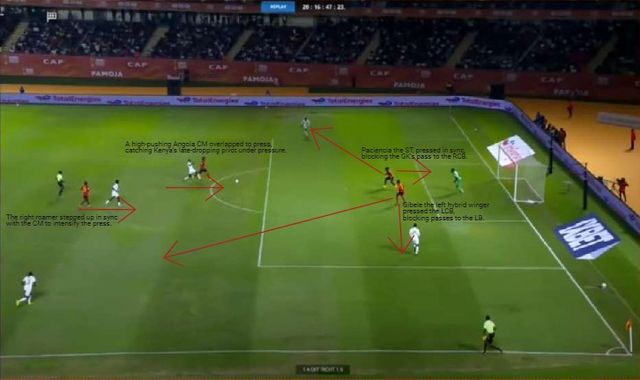 Angola's first defensive line recognized Kenya's lack of passing options during the buildup and triggered a coordinated high press.
Athleticism and Calculated Risk
High pressing is not just a tactic - it is a physical demand. The system thrives on athleticism, stamina, and mental sharpness. Senegal, South Africa, and Angola, boasting squads with players capable of repeating sprints and covering ground at pace, are naturally suited for this style.
However, the risk is always lurking. A missed challenge or a bypassed press leaves defenders exposed - particularly with high lines.
Algeria’s equalising goal against South Africa came from such a scenario: a quick vertical pass beat the press and set up a transitional break. One pass turned defense into attack.
But for these pressing teams, the trade-off is worth it. In modern football, some of the highest-quality chances come not from elaborate build-up play, but from transitional moments - intercepted passes, quick turnovers, and broken defensive shapes. High pressing creates these scenarios by design.
Low Blocks: Discipline, Patience, and Defensive Solidity
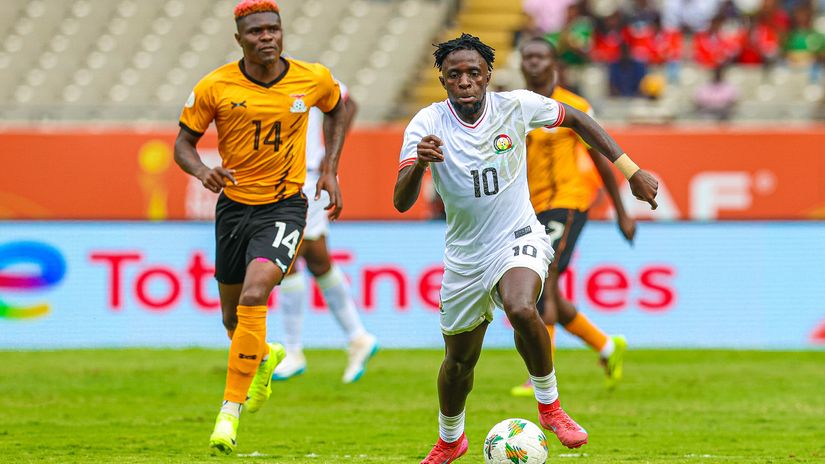
At the opposite end of the spectrum is Kenya’s Harambee Stars, who have embraced the conservative yet effective method of low-block defending.
Under head coach Benni McCarthy, Kenya has prioritised structural integrity over territorial dominance - especially when playing with a man down, which has occurred in two separate matches.
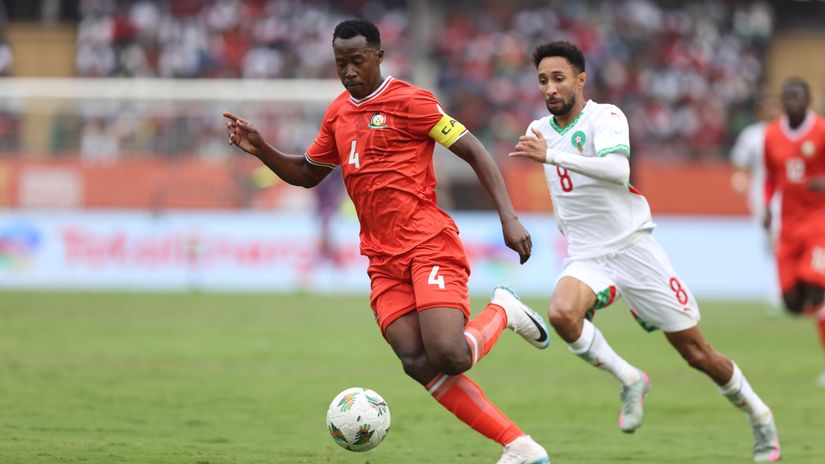
In group-stage matches against Angola and Morocco, Kenya dropped into a compact 5-2-2/5-3-1 shape when out of possession. The main goal was not to win the ball back high - it was to protect the space in front of their goal, deny central progression, and channel opponents into wide areas.
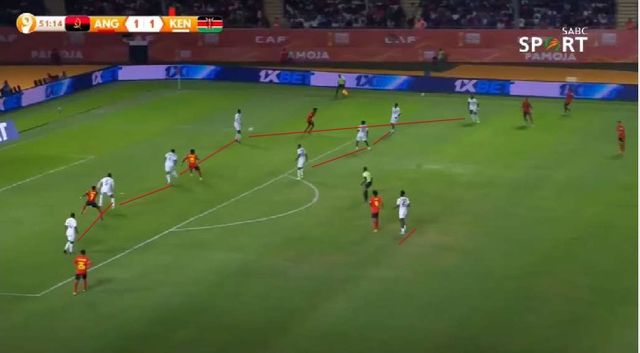 Visualization of Kenya’s Harambee Stars, who dropped into a disciplined back five, forming a low block to absorb pressure and counter Angola’s desperate attacking surge.
Organisation Over Possession
In both matches, Kenya conceded possession and allowed their opponents to control the ball in non-threatening zones. But when Angola and Morocco entered the final third, they found a wall of red shirts narrowing the space.
The back five stayed tight, the midfield dropped close, and distances between lines were minimal - leaving little room for through balls or creative combinations.
Visual analysis of Kenya’s shape above shows a well-drilled backline protecting the penalty box. The central defenders were aggressive in dealing with crosses, while midfielders screened passing lanes to playmakers.
For long stretches, Angola and Morocco could do little more than pass the ball laterally or resort to speculative long shots - most of which went harmlessly wide.
This was not about domination. It was about survival, and it worked. Even when down to ten men, Kenya frustrated two technically superior sides by staying compact, composed, and tactically aware.
A Philosophical Divide: Pragmatism vs. Proactivity
The debate between high pressing and low blocks at CHAN 2024 is more than a tactical preference. It is a reflection of resources, identity, and tournament context.
Teams like Senegal and South Africa press high because they can. They have the physical tools, the squad depth, and the training regimes to support such an intense system.
The approach aligns with their broader footballing philosophies: win the ball early, dominate transitions, and force the opponent into uncomfortable areas.
Kenya, on the other hand, has optimised its resources differently. Knowing they may not match the top sides for technical finesse or athletic explosiveness, they have chosen structure and grit.
Their low block is not passive - it is calculated. In a short tournament where every point matters and every mistake is magnified, playing not to lose is sometimes more valuable than chasing a win.
Two Sides of the Same Coin
What CHAN 2024 has shown so far is that there is no one-size-fits-all approach to getting enough points for advancing to the next round. Both high pressing and low blocks have delivered results and exposed weaknesses.
● High pressing dazzles with intensity and promise, but a single ball over the top can unravel the entire structure.
● Low blocks frustrate and neutralise, but come at the cost of attacking ambition and territorial control.
Ultimately, it is not about which is better, but it is about which fits best. The best teams are those who understand their strengths and limitations, and build a tactical approach around that self-awareness.
In that sense, so far CHAN 2024 has not just been a showcase of African talent - it hass been a masterclass in tactical identity.