


Harambee Stars analyst on why Kenya is lagging behind in football data








Reading Time: 4min | Tue. 07.07.26. | 19:56
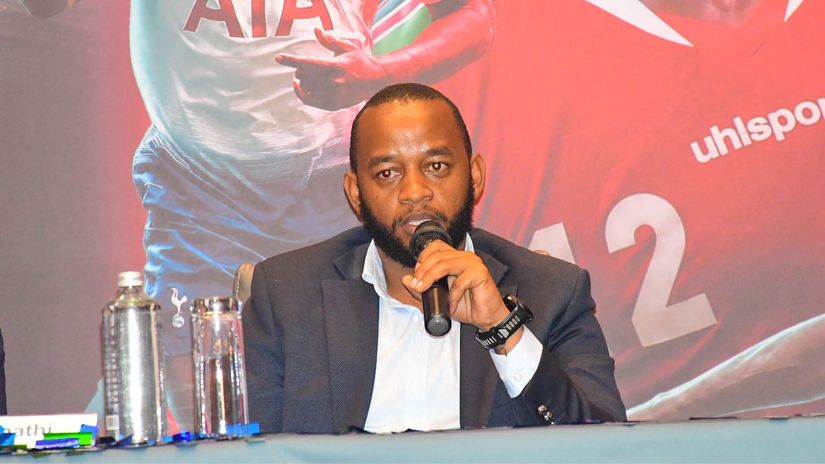
Since joining the Football Kenya Federation (FKF) in March 2024, he has been at the centre of the federation's push towards a more data-driven approach to football
When most football fans hear statistics, they think of goals, assists, or distance covered. However, for Harambee Stars team manager and lead data analyst Nick Kimanthi, those numbers are only the starting point.
Download our Mozzart Sport app for more news
The former Saracens Women performance analyst believes Kenyan football's biggest challenge is not the lack of data but the lack of reliable, consistent data that provides the context needed to make better decisions.
Before returning home, Kimanthi built an impressive career in sports performance analysis in England, working with Saracens Women and serving as a FIFA tournament analyst during the 2022 FIFA World Cup in Qatar.

Since joining the Football Kenya Federation (FKF) in March 2024, he has been at the centre of the federation's push towards a more data-driven approach to football.
In July 2025, he was appointed Harambee Stars team manager, succeeding Jectan Oitang'or, while continuing to oversee the national team's performance analysis.
His role stretches far beyond crunching numbers. As team manager, Kimanthi coordinates training camps, oversees travel logistics, processes player documentation, and ensures compliance with CAF and FIFA regulations.
Alongside those responsibilities, he leads the collection and interpretation of performance data gathered through GPS tracking systems, wearable technology, and video analysis.
The reports he produces help coaches assess opponents before matches, review performances afterwards, and make informed tactical and selection decisions.
He also works directly with players, using individual performance metrics to identify strengths, weaknesses, and areas for improvement.

However, despite the technological advances, Kimanthi believes Kenya is still scratching the surface.
"People often get excited by the numbers without considering the context. One of our biggest challenges is that our national league does not consistently produce reliable data. For me, data is never just about the numbers; it is about the story behind them,” he said.
For Kimanthi, statistics without context can easily create false conclusions.
"If you tell me a player has scored a certain number of goals, I need to see the context. I need to watch the video, understand the situation, and then make a judgment based on that," he explained.
The same principle applies to physical performance metrics.
"You cannot simply tell me a player covered 15 kilometres and expect that to be enough. We want to know the story behind those numbers because data tells a story, but sometimes that story can be misleading. That is why you need the full picture,” he offered.

According to Kimanthi, one of the biggest obstacles facing Harambee Stars is the inability to compare player data over long periods because of inconsistent data collection across Kenyan football.
"At the national team, one of our biggest struggles has been the lack of consistency in our systems and the difficulty of accessing reliable data.
We also need league data that is collected consistently so that I can measure the same metrics over time and make meaningful comparisons and assessments,” he averred.
Despite the challenges, he believes attitudes towards sports analytics have changed significantly in recent years.
"I honestly think we are only using about 10 per cent of what data analysis can offer, but we are moving in the right direction. A few years ago, people did not really understand what I was doing.
Today, there is much greater awareness of analysis, and I am seeing more people getting involved. That is encouraging because it shows we are making progress,” he said.

Kimanthi's path into elite football analysis was anything but conventional.
His professional career began in 2012 as an assistant accountant at Scott Christian University in Machakos before moving to Co-operative Bank of Kenya in 2016 as a senior sales executive, where he specialised in business growth and cross-selling.
His transition into football came in 2018 with Spanish club RCD Espanyol, where he worked in commercial partnerships, helping secure sponsorship deals, negotiate player contracts, and expand the club's customer base through digital campaigns.
In 2021, he joined sports technology company Catapult as a referral partner for East Africa, promoting GPS tracking systems designed to improve athlete performance.
The following year, he relocated to England and transformed the performance analysis department at Milton United FC, where data-driven planning reportedly contributed to a 30 per cent increase in match victories.
His growing reputation earned him a role as first team performance analyst and data insights lead at Saracens Women, where he led key aspects of pre-match, live, and post-match analysis while helping shape winning strategies.
Kimanthi also worked as a recruitment analyst for Queens Park Rangers and served as a FIFA tournament analyst during the 2022 FIFA World Cup in Qatar.
Academically, he holds an MBA in Sports Management from EU Business School and a Master of Science in Sport Performance Analysis from Middlesex University, graduating with merit.
He is currently pursuing a PhD at Middlesex University, focusing on data-driven scouting models in the English Premier League.
In October 2024, he also completed the CatalyzU Venture Capital Fellowship, adding investment and portfolio management to a résumé that reflects a career built on combining strategy, technology, and performance.