


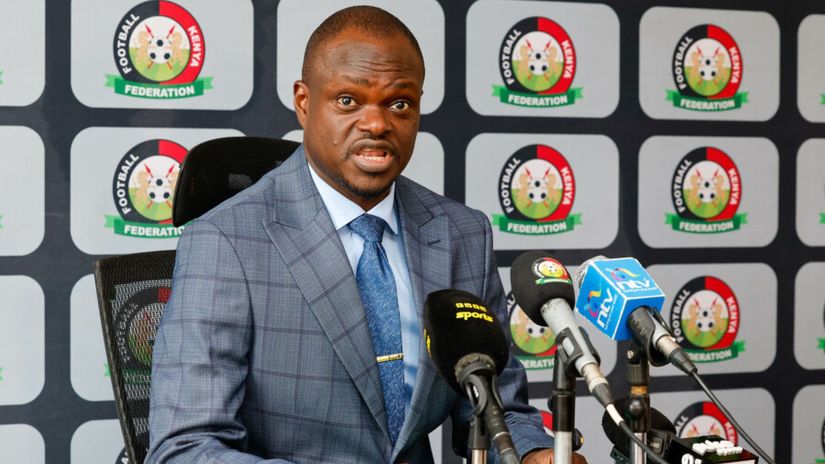
Former Gor Mahia official pokes holes into 21 charges levelled against FKF CEO


.jpg)



Reading Time: 5min | Mon. 12.01.26. | 19:33
In a letter dated December 31, 2025, and signed by FKF President Hussein Mohammed, the federation outlined 21 allegations against Ndege, a development widely interpreted as groundwork for his removal from office
Former Gor Mahia sporting director and ex-Football Kenya Federation (FKF) CEO Lordvick Aduda has rubbished the 21 charges levelled against FKF CEO/General Secretary Harold Ndege, questioning the public outrage surrounding the move and dismissing claims that the current FKF regime ever represented a genuine 'fresh start'.
Follow our WhatsApp channel for more news
In a letter dated Wednesday, 31 December 2025, and signed by FKF President Hussein Mohammed, the federation outlined 21 allegations against Ndege, a development widely interpreted as groundwork for his removal from office.
The charges span national team preparations, youth football, international engagements, financial matters and administrative oversight.
The move stunned sections of Kenyan football fans, many of whom viewed it as a betrayal of the reformist promises made during the FKF election campaign.
Social media erupted with criticism, with fans questioning how a leadership that preached transparency and professionalism could descend into internal conflict so quickly.
Aduda, however, was unmoved by the outrage.
“To be very honest, I don’t know what Kenyans expected,” he told Mozzart Sport. “The idea of a fresh start was a fantasy people convinced themselves about."
Drawing from decades of administrative experience and close engagement with FIFA structures, Aduda argued that Kenyan football has always operated within the same global framework and could not suddenly reinvent itself.
“When did Kenya become a member of FIFA? Around 1960. We have had a football federation since then, so why do people think this is a fresh start?” He posed.
.jpg)
He insisted that football governance in Kenya remains bound by FIFA statutes, CAF regulations, and local constitutional frameworks.
“You cannot run football away from FIFA status. You cannot run football outside the laws of the game. You use the constitution, you use the rules and regulations governing Kenyan football. Anything outside that, you are not doing football.”
According to Aduda, expecting radical change without addressing systemic governance structures was unrealistic from the outset.
The Sports enthusiast further said he reviewed the list of allegations and found many of them misplaced, arguing that the CEO had been unfairly turned into a scapegoat.
“I looked at some of those allegations and laughed, not because I am defending the CEO or holding briefs for him, but because many of those issues do not fall under his mandate.”
He cited allegations touching on under-15 and under-17 teams, CECAFA competitions, Harambee Stars matches and international engagements, saying these are handled by specific FKF committees.
“We have a Technical and Training Committee. What is their work? National team preparation is under that committee,” he noted.
He also referenced the Director of National Teams, the International Matches Organising Committee, and other standing bodies within FKF.
“So when you list all these things and pin them on the CEO, the question is: what are all these committees doing?”
Aduda was particularly critical of claims relating to financial mismanagement, saying they exposed deeper governance failures rather than individual wrongdoing.
“You are talking about money being inflated, don’t we have a finance director? Isn’t there a chairman of the finance committee?”
He questioned how financial issues could be blamed on the CEO when budgets are approved collectively.
“I thought the General Assembly approves the budget for the running year. How do you then turn around and lump everything on the CEO?”
Aduda stressed that FKF operates under collective responsibility, warning that isolating one office-holder undermines institutional accountability.
According to Aduda, if FKF governance worked as intended, responsibility for failure should rest with committee chairpersons who failed to execute their mandates.
He explained that FIFA issues an annual international calendar detailing all competitions, qualifiers and tournaments.
“Every year, FIFA sends a calendar of activities. CAF then plots its competitions on that same calendar,” he explained.
“That calendar goes to all member associations. Women’s football knows when the qualifiers are. Youth football knows when U17 and U20 competitions are. Senior teams know when World Cup qualifiers are.”
He questioned how teams could be caught unprepared when schedules are known well in advance.
“So if something fails, from women’s football to youth teams, what were the respective committees doing?”
In their letter to Ndege, FKF blamed him for the poor performance of the U17 team at the CECAFA Championships in Ethiopia, citing a lack of structure and inadequate preparation.
The federation claimed no corrective measures came from the CEO’s office, forcing direct intervention from the president.
Aduda rejected that reasoning.
“Youth teams fall under the Youth Development Committee; under-15 and under-17 football is not the CEO’s job.”
He insisted that technical planning and preparation should originate from the technical and youth structures within the federation.
.jpg)
Aduda further clarified that the CEO has no authority to appoint national team coaches, contrary to public perception.
“It is the Technical and Training Committee together with the Director of Football Development that recommends coaches,” he said.
“Those recommendations go to the CEO, who then seeks approval from NEC. Not even the president can act without NEC approval.”
Once NEC approves, the CEO’s role is limited to communication and implementation.
“So when people say the CEO failed to appoint coaches, that is simply not how football governance works.”
In a striking critique, Aduda questioned the legitimacy of the CEO title itself, arguing that it does not exist within FIFA or CAF structures.
“Who is the FIFA CEO?” he asked. “Have you ever heard of one? It is called a General Secretary.”
“CAF does not have a CEO. It has a General Secretary. So where did we get this CEO cap from?”
Aduda revealed that during his tenure at both KFF and FKF, official correspondence from FIFA and CAF was always addressed to the General Secretary.
“You cannot invent your own titles. We are affiliates of FIFA and CAF. Their letters don’t come addressed to CEOs.”
Ndege’s fate is expected to be discussed later this week, with FKF planning a meeting to formalise his removal.
However, the process has stalled after Ndege obtained a court order restraining Mohammed from proceeding with the ouster.
The legal intervention has thrown the federation into uncertainty, intensifying scrutiny of FKF’s governance structures and internal power dynamics.