


 T. Nashipae
Reliving Kenya's steeplechase glory days: What went wrong?






Reading Time: 6min | Wed. 01.11.23. | 09:00
The standards of the country's once stronghold are now worrying, even as the Paris 2024 Olympics fast approaches
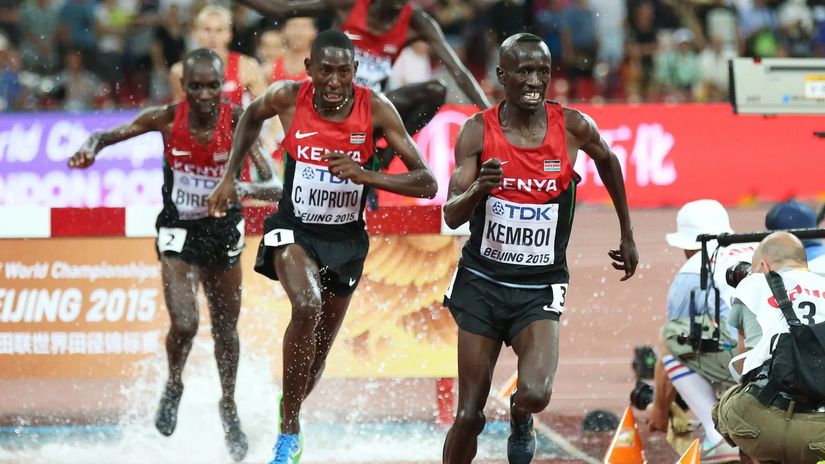
The history of Kenyan athletics would be incomplete without mentioning the Kenyan-born legends who have brought the country so much glory by dominating major 3000m steeplechase international events.
Like many track and field events, the steeplechase's origins can be traced back to the United Kingdom. Runners would often race each other from one town's church steeple to the next.
The steeples were chosen because they were easy to see from long distances, leading to the name "steeplechase." Despite having its origin in the UK, since 1968, the sport has been dominated by East Africans.
Ezekiel Kemboi, the undeniable champion of his time in the 3000m steeplechase, graced us with 15 years of unparalleled entertainment. After his retirement,that team has never been the same. Let's hope to have some to take over from Faith Kipyegon when she retires. pic.twitter.com/0OVSpgBaqs
— LazooJ (@Lazooj) August 22, 2023
Kenya did not compete in the 1976 and 1978 Olympics due to political reasons. Twenty-nine countries, including Kenya, boycotted the games due to the refusal of the International Olympic Committee (IOC) to ban New Zealand after the New Zealand national rugby union team had toured apartheid South Africa earlier in 1976.
Despite not participating in the two Olympic editions, from 1968 up to 2012, Kenya won 21 of the 30 medals available, with a clean sweep of gold medals. These medals have not been won by one or two individuals but by nine different men.
In 1968, Amos Biwott set the ball rolling, winning the 1968 Mexico Olympics. Biwott was the first of the many Kenyan runners to dominate the 3,000-metre steeplechase. His surprising win at the Mexico City Olympics presaged Kenyan dominance in distance running.

He had not only run three steeplechase races before the Olympics, and his technique was ungainly at best, but he was also the first man to have the courage not to place one foot on the barrier, as well as finish the race with completely dry feet.
After this golden moment, Biwott’s athletics career went slowly downward. He finished third at the 1970 Commonwealth Games, sixth at the 1972 Munich Olympics, and finished his career with an eighth place at the 1974 Commonwealth Games.
At the 1972 Munchen Olympics, legendary athlete Kipchoge Keino defied the odds to claim a gold medal, while Biwott came in sixth.
In 1984, after the boycott, Kenya came back with a bang, with Julius Korir setting a new world record to kickstart the momentum.
Conseslus Kipruto does it again for Kenya 🇰🇪 in the men’s 3000 meters steeplechase defending his world title in a dramatic photo finish #KenyanTraffic #WorldAthleticsChamps pic.twitter.com/TzJF0CAazy @citizentvkenya
— KenyanTraffic (@KenyanTraffic) October 5, 2019
Julius Kariuki went home with gold in the Seoul 1988 Olympics, while Matthew Birir emerged victorious in the Barcelona 1992 Olympics. It was in that event that the Kenyans swept the podium and hurdled to celebrate the sweet moment together.
Their fine form continued, and in the 1992 Barcelona Olympics, Joseph Keter outclassed the strong contingent to come out victorious. Reuben Kosgei dominated the Sydney 2000 Olympics; Ezekiel Kemboi won two golds in the Athens 2004 Olympics and the London 2012 Olympics; and Brimin Kipruto carried the day in the Beljing 2008 Olympics.
History also dates back to the likes of Wilson Boit Kipketer, who, still after retiring in 2001, entered the annals of his sport as only the second man in history to set outdoor world records at 3000m, 5000m, and the 3000m steeplechase—after fellow Kenyan Henry Rono. He was also the first man to run both sub-eight in the steeplechase and sub-13 in the 5000m.
The country would then relinquish its 3000m steeplechase world title at the World Championships (July 2022) in Oregon after Olympic champion Soufine El Bakkali dethroned Conseslus Kipruto in the men's title, while Celliphine Chespol faded to 13th place.
The standards of the country's once stronghold are now worrying, even as the Paris 2024 Olympics fast approaches.
Mozzart Sport caught up with various coaches who understood that the steeplechase field is a technical one that needs technique compared to other races on flat tracks.
Coaches Boniface Tiren and Alex Sang were all in a dilemma about what went wrong.
Veteran coach Tiren was well aware that nurturing steeplechase talent from an early age was a challenging task, compounded by the scarcity of suitable facilities in both primary and secondary schools.
“The event is introduced at the regional level, with the majority transitioning from the 1,500m and 5,000m to the seven-and-a-half lap event,” Tiren explained.
“The 3,000m steeplechase is a very technical event, which requires a very technical coach, especially at the introductory level. It is an event where one must develop courage, unlike in the 1,500m, 5,000 m, and even 10,000m. The athlete has to understand the risks involved, including hitting the barrier, falling, or colliding with other competitors at the water jump. One must attack the barrier and land in a good way,” Tiren offered.
The tactician further explained that steeplechase did not have progression into slower races like marathons. An athlete's career is likely to end after they retire from steeplechase. In the past, we have seen athletes shifting to slower races, with the likes of Faith Kipyegon even doubling up the 1,500 and 5,000 meters in Budapest.
“This race doesn’t have progression into the slower races like the 5,000m or 10,000m. Once you compete in the 3,000-meter steeplechase, that marks the end of you, unlike those in the 1,500-metre race, who can progress into slower races, including 10,000 m and road running. Kemboi and Jairus Birech tried to go into road races, but they did not succeed. But look at athletes like Ibrahim Hussein, who started in 800 meters, moved to steeplechase, and did well in the marathon. Legendary Kipchoge did well up to 10,000m but never went into the marathon, as well as Jipcho,” he said.

Former 800m runner Alex Sang, who is also a coach, revealed that steeplechase was a more technical game. Sang noted that the barriers are exhausting, and once the body is conditioned to jump over the barriers, it becomes difficult to compete in flat races.
“Let us just say steeplechase is a painful event. One must calculate well and run with his head. This is because one feels the ground whenever he or she is running, and it causes pain each time you land. Steeplechase runners apply more while competing compared to runners competing in a flat race. Barriers are very exhausting, and the body tends to get used to this kind of running,” Sang pointed out.
During the World Championships held in Budapest in August, all hopes were resting on the Kenyan trio of world record holder Beatrice Chepkoech, World Under-20 champion Faith Cherotich, and Commonwealth Games champion Jackline Chepkoech.
However, Team Kenya failed to reclaim the title but managed to impress by taking the second and third places. Bahrain’s Winfred Yavi won the race, as Chepkoech and youngster Cherotich finished second and third, respectively. Another Kenyan in the race was Jackline, who faded to finish ninth in 9:14.72.
In the men's category, Abraham Kibiwott finished on the podium in 8:11:98.
.jpg)