


.jpg)
Veteran swimming coach explains how Kenya can win more Olympic medals






.jpg)

Reading Time: 4min | Fri. 03.01.25. | 14:32
Kenya has not been a swimming powerhouse since the days of the Dunford brothers who made major headlines
Seasoned swimming coach Fakhry Manssour famously known as King Fakhry has shared valuable insights on how Kenya can secure more Olympic medals in the sport.
Kenya has not been a swimming powerhouse since the days of the Dunford brothers who made major headlines.
Jason Dunford was the first Kenyan swimmer to win an international medal after bagging gold in the 100m butterfly at the African Swimming Championships in Dakar, Senegal in 2006.

Dunford was one of the first two Kenyans, the other being his younger brother David, to ever qualify for the Olympics when they made it to the 2008 Beijing Summer Games. Before that, Kenyans went to the Olympics through wildcards.
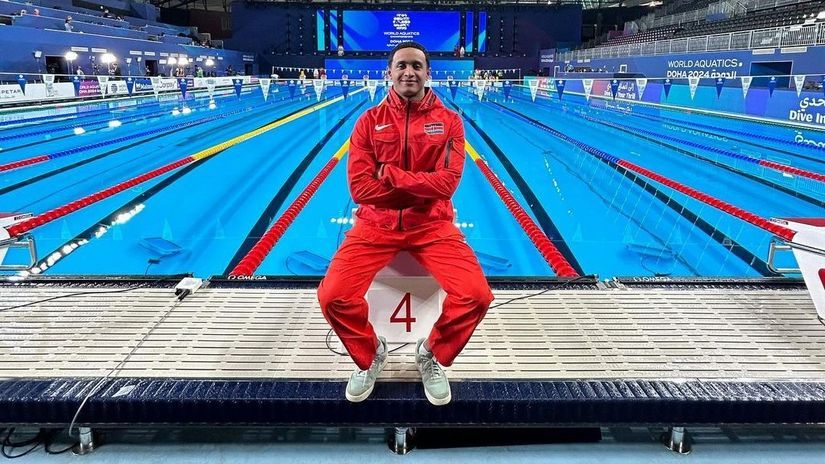
During the 2024 Paris Olympics, Kenya was represented by Ridhwan Abubakar from Mombasa County and Maria Brunlehner.
Abubakar, competing in the 400m freestyle was eliminated in the heats. That brought an end to his Olympic journey.
Brunlehner on the other hand finished third in her heat during the Olympics but missed out on a semi-final slot.
She took part in the women’s 50m freestyle event where she clocked 25.82 seconds for third place in the seventh heat. She needed to be among the 16 fastest swimmers to make it to the semi-final.
Speaking to Mozzart Sport, King Fakhry noted that early identification and development of talents is the way to go.

He believes by focusing on youth development, Kenya can cultivate the next generation of world-class athletes who are not only equipped with the right skills but also possess the mental toughness needed to excel in high-pressure environments.
“Honestly, work must be done. You do not start one year at the Olympics. It has to be a program where you start kids from a young age. The same way the Chinese, Americans, and Australians are doing.
They do not train for two or three years for a competition, they start as young as six years. That is why they have swimmers at the Olympics,” the tactician offered.
King Fakhry also reflected on the significant changes in the sport over the years.
One of the most notable changes is the improvement in training methods. Swimmers today have access to more advanced facilities, which provide a conducive environment for honing their skills.
With the aid of modern technology, training has become more precise, with tests and tools in place to track swimmers' progress and measure their improvement over time.
“In terms of technology, things have now changed. Training too. There are more facilities, and more tests to see swimmers improving their time.
Today, records have been broken and times have been lowered. This means that there is progress,” he revealed.
.jpg)
In addition to the training environment, Fakhry highlighted the improvements in coaching techniques. Swimmers now benefit from a deeper understanding of their sport and how to push their limits.
Equipment has also played a significant role in these advancements. Modern swimming gear, such as high-performance swimsuits and state-of-the-art training tools, has contributed to faster speeds in the pool.
Swimmers are now equipped with the best possible resources to help them perform at their peak.
“This is because the technique of coaching has become better. The equipment being used has improved. There is an improvement in the type of food people are eating today. People know what to eat. Some things like recovery training are a boost to swimmers,” Fakhry noted.
The former swimmer further addressed the financial challenges faced by swimmers in the country, noting that the sport is becoming increasingly expensive.
“To join a club you have to pay for membership, use the pool, and you have to pay the coaches. Swimming equipment is also expensive.
For you to progress, you have to move from the provisional level to levels like national, etc. You need money,” he concluded.
Manssor represented Kenya during the 1998 Africa Senior Championship in Kasarani where he won two bronze medals. He also competed in the 2005 Open Water Swimming Championships (5km and 10km) in Egypt.
In addition, he was Team Kenya's head coach during the Tokyo Olympics. Today, he coaches Aga Khan Academy and Bandari Swimming Club.
Manssour is the coach of Ridhwan Abubakar who represented Kenya at the Paris Olympics. He also coached Team Kenya during the Tokyo Olympics. The FINA Level 3 accredited coach is also an experienced swimmer who holds 15 national records.