


OPINION: How private investment will benefit WRC Safari Rally

.jpg)

Reading Time: 3min | Sun. 29.03.26. | 13:22
A privately funded rally introduces a level of financial discipline that can significantly reduce wastage and seal the loopholes that often exist in less tightly managed systems
On Sunday, 15 March, President William Ruto announced that the government would step back from funding the Safari Rally.
While for many this marked the end of an era, I view it as a possible beginning of a more sustainable and accountable future for one of Kenya’s most iconic sporting events.
For years, the Safari Rally, part of the prestigious World Rally Championship, has been a source of national pride, global attention, and economic activity.
Download our Mozzart Sport app for more news
But as with many state-funded ventures, questions around efficiency, accountability, and optimal use of resources have lingered in the background. The shift toward private sector control, therefore, seems more like a structural reset.
At its core, the private sector operates on a fundamentally different model from government. It is driven by results, sustained by performance, and scrutinised by stakeholders who demand value for money. In such an environment, every shilling must be justified. Waste is bad business.
And this is where the Safari Rally stands to benefit the most.
A privately funded rally introduces a level of financial discipline that can significantly reduce wastage and seal the loopholes that often exist in less tightly managed systems.
Budgeting becomes sharper, procurement processes more transparent, and execution timelines more predictable. The result is not just a well-run event but one that can consistently meet and even exceed, global standards.
Having served as an assistant route liaison during the 2024 edition of the Safari Rally, I witnessed firsthand the intricate planning and coordination required to deliver a successful rally.
Working under the experienced Anwar Sidi, who has since stepped down from the role, offered a deeper appreciation of the operational demands behind the scenes. From route mapping to stakeholder coordination, every detail matters, and even small inefficiencies can have ripple effects across the entire event.
It is from this vantage point that the idea of a more structured, efficiency-driven model becomes even more compelling. A system that minimises delays, streamlines decision-making, and prioritises accountability would not just ease operations; it would elevate the rally’s overall delivery.
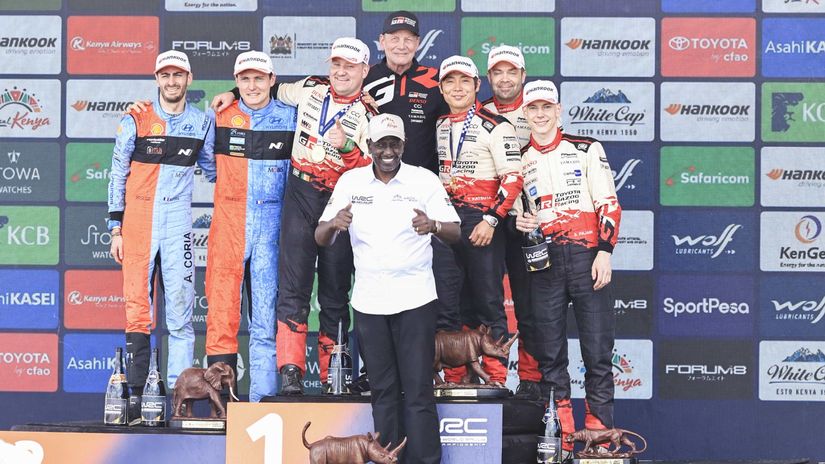
Take the 2026 edition as a case in point. The rally delivered high-level competition, with Takamoto Katsuta and Aaron Johnston of Toyota Gazoo Racing clinching victory. They were followed by Adrien Fourmaux and Alexandre Coria of Hyundai Shell Mobis, while Sami Pajari and Marko Salminen secured third for Toyota.
The competitive quality is already there; what remains is to match it with an equally world-class organisation behind the scenes.
Private investors, unlike public institutions, also have a vested interest in brand value. For them, the Safari Rally is a product. One that must attract sponsors, audiences, and global visibility. This naturally leads to better marketing, enhanced fan experiences, and stronger commercial partnerships.
Equally important is the government’s reasoning for stepping aside.
According to the president, the government is making a strategic pivot by reallocating funds toward grassroots sports and infrastructure.
If that happens, it would be a step forward for the country’s sports.
Investing in school sports and facilities builds a pipeline of talent that benefits the entire sporting ecosystem.
Of course, the transition will not be without its challenges. Private sector involvement must still be guided by strong regulatory oversight to ensure that commercial interests do not override the spirit of the sport. Accessibility, affordability, and national identity must remain central to the rally’s character.
But if managed well, this shift could strike the perfect balance of a world-class event run with private sector efficiency, supported by a government focused on building the future of Kenyan sport from the ground up.