

 T. Nashipae
Karate's evolution: From ancient Japan to Kenya's sports arena - unveiling the discipline, strength, and cultural impact




.jpg)



Reading Time: 3min | Wed. 10.01.24. | 12:41
Karate traces its roots to the Ryukyu Kingdom, an archipelago in Okinawa, Japan
Martial arts have captivated the human imagination for centuries, embodying discipline, strength, and grace.
Karate is a formidable and revered art form among the many martial arts practiced worldwide. With its origins deeply rooted in ancient Japan, karate has evolved over centuries, blending physical techniques with philosophical principles. In this blog, we will delve into the fascinating history, principles, and cultural significance of karate.
Origins and Historical Development
Karate traces its roots to the Ryukyu Kingdom, an archipelago in Okinawa, Japan. The martial arts emerged during political unrest and the Ryukyu Kingdom’s prohibition on weapons. To protect themselves, the inhabitants of the Ryukyu Islands developed unarmed self-defense techniques, which eventually evolved into Karate.
Chinese martial arts, especially Kung Fu, had a significant influence on the development of Karate. Chinese traders and emissaries brought their fighting techniques to Okinawa, where they intermingled with the local traditions, giving rise to the unique martial art known as Karate. Over time, Okinawa became a melting pot of various styles and techniques, leading to the birth of different Karate schools or styles.
Years later, the sport is fast taking shape in the Kenyan sports scene.
To determine the extent to which the sport has taken root in the country, Mozzart Sport caught up with Paul Kamau Macharia, a coach for the Nakuru-based Menengai Karate Club who also doubles up as a referee for the World Karate Federation.
According to the tactician, one of the core reasons he takes pride in coaching the sport is its impact on the players' character.
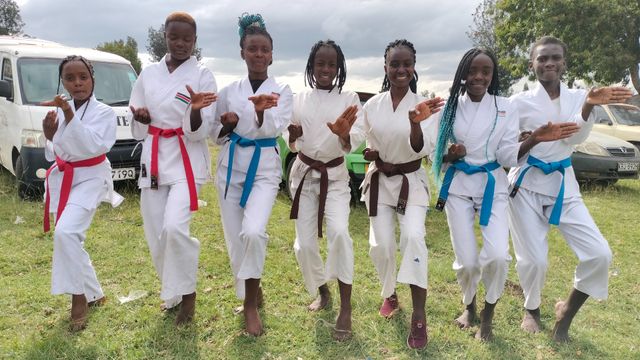
Coach Macharia explained that the core values of the sport are perfection of character, faithfulness, endeavor to excel, respect for others, and self-control.
"What motivates me to teach this sport is that it instills discipline in children. If you raise a child with those principles, they will grow to be kids of value," he told Mozzart Sport.
The gaffer was also excited by the government's support for the sport, but he decried the lack of finances for his team.
"So far, the government has been supporting Karate, and there is a team that flies for major championships. However, as a club, we have had financial challenges," he lamented.
Macharia was, however, optimistic that karate was fast taking shape in the country. He lauded the competency-based curriculum (CBC) for giving children room to engage in sports, noting that it would serve as a hotbed for talent.
"With Karate being introduced in schools, the future is bright. The CBC accommodates sports like Karate, and I am sure the kids will grow well," he averred.
The Menengai Karate Club was started in 2002 when interested players would train at the Menengai Social Hall. More than two decades later, the team has grown to accommodate hundreds of players. The team came in second at the inter-counties competition and took third place during the inter-clubs competition.
It is made up of kids from as little as five years of age to elderly people nearing 60 years.
In January 2023, Masinde Muliro University of Science and Technology (MMUST) played host to the National Inter-counties Karate Championships, with over 20 clubs taking part in the competitions. The competitions also doubled up as preliminaries for the National Playoffs for indoor games that were held at Meru University on 25th February 2023.
During the championships, Rongo University clinched the first position followed by Maseno University, and MMUST took the third position. They were followed by Kaimosi University in fourth position, Kibabii University, Kisii, and Jaramogi Oginga Odinga University.