


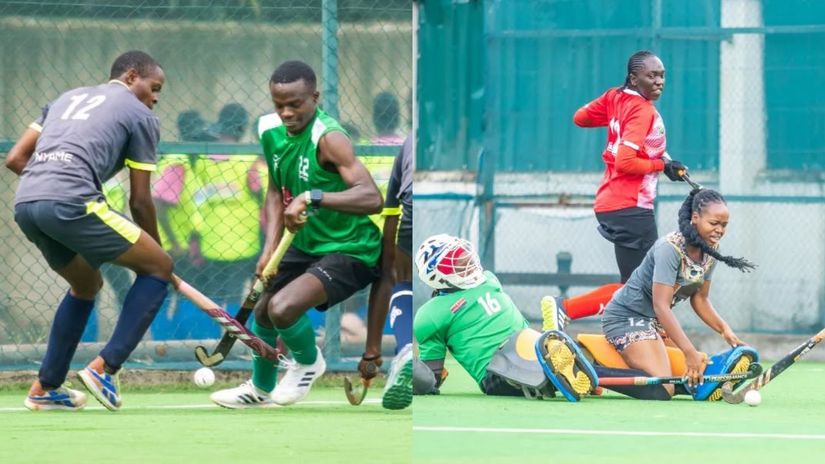
2025 Hockey Review: From tight league battles to elections and Africa Cup of Nations progress




.jpg)



Reading Time: 6min | Thu. 25.12.25. | 09:02
From intense league battles that carried into the Christmas break, to continental duty and long-awaited national governing body elections, the year painted a picture of a sport seeking stability while pushing for progress
Kenyan hockey in 2025 was defined less by silverware and more by process, a year that exposed long-standing structural challenges while simultaneously offering hope through youth development, governance renewal, and sustained competitiveness across domestic leagues and continental tournaments.
From intense league battles that carried into the Christmas break, to continental duty and long-awaited national governing body elections, the year painted a picture of a sport seeking stability while pushing for progress.
Domestic leagues: Tight races as season heads to a break
As the 2025 season entered the Christmas break, the Kenya Hockey Union (KHU) acknowledged the dedication and professionalism exhibited by clubs, athletes, technical officials, and supporters throughout the year.

The standings offered a clear snapshot of a campaign defined by tight races and sustained pressure at both ends of the table.
In the Men’s Premier League, Butali Warriors are leading the charge, with USIU-A staying close and Western Jaguars keeping themselves firmly in the hunt.
The Women’s Premier League saw Lakers shine at the top, with Blazers and USIU-A Ladies maintaining close pursuit.
The Men’s Super League is tightly contested by Kisumu Youngsters, Greensharks, and Parkroad Tigers, while in the Women’s Super League, UON Ladies dominated, with Wolverines pushing hard and Lakers B remaining competitive.
Across the men’s National Leagues, regional stories unfolded simultaneously. Rift Pirates impressed in the Central region, Mombasa Sports Club showed consistency in the East, and Kitale led in the West.
Africa Cup of Nations: Continental stage in Ismailia
October’s Hockey Africa Cup of Nations in Ismailia, Egypt, was one of the most significant continental engagements of the year, serving as Africa’s premier field hockey championship and doubling as the qualifier for the 2026 FIH Hockey World Cup.
𝐻𝑜𝑛𝑔𝑒𝑟𝑎 𝑡𝑜 𝑜𝑢𝑟 Kenya Hockey 𝑙𝑎𝑑𝑖𝑒𝑠 team, 🏒🇰🇪 𝑓𝑜𝑟 𝑎𝑛 𝑖𝑚𝑝𝑟𝑒𝑠𝑠𝑖𝑣𝑒 𝑟𝑢𝑛 𝑜𝑓 𝑟𝑒𝑠𝑢𝑙𝑡𝑠, 𝑔𝑒𝑡𝑡𝑖𝑛𝑔 𝑎 𝐵𝑟𝑜𝑛𝑧𝑒 𝑚𝑒𝑑𝑎𝑙 𝑎𝑡 𝑡ℎ𝑒 Africa Cup Of Nations 𝑖𝑛 𝐸𝑔𝑦𝑝𝑡.
— Badeqshop (@Badeqshop1) October 19, 2025
We are super proud of you 👏 🏒 https://t.co/AS1NJFDQoK pic.twitter.com/Jk5Vp9e0HN
South Africa ultimately dominated both tournaments, securing double gold and punching their tickets to the 2026 FIH Hockey World Cup in Belgium and the Netherlands.
The South African men defeated Egypt 5–1 in the final, capturing their eighth continental title, while the women reaffirmed their supremacy with a commanding 4–0 victory over Ghana.
For Kenya, the tournament delivered mixed results but also historic moments:
The men’s national team battled fiercely in the preliminary matches. After opening the tournament with a narrow defeat to hosts Egypt and a loss to South Africa, Kenya registered a notable comeback, winning 2-1 against Nigeria, with goals from Mathias Omwaka and Alex Taiswa.
Despite their spirited performances, Kenya fell short of the podium, eventually losing 3-1 in the bronze medal match to Nigeria.
The women’s national team produced one of the standout stories of the tournament. Kenya began with a solid 1–0 victory over Nigeria and followed it up with an emphatic 4–0 win against hosts Egypt.
They held defending champions South Africa to a goalless draw and finished the preliminary stages with seven points, well placed ahead of their rivals.
Kenya went on to win the bronze medal match against Nigeria 1–0 through a decisive goal by Grace Bwire, delivering a proud moment for the side on African soil.
While Kenya missed out on World Cup qualification, their performances, especially on the women’s side, reflected growing competitiveness and resilience. The team’s draw with South Africa and bronze medal finish will serve as confidence builders heading into future continental campaigns.
Junior Africa Cup: Lessons for the future
Earlier in the year, the Junior Africa Cup offered Kenya’s U21 teams an important competitive platform. The tournament revealed considerable talent and tactical application, even as it exposed gaps in preparation and transition strategies, particularly when compared to teams that benefit from more extensive training programs.
Kenya’s junior fixtures underscored the need for earlier and decentralised preparations, expanded talent identification, and formalised pathways from junior to senior levels, issues that stakeholders have flagged repeatedly.
Olympic ambition and high-performance support
One of the most consequential developments in Kenyan hockey in 2025 came in December, when the women’s National Hockey Team was awarded an International Olympic Committee (IOC) Scholarship worth approximately USD 50,000 (about Ksh6.4 million) under the Olympic Solidarity “LA 2028 Scholarship Programme.”
The award, presented by the National Olympic Committee of Kenya (NOC-K), is designed to underpin long-term high-performance preparations as the team embarks on its journey towards qualification for the Los Angeles 2028 Olympic Games, a historic aim for a squad that has never previously featured at the Olympics.
Unlike short-term grants tied only to individual events, this scholarship will run from January 2026 through to 2028, providing structured support throughout the entire Olympic cycle.
Kenya has a massive inline hockey community that gets almost no attention — even though hundreds show up to watch.
— Hockey Wrap Around (@HockWrapAround) December 22, 2025
That’s where the game grows next.
Full episode → https://t.co/GKqdaPyLen pic.twitter.com/OU4rKm5EN7
It aims to boost areas where Kenyan teams have historically faced shortfalls, including enhanced training camps, international competition exposure, coaching and technical development, athlete welfare and high-performance support systems.
The team’s receipt of this scholarship follows their bronze medal performance at the 2025 Africa Cup of Nations, one of their best continental showings in recent years and sets the stage for Kenya’s most ambitious Olympic campaign yet.
Grassroots Hockey: Development and Innovation
Away from elite competitions, grassroots hockey continued to be the backbone of the sport in Kenya. Hockey academies from across the country consistently delivered players ready for club and national selection, illustrating the value of long-term, structured development.

School hockey remained vibrant, institutions such as boys’ national champions Musingu High School, girls’ national champions Tigoi Girls, and East African champions St. Joseph’s Girls Kitale sustained competitive standards and reinforced the importance of school programs as foundational pipelines.
At the county level, the Mombasa County Hockey Association (MCHA) emerged as one of the year’s most innovative administrative units. Their Inter-Mtaa tournaments, Coast Hockey League, and expansion into Beach Hockey had tangible impacts, broadening participation and introducing new formats to local communities.
KHU Elections: A long-delayed reset
A defining governance milestone came in July 2025, when the KHU finally held its long-awaited national elections, three years after they were originally scheduled. Delegates elected a leadership team that blended continuity with cautious renewal:
President: Nahashon Randiek, Deputy President (Female): Elynah Shiveka, Deputy President (Male): Teddy Jhite, Secretary General: Wycliffe Ongori, Deputy Secretary General: Catherine Mulwa, Treasurer: Godfrey Bila, Deputy Treasurer: Francis Munyao Kisaingu, Match and Fixtures Secretary: Moses Majiwa, Deputy Match and Fixtures Secretary: Jane Nyamogo, Public Relations Officer: Kelvin Mwangi
Visibility, media, and fan engagement
One of the most encouraging trends in 2025 was the increased visibility of Kenyan hockey through digital platforms. Match updates, photography, short-form videos, and analytical content helped bring the sport closer to fans, particularly during domestic school and league competitions where mainstream media presence has historically been limited.
This shift highlighted the growing influence of independent media and content creators in shaping hockey narratives, while also signalling an opportunity for the federation and clubs to build stronger digital engagement strategies.
As 2025 draws to a close and the season pauses for the Christmas break, Kenyan hockey has found itself at a familiar crossroads.
The sport boasts passionate players, dedicated coaches, and resilient grassroots foundations. Yet challenges such as funding, facilities, international competitiveness, and cohesive governance execution remain pressing.
HERE WE GO! #TeamKenya 🇰🇪
— TeamKenya (@OlympicsKe) December 3, 2025
The National Olympic Committee of Kenya (NOC-K) has this afternoon awarded the Kenya Women’s National Hockey Team, the Blades, an IOC Scholarship worth USD 50,000, marking a major boost to the team’s high-performance preparations for the Los Angeles… pic.twitter.com/wyLltYHXl8
What 2025 ultimately delivered was clarity that domestic competitiveness must be matched by structural support, clarity that governance legitimacy is only meaningful when followed by measurable action and clarity that sustainable growth depends on deliberate planning, not chance.
If these lessons are turned into strategy and execution in 2026, this year may be remembered as the moment Kenyan hockey began aligning ambition with reality.