


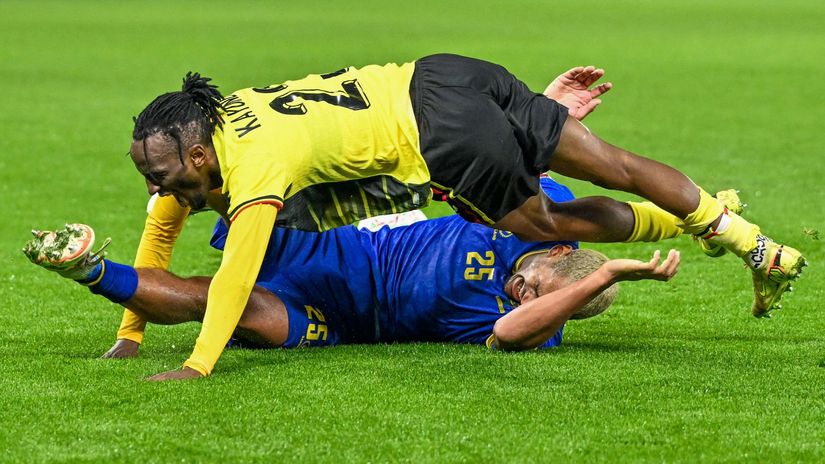
TACTICAL ANALYSIS: Uganda's stalemate against Tanzania in East African Derby epitomised a tactical chess battle






Reading Time: 6min | Sun. 28.12.25. | 15:55
In a derby defined by shapes shifting under pressure, the match epitomized East African football's evolution
At Rabat's Al Medina Stadium, where the echoes of East African rivalry reverberated through the stands, Uganda and Tanzania clashed in a pulsating Group C encounter that encapsulated the raw passion and tactical intrigue of the 2025 Africa Cup of Nations.
Dubbed the East African Derby, this 1-1 draw was no mere stalemate but a chess match of wits between managers Paul Put and Miguel Gamondi, where long balls clashed with structured build-ups, high presses evolved from passive setups, and late substitutions ignited dramatic shifts in momentum.
Follow our WhatsApp channel for more news
As fans from Kampala to Dar es Salaam held their breath, the game unfolded systemically, with early Ugandan dominance giving way to Tanzanian resilience, culminating in a missed penalty, heroic clearances, and a shared point that kept both nations' round of 16 qualification hopes alive.
What followed was a masterclass in adaptability, with both sides tweaking formations mid-game, exploiting flanks, and battling for midfield supremacy in a contest that highlighted the growing sophistication of East African football.
Paul Put's Uganda Cranes kicked off in a nominal 4-2-3-1 formation, designed for balance between defensive solidity and creative flair.
Denis Onyango anchored in goal, backed by right-back Kenneth Semakula, the marauding left-back Azizi Kayondo, and central defenders Jordan Obita and Toby Sibbick.
The double pivot of Baba Alhassan and Bobosi Byaruhanga provided screening and progression, allowing Travis Mutyaba to roam as the advanced midfielder between the lines.
The flanks were occupied by Allan Okello on the right and Rodgers Mato on the left, with Jude Ssemugabi as the lone striker, often drifting right to link with Okello.
In possession, Uganda fluidly transitioned into a 3-3-4/3-2-5 settled attack, with Kayondo pushing high on the left to provide width and crosses, while Okello cut inside from the right for penetrative movements.
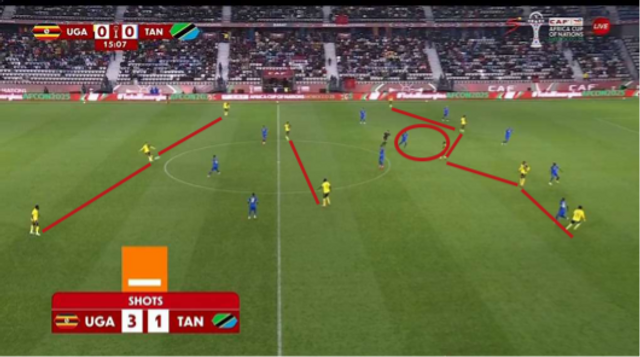 Uganda's fluid 3-3-4/3-2-5 in-possession shape in settled attack sees left-back Azizi Kayondo venturing high to occupy the last line, providing width and deliveries, while Travis Mutyaba or Allan Okello, one of them drops into pockets or half-spaces to link play and create central overloads
This shape emphasised proactive ball progression, blending central build-up with long balls over the top to Ssemugabi or Mato, who excelled in bringing down aerial deliveries and initiating quick transitions.
Their play revolved around intensity in the press, luring opponents into committing numbers before countering swiftly, and exploiting wide areas through Kayondo's bursting runs, which became a recurring pattern to deliver into the box.
.jpg)
Miguel Gamondi's Taifa Stars countered with a 4-3-3 setup, prioritising directness and wide threats.
Zuberi Masudi started in goal, protected by right-back Haji Mnoga, left-back Mohamed Mohamed, and centre-backs Ibrahim Hamad and Bakari Mwamnyeto.
The midfield featured Novatus Miroshi as the deep-lying anchor for defensive cover and build-up, Alphonce Msanga balancing progression and transitions, and Feisal Salum as the advanced playmaker drifting wide to link with wingers Tarryn Allarakhia (left) and Saimon Msuva (right), who frequently switched flanks. Kelvin John led the line as striker.
Out of possession, Tanzania adopted a 4-4-2 or 4-1-3-2 mid-block, compacting central spaces to deny Uganda's playmaker Mutyaba time on the ball, with Miroshi specifically tasked with tracking him.
Their style leaned on long balls to wide areas, bypassing midfield pressure, and high pressing triggers through John and Salum to disrupt Uganda's goalkeeper-involved build-up.
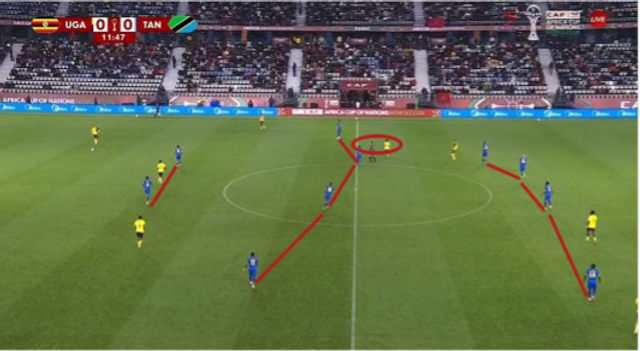 Tanzania's compact 4-4-2 out-of-possession mid-block features deep-lying pivot Novatus Miroshi tightly tracking Uganda's creative hub Travis Mutyaba between the lines, denying him time and space to receive and dictate play in dangerous central pockets
Patterns included Msuva's early pressure on Semakula to stifle right-flank progression, and combinations through Salum and Msuva on the left to create attacks, reflecting a principle of astuteness in defense while seeking opportunistic counters.
The first half showcased Uganda's tactical edge, as Put's side piled early pressure on Tanzania's build-up, forcing errors in their box through high-intensity upfront.
Uganda's 4-2-3-1 out of possession mid-block balanced compactness with proactive stepping, allowing them to regain possession centrally and transition via Mutyaba's deep drops to link play.
This adaptability neutralised Tanzania's initial reluctance to press high, baiting Onyango's distributions without engagement.
Uganda dominated through left-sided combinations, with Kayondo's overlaps and deliveries proving crucial, while long aerials over the top targeted Ssemugabi and Mato for duels, positioning Mutyaba or Okello to pounce on second balls and accelerate tempo into the attacking third.
Tanzania, in response, shifted from passive to active high pressing after the opening minutes, but their 4-4-2 out of possession struggled against Uganda's structured in-possession build-up, which created quality chances - Zuberi's outstanding saves kept the score level.
Gamondi's men relied on direct long balls and Msuva's flank switches, but Uganda's principles of proactive ball-winning and swift changes in rhythm made them the half's protagonists, highlighting Put's emphasis on fluid movements and link-up play on the left.
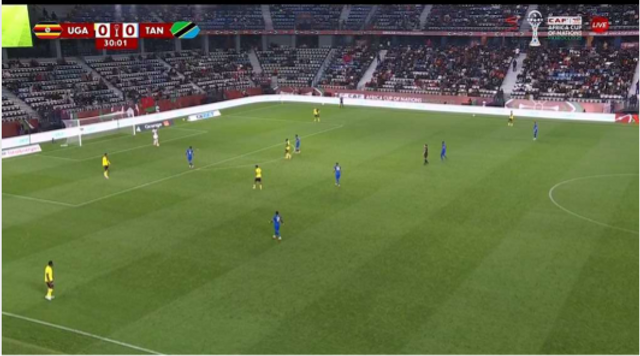
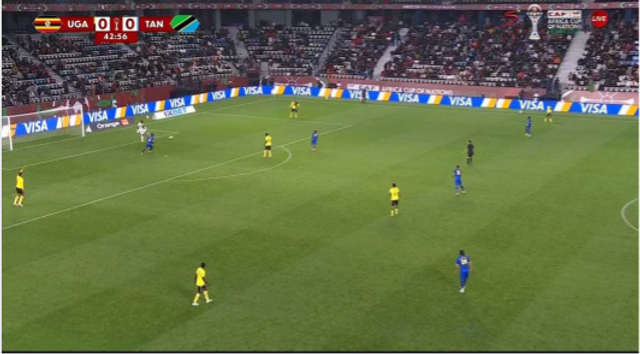 Tanzania activated a high press late in the first half, with Feisal Salum and Kelvin John leading the charge through aggressive shadow marking on Uganda's central midfielders, effectively denying access to pockets for structured build-up and forcing the Cranes into hurried long balls forward
Entering the second half, Tanzania emerged with renewed vigour, pushing higher to exert forward pressure and disrupt Uganda's rhythm - a clear adjustment from Gamondi to counter the first-half dominance.
This shift paid dividends in the 57th minute when a left-sided cross led to Alphonce's shot deflecting off Alhassan's hand, earning a penalty that Msuva converted in the 59th for his 23rd international goal, putting Tanzania 1-0 up.

Substitutions followed: Gamondi introduced Mbwana Samatta and Dickson Job for Allarakhia and John in the 64th, tweaking to a back-five with two strikers (Samatta and Msuva) upfront, emphasising defensive solidity while maintaining progressive intent to protect the lead.
This adaptability transformed Tanzania's out of possession into a deeper, more resilient block, defending set-pieces like Uganda's short corners effectively and transitioning via long balls to exploit spaces behind.
Put responded swiftly, substituting Dennis Omedi for Alhassan, shifting Okello centrally for added creativity and positioning Omedi on the right for width and depth.
Uganda bypassed midfield build-up with long balls to wide areas, aligning with their transitional principles but adapting to Tanzania's high push.
Further tweaks came in the 76th, with Uche Ikpeazu and James Bogere replacing Ssemugabi and Mutyaba for attacking thrust, injecting physicality and fresh legs upfront.
This managerial chess move restored parity in the 80th minute: Omedi's right-wing cross met Ikpeazu's brilliant header over Mwamnyeto, underscoring Uganda's pattern of exploiting flanks and aerial prowess.
Late drama ensued in the 87th when Mnoga fouled Bogere in the box, but Okello's 90th-minute penalty sailed over the bar - a missed opportunity reflecting pressure's toll.

Tanzania nearly snatched victory in the 92nd, with Mohamed's left-wing cross slipping past Onyango, only for Kayondo's clearance and Mmombwa's high finish to preserve the draw.
Gamondi's post-lead adjustments - fortifying the backline while probing progressively - demonstrated tactical prudence, but Uganda's relentless adaptability, from in possession fluidity to out of possession compactness, ensured they clawed back.
The match epitomised East African football's evolution: Put's Uganda blended intensity, wide patterns, and transitional speed with managerial tweaks for comeback resilience, while Gamondi's Tanzania evolved from direct long balls and mid-block defense to high-pressing aggression and defensive reinforcements.
In a derby defined by shapes shifting under pressure - Uganda's 3-3-4/3-2-5 in possession clashing with Tanzania's 4-4-2 out of possession, evolving into back-five tweaks - the 1-1 result masked a tactical symphony of principles like proactive pressing, central denial, and flank exploitation, leaving both sides wiser and more battle-hardened.
As Group C heads into its decisive final round of fixtures, Uganda and Tanzania each sit on a single point, their qualification hopes to the knockout stages hanging delicately in the balance yet burning brightly with belief.
Paul Put’s Cranes convinced they can pull off a shock against giants Nigeria, while Miguel Gamondi’s Taifa Stars carry the quiet confidence that an upset victory over Tunisia remains within reach, ensuring the East African rivals will approach their respective must-win encounters with renewed tactical clarity, fierce determination, and the knowledge that a place in the AFCON 2025 round of 16 is still very much theirs to seize.