


TACTICAL ANALYSIS: McCarthy's Harambee Stars masterclass against Lesotho



Reading Time: 7min | Mon. 08.06.26. | 18:17
Lesotho’s structural flaws at the back in low build up proved to be their undoing, as they lacked the structural discipline to cope with Kenya's wide rotations and high-intensity counter-pressing
Kenya secured a commanding 4-0 victory over Lesotho in their second friendly match that was defined by structural positional flexibility, lethal wide overloads, and high-intensity counter-pressing triggers.
Download our Mozzart Sport app for more news
Competing under heavy developmental and narrative stakes, the Harambee Stars delivered a tactical masterclass that exposed their opponents through calculated build-up baits and rapid, wide transitions.
Propelled by the clinical finishing of Mohamed Bajaber and a brace from substitute striker Lawrence Okoth, Kenya turned what promised to be a tight tactical chess match into a one-sided affair.
The contest began with two distinct tactical shapes acting as reference points for space control. Kenya lined up in a nominal 4-2-3-1 formation, featuring Brian Okoth in goal behind a centre-back pairing of Alphonce Omija and Deon Woodman.
Rooney Onyango operated as a hyper-aggressive right-back, while Stanley Wilson occupied the left-back role.
In the double pivot, Richard Odada acted as the deep-lying structural anchor alongside Kelly Madada, shielding advanced playmaker Austine Odhiambo.
.jpg)
The wide channels were occupied by Will Lenkupae on the right wing and Mohamed Bajaber on the left, both tasked with supporting central striker Micah Obiero.
Lesotho countered with a traditional 4-3-3 structure designed to maintain vertical lines. Sekhoane Moerane started between the sticks, protected by a back four of Kokerseo Kharajane at right-back, Mohlomi Makhetha and Thabo Makhele in central defense, and Tsepo Toloane at left-back.
The midfield engine room featured a trio of Thabo Mafatle, Tlotliso Mapola, and Lehlohonolo Fothoane, while the frontline relied on Neo Mokhachane and Tholang Makuru to provide width on the flanks, flanking central target-man Sera Motebang.
Lesotho initially approached the match utilising a man-oriented mid-block system designed to restrict central access through the middle of the pitch.
Their midfield trio closely tracked Kenya’s double pivot, attempting to compress the distance between their defensive and midfield lines to prevent Austine Odhiambo from turning in the pocket between the lines.
By matching Kenya's interior bodies, Lesotho intended to establish a central protective shield.
However, this man-oriented defensive logic became the core problem that Kenya later exploited.
Because Lesotho’s full-backs were tasked with tracking the inside movements of Kenya's wide players, they were consistently lured away from their wide zones.
Lesotho prioritised central protection, but their horizontal compactness left the wide channels highly exposed - a structural weakness that Kenya systematically stressed by manipulating the positioning of Lesotho's wide midfielders and full-backs.
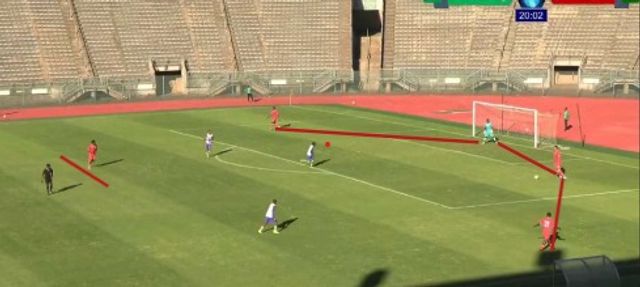
During the first half, Kenya’s build-up structure from the back was engineered to create an asymmetric launching pad.
The base structure took the shape of a 4-1 or a 3-1 variant, where goalkeeper Brian Okoth split the two centre-backs close to his own territory at around the six-yard box.
Stanley Wilson stayed deeper and narrower as a conservative left-back, creating a temporary three-man rest-defense floor alongside Omija and Woodman. This left Richard Odada as the lone, single pivot operating just in front of the back line.
This intentional asymmetry forced a severe tactical dilemma for Lesotho's defensive block. By keeping Wilson conservative, Kenya lured Lesotho’s right-winger high up the pitch.
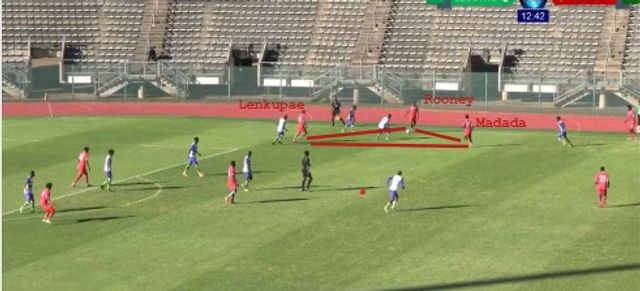
This movement acted as the trigger for Mohamed Bajaber and Rooney Onyango to bomb forward into aggressive positions on the flanks, where Rooney transformed himself into an auxiliary right-winger.
Simultaneously, Kelly Madada pushed higher into the half-space, creating an interior overload.
.jpg)
The rotation forced Lesotho’s left-back into a classic 2v1 underload, leaving him trapped between tracking Onyango's overlapping run or staying attached to the wide winger.
Kenya repeatedly punished Lesotho’s man-orientations by creating wide rondo-like triangles consisting of a central midfielder, a full-back, and a winger.
By circulating the ball into these areas, Kenya baited Lesotho’s full-back and tracking winger into a tight press, only to rapidly exploit the space vacated behind them.
The opening goal in the seventh minute served as the perfect case study for this pattern.
Kenya initiated an attack down the right flank, using a wide overload to drag Lesotho’s defensive line over.
With the defense heavily shifted, a precise cross from Micah Obiero was delivered toward the back post.
Mohamed Bajaber, executing an intelligent blind-side run, ghosted behind the tracking defender to convert cleanly at the far post.
Even when Lesotho managed to force turnovers by capitalising on occasional Kenyan mispasses at the back between the 15th and 18th minutes, Kenya's rest-defense structure - comprising three defenders and one sliding central midfielder - consistently delayed the counter-attack, forcing Lesotho into low-value, long diagonal balls that were easily snuffed out.
Kenya’s positional superiority was achieved through absolute domination of the wide areas and the half-spaces.
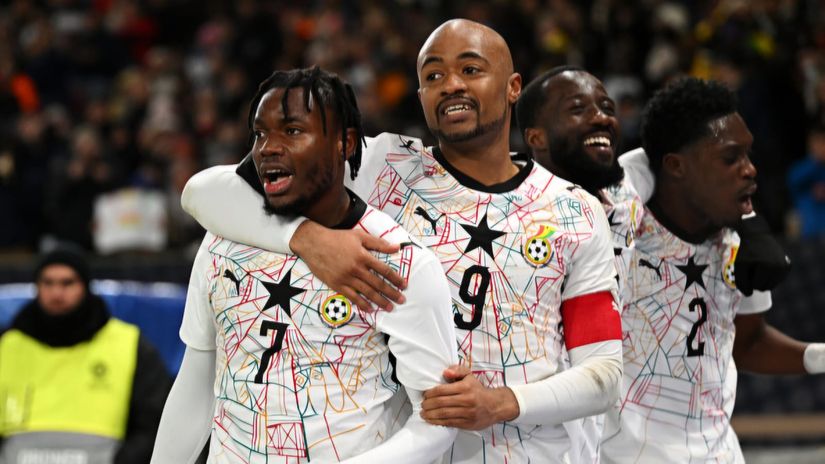
On the left flank, Kenya intentionally kept Mohamed Bajaber isolated as a high-value "rest attack" option.
The moment possession was recovered deep, the ball was instantly funnelled into the wide channel, allowing Bajaber to attack the opposition full-back in 1v1 isolation scenarios.
Furthermore, Kenya leveraged wide dead-ball situations to target specific zones inside the box.
During corner routines, playmaker Austine Odhiambo consistently targeted the near-post zone, utilising curved deliveries aimed at the first contact point of centre-backs Alphonce Omija/Deon Woodman.
By packing players into the half-spaces and forcing Lesotho’s defense to contract centrally, Kenya routinely opened up crossing avenues that bypassed the opponent's defensive cover.
Out of possession, Kenya deployed a highly intense 4-2-3-1/4-1-3-2 pressing shape that seamlessly morphed into a 4-4-2 mid-block once the initial line of engagement was established.
The frontline press did not jump man-to-man immediately; instead, the forward and advanced midfielder blocked the vertical passing lanes to Lesotho's pivots, forcing the opposing centre-backs to circulate the ball wide.
The pressing triggers were highly specific. The moment a pass travelled toward Lesotho’s full-backs, the nearest Kenyan winger would curve their run to shadow the touchline, cutting off the linear passing option.
This flank trap compelled Lesotho into launching rushed, long diagonal balls into wide areas, which were heavily dominated by the physical superiority of Omija and Woodman.
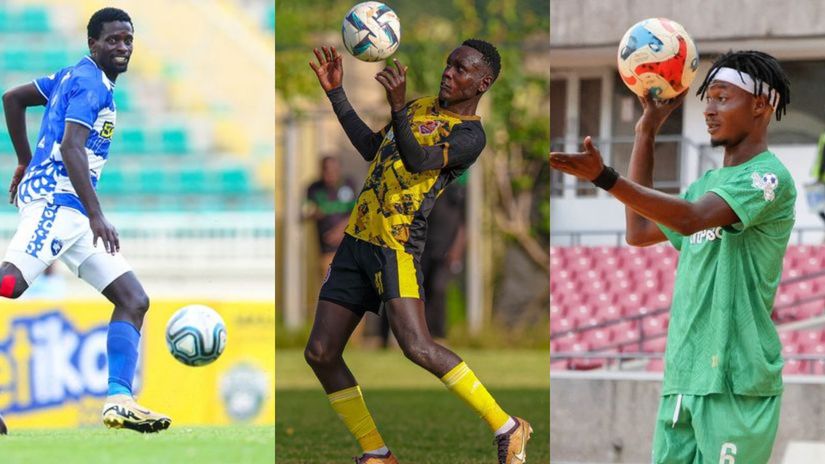
If Lesotho managed to bypass the initial wave, Kenya rapidly dropped behind the ball, restricting interior channels and protecting second-ball zones.
A crucial component of Kenya's four-goal victory was their impeccable counterpressure and rest-defense organisation, which essentially choked Lesotho’s transition potential.
Whenever possession was lost in the attacking third, Kenya’s closest players applied immediate pressure to the ball-carrier, while the remaining structural units squeezed the pitch vertically.
The centre-back pairing of Deon Woodman and Alphonce Omija remained highly disciplined, anchoring a rest-defense wall that stayed close to Lesotho's lone striker.
By preventing easy hold-up play, any clearance from Lesotho was immediately intercepted, allowing Kenya to sustain waves of continuous pressure and recycle possession before the opponent's defensive block could reset its lines.
The second half brought significant tactical adjustments that evolved the game state.
Kenya introduced Eric 'Marcelo' Ouma and Clarke Oduor for Kelly Madada and Stanley Wilson.
The build-up mechanics shifted into a more structured, symmetrical look: the goalkeeper split the centre-backs around the six-yard box inside the penalty zone, the full-backs stayed closer in proximity to the centre-backs to provide immediate passing options, and Richard Odada functioned as the deep pivot.
Kenya engaged in patient circulation of possession at the back, using short passes to bait Lesotho's press before exploiting the spaces opening behind them.
This baiting strategy yielded immediate results in the 51st minute.
Odada pushed high out of possession to aggressively trigger a press, forcing a loose backpass from a pressured Lesotho defender. Odhiambo intercepted, quickly feeding Bajaber, who scored his second.
Two minutes later, Lesotho's goalkeeper Sekhiane Moerane was red-carded, reducing them to ten men.
Following the dismissal, Odada began dropping frequently into the right-back slot, acting as a false fullback.
This adjustment allowed Rooney Onyango to push incredibly high as an outright winger, while Clarke Oduor took complete control as the main orchestrating conductor in front of the defense.
Even after making five changes in the 68th minute - introducing goalkeeper Caleb Kramer, striker Lawrence Okoth, and handing debuts to Sydney Agina and Heina Kamau - Kenya maintained absolute tactical consistency.
They retained their structured 4-4-2 mid-block when out of possession, ensuring that despite heavy personnel rotation, the defensive spacing remained intact.
With Lesotho down to ten men, Kenya’s deeper block prioritised clean ball circulation and game management.
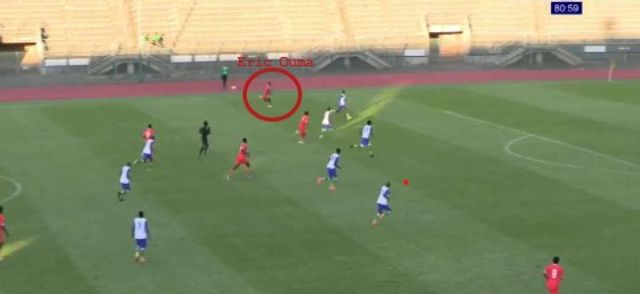
Eric Ouma provided massive width on the left flank, while the central defenders stepped forward aggressively whenever Lesotho attempted a rare direct transition.
This collective discipline prevented Kramer from facing any meaningful threats, successfully completing the defensive phase of the tactical story.
The final 20 minutes became an exercise in precise positional play and surgical penetration against a tired, understaffed low block.
Kenya’s patient circulation dragged Lesotho's remaining midfield units out of position, opening up the right and left half-spaces for their energetic substitutes to exploit.
In the 83rd minute, debutant right-back Sydney Agina drove aggressively into the right half-space, drawing two defenders toward him.
Agina then executed a brilliant, looped pass over the defensive line, finding Lawrence Okoth, who timed his run perfectly to smash home a precise shot.
Shortly after, Lawrence Okoth sealed the 4-0 scoreline by receiving a pass on the left flank, cutting sharply inside to expose a fractured defensive line, and unleashing a superb strike past the substitute goalkeeper.
Ultimately, Kenya’s 4-0 triumph over Lesotho was a triumph of superior tactical preparation and structural flexibility. By engineering wide overloads in the first half and executing patient, baiting possession patterns in the second, Kenya completely dictated the terms of the match.