


TACTICAL ANALYSIS: How Hossam can use Salah, Marmoush to end Egypt’s long wait for World Cup win


.jpg)
.jpg)

Reading Time: 5min | Mon. 08.06.26. | 10:18
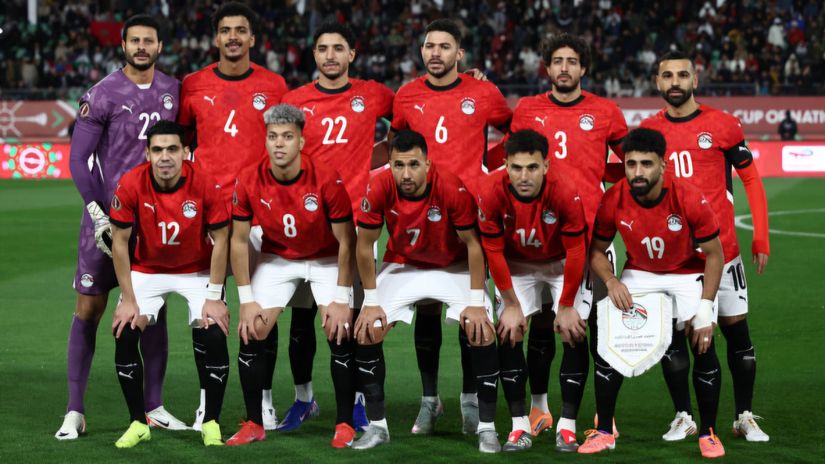
Drawn into Group G alongside Belgium, Iran, and New Zealand, Egypt's unbeaten qualifying campaign has fuelled immense local hope that they can finally break their historical tournament curse
Egypt enters the 2026 FIFA World Cup ranked 29th globally and fourth in Africa.
Coached by the legendary Hossam Hassan and captained by global icon Mohamed Salah, the Pharaohs are making their fourth World Cup appearance, fiercely determined to secure their first-ever tournament victory on the global stage.
Drawn into Group G alongside Belgium, Iran and New Zealand, Egypt's unbeaten qualifying campaign has fueled immense local hope that they can finally break their historical tournament curse.
Download Our MozzartSport App For More News
Egypt holds deep historical significance in international football, famously becoming the first African and Arab nation to qualify for a FIFA World Cup in 1934, where they lost a knockout match to Hungary 4-2.
However, their subsequent appearances have been historically sparse, spanning only two other tournaments: 1990 in Italy, where they secured notable group stage draws against the Netherlands (1-1) and the Republic of Ireland (0-0), and 2018 in Russia under Héctor Cúper, where they failed to earn a single point.
Overall, Egypt's historical World Cup record stands at 7 matches played: 0 wins, 2 draws, and 5 losses.
To conquer Group G, Hassan counts on a blend of elite European quality and battle-tested domestic talent.
The undeniable focal point is Salah, the nation's record goalscorer, who provides world-class pace, power, creativity, and match-winning individual brilliance from the right flank.
Leading the attack as a nominal striker is Omar Marmoush, who offers dynamic forward play and technical excellence.
At the same time, the experienced Trezeguet remains vital for building structured attacks down the left flank.
.jpg)
In possession, Egypt builds primarily from a 4-2-3-1 base but dynamically alters its shape depending on the phase of play to unleash its lethal front line.
During the initial phase of construction, the two centre-backs split close to the goalkeeper around the six-yard box.
To beat opposition pressing lines, Egypt utilises an asymmetrical double pivot:
● One central midfielder drops directly alongside the center-backs to create a fluid three-man backline.
● The second central midfielder stays positioned just in front of them, creating a distinct 3-1 low build-up structure as illustrated below;
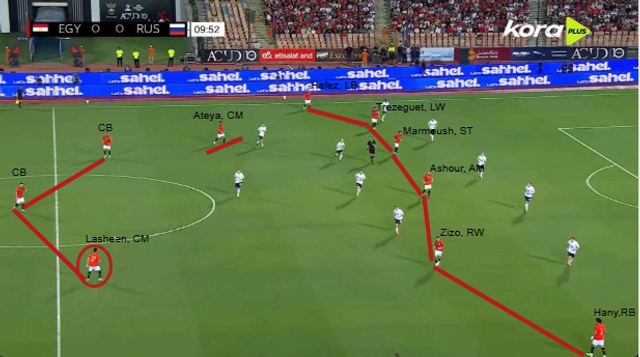
This numerical arrangement permits the full-backs – particularly on the left flank – to push significantly higher up the pitch to occupy the opposition's defensive line.
As the ball enters the opposition half, the structure evolves into an expansive 3-1-6 or 2-4-4 shape.
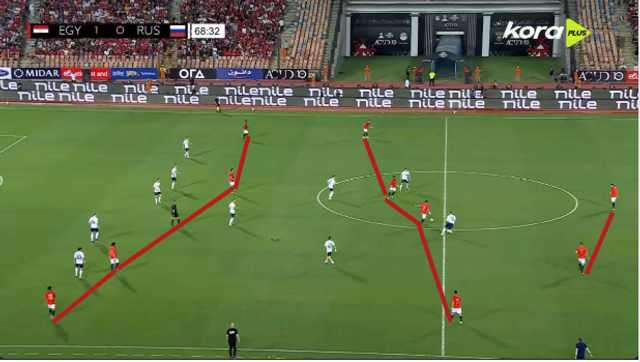
The full-backs push high to provide maximum width on the last line of attack, which forces the wide wingers (Salah and Trezeguet) to invert into the inside half-spaces.
Simultaneously, the advanced playmaker pushes vertically to join the central striker.
To break down low defensive blocks, Hassan introduces fluid positional rotations up front.
The winger will occasionally cycle into the striker position, the striker drops into space as an attacking midfielder and the attacking midfielder runs beyond as the primary forward.
This fluid interchangeability makes tracking markers incredibly difficult.
Alternatively, the two center-backs and two central midfielders form a rigid box structure at the back, anchoring a sustained six-man attack that overloads the opponent's penalty area with crosses targeting aerial threats.
This pattern proved successful in their recent friendly against Russia.
Defensively, Hassan's side prides itself on a tight defensive setup, having conceded only one open-play goal during their qualifying run.
They balance high-intensity pressing with disciplined zonal tracking.
When dropping into a settled defensive stance, Egypt organises into a compact 4-4-2 mid-block.
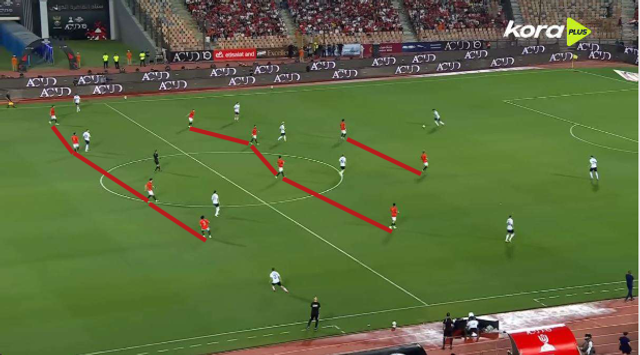
The absolute priority of this shape is to compress the space between the defensive and midfield lines, effectively denying the opposition access to central channels and interior progression lanes.
By choking the middle, they funnel all opposition attacks out wide.
Once the ball is forced wide, Egypt's defensive mechanics shift aggressively.
The wide wingers track back diligently to create defensive superiority, working in sync with full-backs to double-up on opposition wingers.
If under immense pressure in games, this mid-block can morph into a 5-4-1 deep block, with one of the central midfielders dropping completely into the defensive backline.
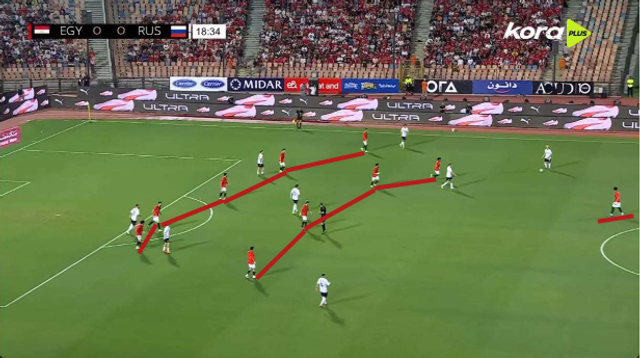
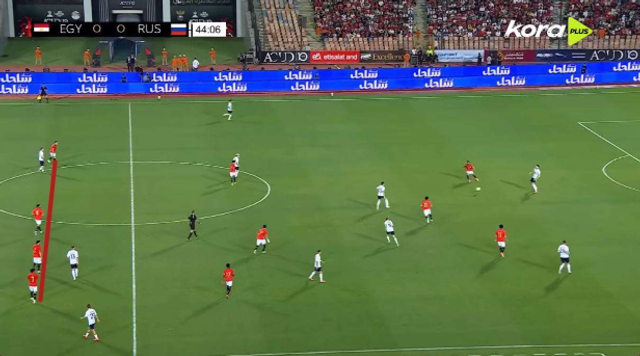
When opponents attempt to build low from the back, Egypt shifts into a high, aggressive man-oriented press, keeping their defensive line positioned near the halfway line.
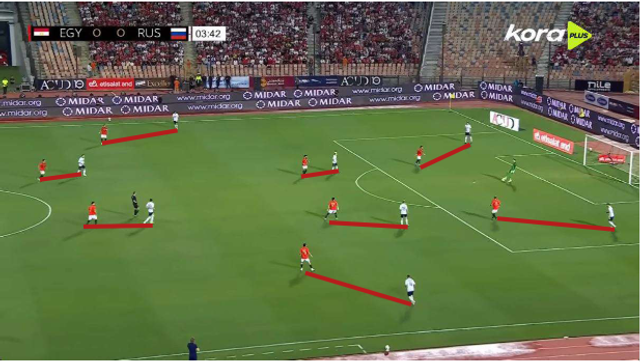
They utilize a offside trapping mechanism: as the opponent plays lateral passes across wide areas, Egypt's defensive unit slides over with heavy numbers on the ball-side, aggressively congesting the space against the touchline to force high-value turnovers close to the opponent's territory.
Egypt is fundamentally a lethal counter-attacking and transitional team.
Their primary tactical objective out of possession is to win the ball high, force turnovers, and launch immediate vertical breaks.
This directness is reflected in their statistical profile, scoring a high volume of goals following fewer than three passes.
They attack through immediate depth from wide areas, using quick vertical releases into space for the flying runs of Salah, Marmoush, and the likes of Trezeguet.

However, this high-reward style introduces specific risks. In the build-up phase, Egypt can suffer from large vertical distances between the defensive unit and the advancing attacking line.
If opponents successfully disrupt the 3-1/2-2 build-up, Egypt faces a high risk of turnovers in dangerous areas.
When under pressure, the team can become stuck passing backwards or forced into hitting speculative long balls.
Furthermore, because their full-backs step out aggressively to engage opposing wide players, savvy transitional teams can exploit the temporary defensive vacancies left behind them.
Hossam Hassan has engineered an Egyptian side that perfectly respects its modern footballing DNA: defensively solid, highly structured, and devastatingly direct.
By building a solid defensive platform that funnels opponents wide, they protect their box while setting the stage for their world-class transition threats.
If Salah and Marmoush can continue to punish teams on the break within this sophisticated framework, the Pharaohs are well-equipped to secure that elusive first World Cup victory and make a deep run into the knockout stages of the 2026 tournament.