


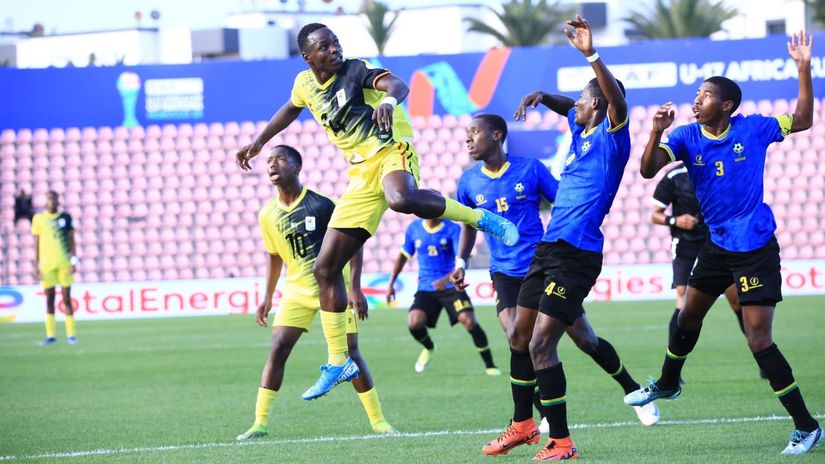
TACTICAL ANALYSIS: How Uganda's wing play delivered victory over 10-man Tanzania in U17 AFCON




.jpg)




Reading Time: 5min | Fri. 04.04.25. | 11:19
With both teams wounded from their opening fixtures, this match presented an opportunity for redemption
Uganda roared back to life from a humbling 5-0 defeat in their opening match to claim a resounding 3-0 victory over regional rivals Tanzania in their second Group B encounter at the U-17 Africa Cup of Nations in Morocco.
It was a battle of familiar foes, having previously clashed in the CECAFA Qualifiers final, where Uganda staged a comeback to win 2-1.
With both teams wounded from their opening fixtures, this match presented an opportunity for redemption. It was Uganda, under the guidance of Brian Ssenyondo, who seized the moment, overpowering their East African counterparts once again.

Tactical Setup and First-Half Analysis
Ssenyondo deployed a well-structured 4-2-3-1 formation, entrusting Adrian Mukwanga with goalkeeping duties. The defensive line featured Steven Oyirwoth and Jovan Mukisa as center-backs, flanked by fullbacks Elvis Torach on the right and John Owino on the left.
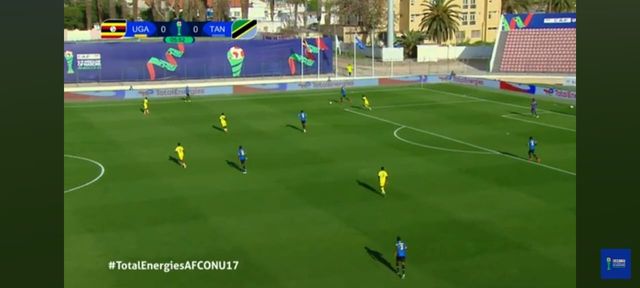
In midfield, Hamza Sengooba and Ashraf Kyakuwa operated as the double pivot, while Mulala Magala took on the central attacking role. The forward trio consisted of Simon Wanyama and Richard Okello on the wings, with James Bogere leading the attack.
Uganda’s game plan heavily leaned on wing play, aiming to exploit their superior pace and power to deliver early high crosses into the box. This approach saw Uganda physically dominate Tanzania in wide areas, forcing their opponents onto the back foot.
However, the final execution proved problematic, as Tanzania’s towering center-back pairing of Mohamed Makarani and Hussein Mbegu comfortably dealt with the aerial deliveries.
Recognizing the early struggles, Tanzanian head coach Aggrey Morris made an immediate adjustment, withdrawing right-back Athumani Kimate for Elick Yusuf. However, the change did little to stem Uganda’s dominance on the flanks, as the Cranes continued to pepper the box with crosses, albeit with limited success.

Uganda also sought to build from the back, with their center-backs splitting wide to facilitate progression. However, once they bypassed the first phase, they opted for direct balls into the striker, either to contest aerial duels or apply immediate pressure to regain possession in dangerous areas.
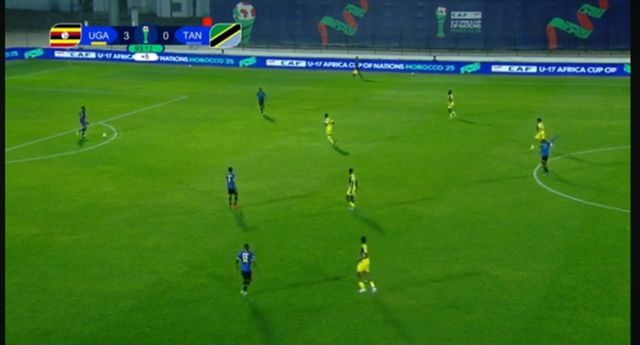
Defensively, Uganda transitioned between a 4-4-1-1 shape in settled play and an aggressive man-to-man press to disrupt Tanzania’s buildup.
Tanzania, despite enjoying 53% possession in their own 4-2-3-1 setup, struggled to break through Uganda’s defensive structure. Their approach relied on intricate midfield play to create openings, but Uganda’s disciplined press meant that most of their possession was sterile—retained in areas that posed no real threat.
As a result, Tanzanian forwards Josiah Samson, Idrisa Kilendemo, and Juma Sagwe were starved of service, reduced to chasing hopeful long balls and feeding off scraps. The statistical disparity was telling: despite having more of the ball, Tanzania only managed eight shots, compared to Uganda’s 22.
Second Half: Tactical Adjustments and Uganda’s Breakthrough
Both teams refrained from making halftime substitutions, choosing to stick to their initial strategies. However, Uganda subtly refined their approach, adding an extra dimension to their wing play.

Instead of solely relying on early high crosses, their wingers began to mix things up—alternating between crossing early, cutting inside to shoot, or driving to the byline for low-driven deliveries.
This variation unsettled the Tanzanian defense, which was more comfortable defending aerial balls than dealing with Uganda’s pace and agility in ground duels.
Bogere, in particular, thrived under this tactical shift. Operating primarily from the left flank, his close control at high speed tormented the Tanzanian defenders, forcing them into uncomfortable situations.
His influence reached a boiling point in the 57th minute when he drew a red card from Mbegu. Dribbling dangerously toward the box, Bogere was hacked down, and after a VAR review, the referee deemed it a clear goal-scoring opportunity, sending the Tanzanian defender off.
Down to ten men, Tanzania reshaped into a compact 4-4-1 formation, aiming to absorb pressure and hold out for a result. However, their resistance crumbled just four minutes later.
Bogere once again made the difference, outpacing his marker down the left wing before opting against a high cross. Instead, he intelligently cut the ball back into the box, where Wanyama arrived with precision, slotting it home for the opening goal in the 61st minute. It was a masterstroke from Ssenyondo, whose tactical shift had finally unlocked Tanzania’s defensive line.

Uganda’s second goal was almost a mirror image of the first, only this time from the right flank. Substitute Trevor Mubiri, fresh off the bench, delivered a low-driven cross into the danger zone. Bogere’s initial effort was parried by the goalkeeper, but Okello was alert to the rebound, firing into an empty net in the 85th minute to double Uganda’s lead.
The final nail in Tanzania’s coffin came in the dying minutes. Torach, instead of swinging in another expected cross from the right, surprised his marker by cutting inside and unleashing a shot. The effort struck Khamis Haji’s outstretched arm, leaving the referee with no choice but to point to the penalty spot. Bogere, fittingly the architect of Uganda’s dominance, stepped up and confidently dispatched the spot-kick to seal a comprehensive 3-0 victory.
A Tactical Triumph for Uganda
This match was a testament to Uganda’s adaptability and tactical flexibility. Ssenyondo’s ability to tweak his game plan mid-match proved crucial, as the shift from high crosses to dynamic wing play completely unbalanced Tanzania’s defensive structure.
The decision to mix early deliveries with incisive dribbles and low-driven crosses transformed Uganda’s attacking efficiency, while their disciplined pressing game neutralized Tanzania’s attempts at ball retention.
Tanzania, despite their possession advantage, were outclassed tactically. Their reluctance to adapt to Uganda’s evolving approach left them exposed, and once reduced to ten men, they had little response to Uganda’s relentless pressure.

For Uganda, this victory was more than just three points—it was a statement of resilience. After their humiliating opening defeat, they bounced back emphatically, restoring confidence and reigniting their campaign.
If they can build on this momentum and continue refining their tactical execution, they could just make the knockout stage.