


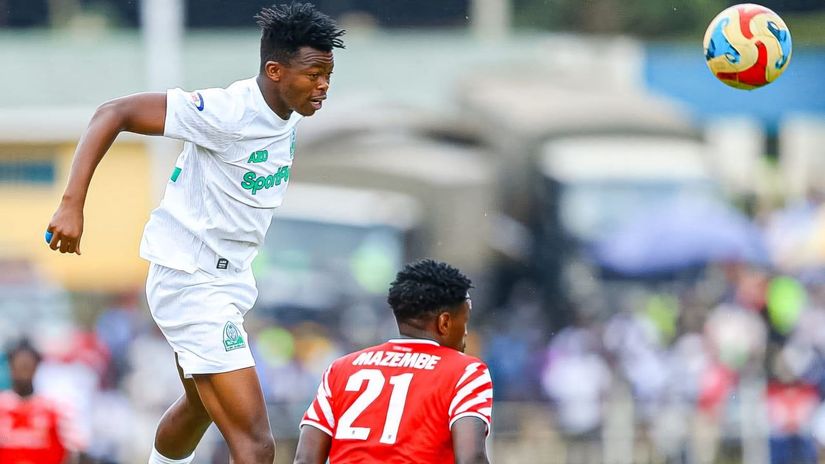
TACTICAL ANALYSIS: How Shabana neutralised Gor Mahia's game plan in barren stalemate

.jpg)
.jpg)
Reading Time: 5min | Mon. 12.01.26. | 20:07
This analysis explores how both teams’ base structures, pressing schemes, and in-game adaptations neutralised one another across the two halves
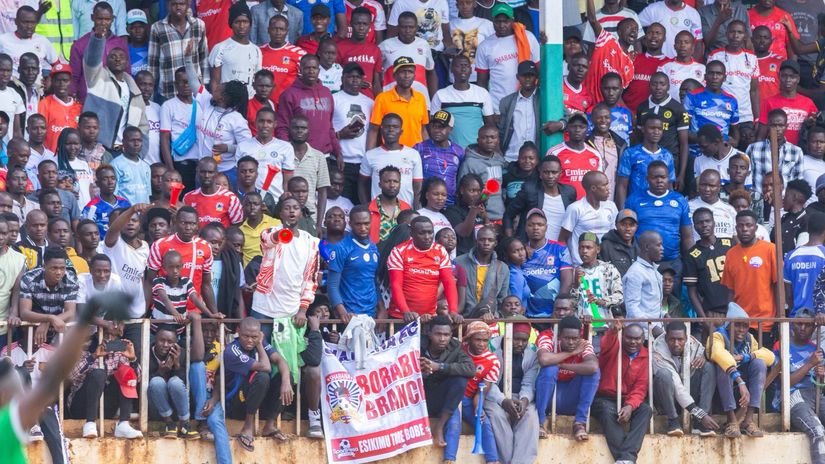
The highly anticipated Nyanza Derby, pitting Shabana FC against Gor Mahia, failed to spark as both teams settled for a barren stalemate in an FKF Premier League clash staged at Gusii Stadium on Sunday.
Follow our WhatsApp channel for more news
While Gor Mahia controlled possession and territory for large spells, Shabana’s organisation, aerial dominance, and selective pressing ensured the contest remained finely balanced.
Rather than a game of clear chances, this fixture unfolded as a tactical stalemate shaped by competing philosophies: Gor’s positional control and wide progression against Shabana’s directness, compactness, and transitional threat.
This analysis explores how both teams’ base structures, pressing schemes, and in-game adaptations neutralised one another across the two halves.
Shabana began the match in a 4-3-3 structure, with Stephen Ochieng protected by a back four of Victor Omondi, Mark Okola, Wycliffe Omondi, and James Mazembe.
In midfield, Kevin Omundi, Byron Otieno, and Derrick Otieno formed a physically robust trio tasked with contesting central duels and protecting second balls.
Humphrey Obina and Bronson Nsubuga occupied the wide lanes, frequently interchanging flanks to disrupt Gor’s defensive reference points, while Erick Otieno led the line as a fixed aerial and pressing reference.
Gor Mahia, by contrast, set up in a 4-2-3-1, with Gad Mathews in goal, fullbacks Paul Ochuoga and Bryton Anyona providing width, and a central defensive pairing of Mike Kibwage and Sylvester Owino.
Enock Morrison and Alpha Onyango operated as the double pivot, Ben Stanley played as the advanced midfielder, flanked by Samuel Kapen and Shariff Musa, with Felix Oluoch spearheading the attack.
Out of possession, Gor Mahia adopted a high, man-oriented pressing structure that often resembled a 4-2-3-1 or 4-4-2, depending on Stanley’s positioning.
Their intent was clear: force turnovers high and attack before Shabana could settle into a defensive block. Shabana, however, did not seek long spells of controlled build-up in the opening phases.
Instead, they frequently bypassed Gor’s first line by using direct restarts and early long balls aimed at Erick Otieno, attempting to establish territorial presence and win second balls.
This immediate verticality was a calculated response to Gor’s aggressive counter-pressing, reducing risk in the first phase while pulling the game into a more physical rhythm.
Gor Mahia’s primary attacking threat in the first half came from wide progression and set-piece situations. Shariff Musa on the left and Samuel Kapen on the right were heavily involved, with Kapen’s long throws providing an additional route into the Shabana box.
Felix Oluoch frequently drifted towards the right flank to combine with Kapen, creating situational overloads against Shabana’s left side.
However, Shabana’s fullbacks held their line well, denying space for early deliveries and forcing Gor into less dangerous crossing angles.
While Gor dominated possession - ending the half with 61% - their circulation rarely translated into central access or clean box entries.
A key mechanism in Gor’s attacking structure emerged midway through the first half, with Ben Stanley making overlapping and underlapping runs on the right side.
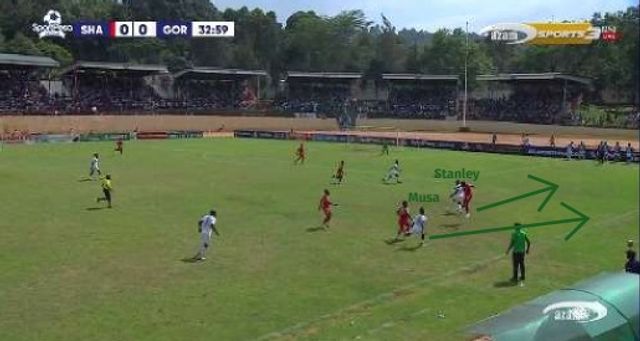
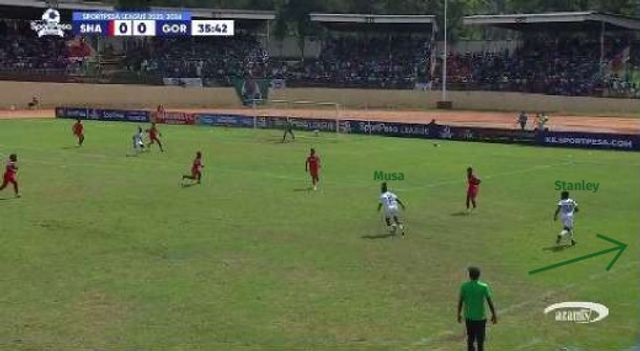 Stanley’s situational underlapping runs combine with Musa on the right flank to create numerical overloads
This movement allowed Shariff Musa to shift inside and deep, briefly opening interior lanes.
Yet these patterns were repeatedly disrupted by Shabana’s midfield compactness and willingness to engage in duels.
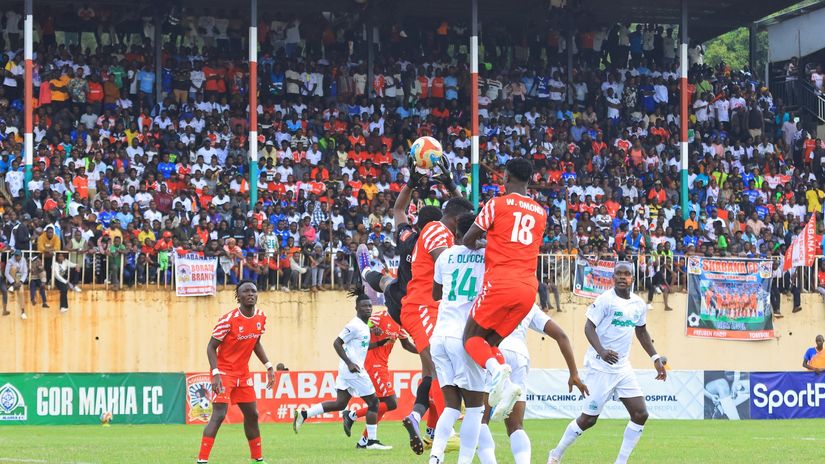
The game became increasingly fractured, with frequent fouls and stoppages preventing Gor from establishing a sustained attacking rhythm.
The only clear chance of the half came from a Morrison free-kick, underlining Gor’s reliance on dead-ball situations rather than open-play penetration.
From Shabana’s perspective, their pressing moments were selective but aggressive.
Erick Otieno led the press by jumping onto Gor’s centre-backs when triggers appeared, while the midfield three stepped up to close second balls rather than sustain a high block.
This hybrid approach - pressing to disrupt rather than to dominate possession - kept Gor at bay and prevented them from committing excessive numbers forward. The half ended goalless, reflecting a tactical balance rather than a lack of intent.
The second half introduced subtle but important structural changes. Shabana replaced Erick Otieno with Brian Michira, altering the midfield dynamics and allowing Bronson Nsubuga to operate more centrally between the lines as an attacking midfielder.
This adjustment gave Shabana a clearer reference point in Zone 14, particularly when Gor pushed their defensive line higher.
Gor’s high line, while useful for compressing space and sustaining pressure, also introduced vulnerability to balls played in behind - an area Shabana increasingly targeted.
Gor Mahia’s own structure evolved after Ben Stanley’s injury late in the first half. With Jackson Dwang introduced, Gor gradually shifted towards a single-pivot system in the latter stages, with Enock Morrison anchoring midfield while Alpha Onyango and Dwang advanced higher.
This gave Morrison greater responsibility in dictating tempo and switching play diagonally to the wings.
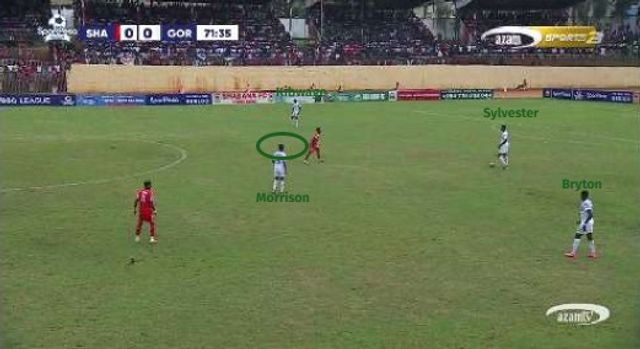
The intent was to stretch Shabana horizontally, especially as fatigue set in, but Shabana’s aerially dominant centre-backs continued to deal effectively with crosses into the box.
Shabana, meanwhile, leaned more heavily into wide progression and hybrid build-up.
They occasionally lured Gor forward through short circulation in the back line before releasing long diagonal passes into wide areas, targeting Michira on the left and Ezekiah Omuri on the right following further substitutions.
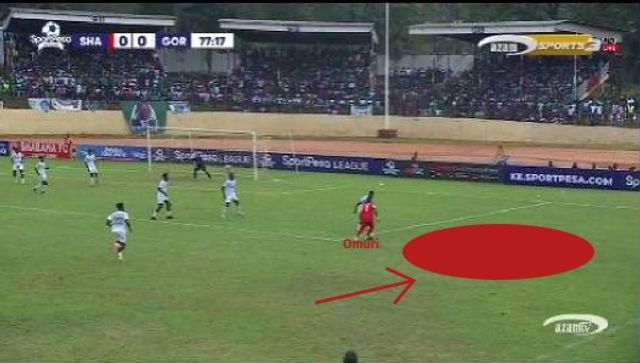
Victor Omondi’s withdrawal saw Humphrey Obina drop into the right-back role, maintaining defensive balance while still allowing overlapping runs when space appeared.
This approach nearly paid dividends in the 83rd minute, when Wycliffe Omondi narrowly missed from a near-post header after Nsubuga’s corner - arguably the clearest chance of the match.
In the final phase, both teams demonstrated strong rest-defence principles.
Gor, despite pushing numbers forward, ensured Morrison and the centre-backs remained close enough to counterpress immediately after losses.
Shabana, for their part, prioritised defensive security over late-game risk, ensuring midfield coverage behind wide attacks.
The result was a closing period marked by effort rather than incision, with neither side able to decisively break the other’s structure.
Ultimately, this match was a study in mutual constraint. Gor Mahia’s possession dominance and wide-oriented attacking patterns were blunted by Shabana’s compactness, aerial strength, and intelligent game management.
Shabana’s directness and transitional ideas, meanwhile, lacked the sustained support required to overwhelm Gor’s rest-defence.
The low xG nature of the contest accurately reflected the tactical balance on display.
Rather than a failure of attacking quality, this stalemate highlighted two teams executing their defensive and structural principles effectively, cancelling out each other’s strengths across all phases of play.