


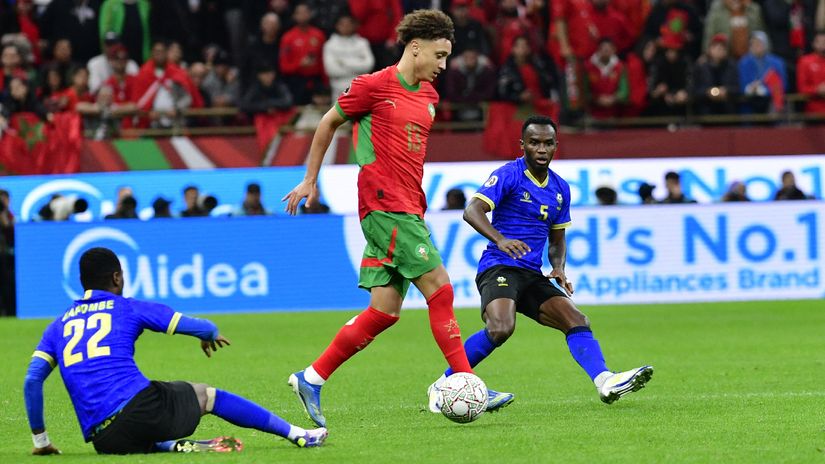
TACTICAL ANALYSIS: Tanzania's game plan that forced Morocco to labour for victory


.jpg)

.jpg)
.jpg)



Reading Time: 6min | Mon. 05.01.26. | 20:42
For the tournament hosts, this was a victory built not on brilliance alone, but on patience, structural superiority, and the gradual erosion of a brave and well-organised Tanzanian resistance
Morocco’s narrow 1-0 victory over Tanzania was not defined by flair in front of goal or a flurry of shots, but by structure, patience, and a gradual tactical squeezing of the contest until the breakthrough finally arrived.
Follow our WhatsApp channel for more news
On the surface, the scoreline suggests a routine win for one of Africa’s most technically gifted sides.
In reality, this was a deeply layered tactical encounter, one in which Tanzania’s organisation and transition threat repeatedly tested Morocco’s positional discipline, while Morocco’s dominance of the ball demanded constant structural adaptation to unlock a resilient opponent.
Morocco began the match in a 1-4-3-3 organisational structure, with Yassine Bounou anchoring the build-up from goal.
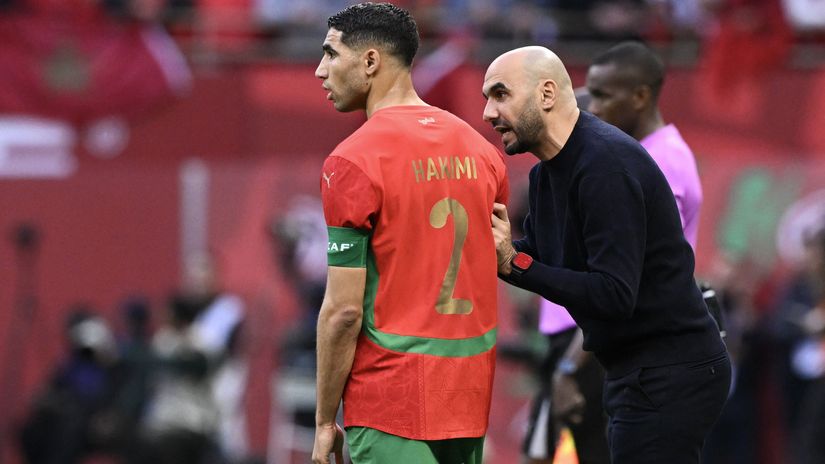
The back line was asymmetrical by design. Achraf Hakimi operated as a high and aggressive right back, often stepping into winger-like positions, while Noussair Mazraoui held a more measured role on the left, initially prioritising balance over constant forward thrusts.
Adam Masina and Nayef Aguerd formed the central defensive pairing, tasked with both circulating possession and managing Tanzania’s direct transitions.
In midfield, El Aynaoui sat as the deep pivot, providing stability and first-phase progression, while Bilal El Khannous and Abdelsamad Ezzalzouli rotated ahead of him, with Ezzalzouli frequently drifting wide left to function as a natural winger.
.jpg)
Ismael Saibari operated between the lines, often occupying the left half-space, Brahim Díaz started nominally on the right but drifted inside, and Ayoub El Kaabi led the line as a box-oriented striker.
Tanzania, under Miguel Gamondi, set up in a 1-3-4-3 that flexed impressively depending on game state.
Masalanga Hussein marshalled the goal, protected by a back three of Dickson Job, Mwamnyeto Bakari, and Ibrahim Hamad, which frequently dropped into a back five when defending deep.
The wing-backs, Haji Mnoga on the right and Hussein Mohamed on the left, were critical to Tanzania’s plan, asked to cover vast distances while providing width in transitions.
In central midfield, Novatus Miroshi and Alphonce Msanga balanced defensive screening with ball progression, while Feisal Salum was the creative fulcrum, operating between the lines to connect midfield to attack.
Up front, Suleiman Mwalimu and Simon Msuva played as mobile forwards, often splitting wide to exploit space behind Morocco’s advanced fullbacks.
The opening phase belonged to Tanzania in terms of intent and disruption. Morocco sought to impose control through high-intensity, man-oriented pressing and patient build-up through El Aynaoui, but Tanzania’s early aggression unsettled their rhythm.
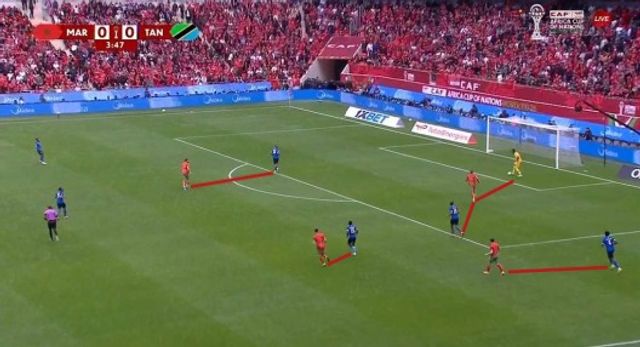 Morocco applied an aggressive, man-oriented high press early on to disrupt Tanzania’s build-up from the back
Feisal Salum was instrumental in this phase, repeatedly receiving on the half-turn during transitions and driving at Morocco’s back line.
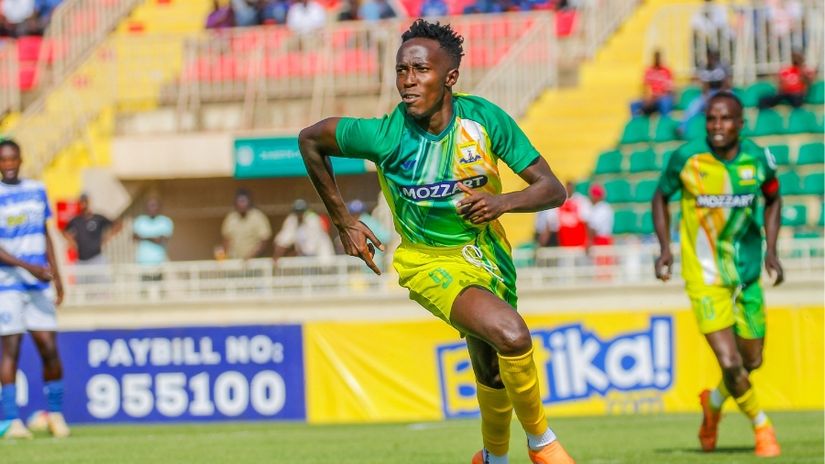
An early chance arrived when Msuva failed to convert from Suleiman’s right-sided transition pass, a moment that underlined Tanzania’s clear plan: attack the spaces vacated by Morocco’s high fullbacks, especially Hakimi.
Out of possession, Morocco alternated into a 4-1-4-1 mid-block, with El Aynaoui screening central lanes and Saibari and El Khannous stepping up to close interior spaces.
Tanzania, meanwhile, showed remarkable flexibility, shifting between a high 5-3-2 or 4-4-2 press and a deeper, compact block depending on Morocco’s ball speed and positioning.
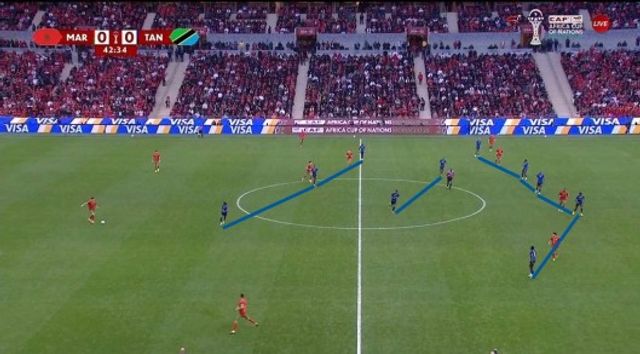 Tanzania dropped into a compact 5-3-2 out-of-possession block, closing interior channels and denying Morocco central progression.
Pressing triggers were clearly defined: lateral passes across Morocco’s back line or heavy touches in wide areas immediately invited pressure.
This disrupted Morocco’s low build-up and, at times, forced them into longer, less controlled passes.
One of Morocco’s key attacking mechanisms in the first half came down the right.
Brahim Díaz frequently vacated the wing to drop into central midfield pockets, drawing markers inside and opening a corridor for Hakimi to surge forward as a temporary winger.
These rotations created passing triangles involving Hakimi, Brahim, and El Khannous, aimed at exploiting third-man runs and breaking Tanzania’s compact lines.
However, Tanzania’s defensive discipline was excellent. Their block remained narrow and synchronised, closing central channels and forcing Morocco wide, where crosses were easier to defend.
Despite Morocco’s territorial dominance, clear chances were scarce.
A Saibari header from an Ezzalzouli free-kick in the 15th minute was ruled offside, but it signalled Morocco’s growing threat from set pieces and wide deliveries.
As the half wore on, the physical and tactical intensity increased.
Tanzania maintained structure without becoming passive, while Morocco gradually increased the tempo of their circulation.
Still, by the 40th minute, there had not been a single shot on target, a testament to Tanzania’s collective defensive effort and Morocco’s difficulty in breaking lines cleanly.
Late in the first half, Morocco began to adjust. Bilal El Khannous dropped deeper to form a midfield double pivot with El Aynaoui, allowing Mazraoui to advance more aggressively on the left.
Simultaneously, Morocco experimented with longer diagonal balls, particularly targeting Hakimi’s high and wide positioning.
The first half ended with Morocco holding 72% possession, Nayef Aguerd leading all players with 52 completed passes, and Ezzalzouli standing out statistically with chances created, duels won, and tackles, reflecting his two-way influence.
Tanzania’s Ibrahim Hamad, meanwhile, was outstanding at the heart of their defense, consistently stepping in to block, intercept, and organise.
The second half saw a clearer shift in Morocco’s attacking posture. Their shape in possession resembled a 4-3-3 that morphed into a 2-2-6, with the fullbacks and advanced midfielders pinning Tanzania deep and flooding the final third.
The left side became the primary focus, as Saibari and Ezzalzouli combined through overlaps and underlaps, aiming to destabilise Tanzania’s right flank.
Crosses became a major weapon, with Morocco repeatedly delivering balls into the box to target El Kaabi and the late-arriving midfielders. By the 62nd minute, Morocco had already attempted 18 crosses, highlighting both their persistence and Tanzania’s resistance.
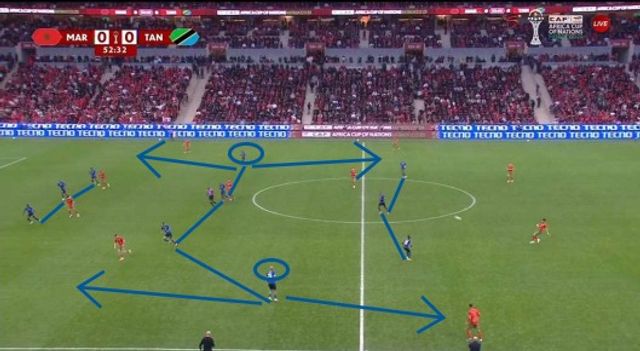 Tanzania remained committed to their 3-4-3 structure but increasingly relied on direct restarts from the goalkeeper, targeting Msuva as the focal point of their counter-attacks.
Tanzania’s 3-4-3 morphed into a 5-3-2 out-of-possession shape, with wing-backs Haji Mnoga on the right and Hussein Mohamed on the left stepping out aggressively to set the pressing triggers.
However, sustained defensive work began to take its toll. The decisive moment arrived in the 63rd minute when Hakimi, once again positioned wide on the right, slipped a pass into Brahim Díaz in the right half-space.
From a tight angle, Brahim finished clinically to give Morocco the lead, a goal born directly from the positional rotations and width overloads that had been building throughout the game.
![AFCON 2025: Brahim Diaz scores again as Morocco send Tanzania packing [VIDEO]](https://cdn3.mozzartsport.co.ke/upload/825x464/News/Image/2026_01/1767551680285_1000613698.jpg)
In response, Tanzania altered their approach. Mwalimu was replaced by Mbwana Samatta to add physical presence and goal threat, and a triple substitution soon followed, sacrificing a defender for an attacker and committing more bodies forward.
This introduced risk, but it was necessary given the state of the game. Morocco responded with like-for-like substitutions of their own, introducing En-Nesyri, Ben Seghir, and Salah Eddine to maintain intensity and structural balance rather than retreat.
Out of possession, Morocco shifted into a 4-2-3-1 mid-block, closing central progression lanes and forcing Tanzania wide, where their attacks were easier to contain.
The final stages saw Morocco manage the game intelligently, circulating possession, winning second balls, and denying Tanzania clear routes into dangerous areas.
By full-time, the numbers told a clear story. Morocco finished with 71% possession, four shots on target, and an xG of 1.01, while Tanzania managed just one shot on target and 0.39 xG.
Nayef Aguerd ended the match with 82 completed passes, Hakimi led all players in chances created, and Ezzalzouli topped the duel count, encapsulating Morocco’s blend of control, width, and intensity.
Ultimately, this was a victory built not on brilliance alone, but on patience, structural superiority, and the gradual erosion of a brave and well-organised Tanzanian resistance.