


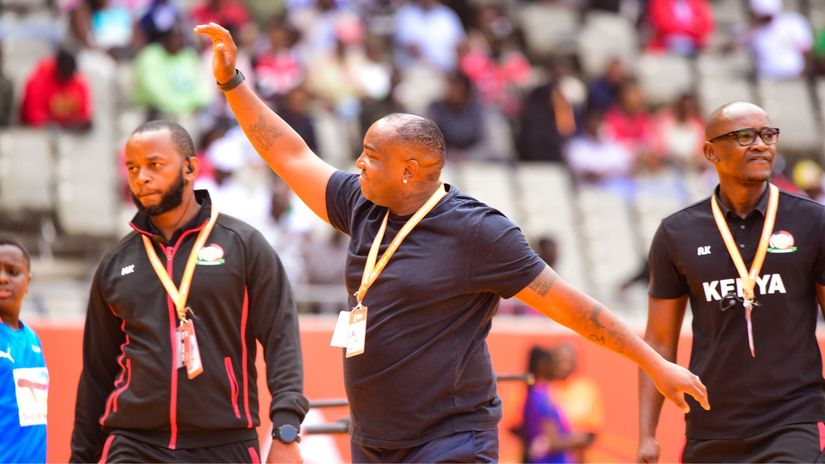
TACTICAL ANALYSIS: Breaking down McCarthy's Mourinho-inspired 'park the bus' against Morocco
.jpg)

Reading Time: 6min | Mon. 11.08.25. | 18:45
In a match that demanded both strategic clarity and mental resilience, Kenya delivered a masterclass in how to outthink and outfight a technically gifted opponent
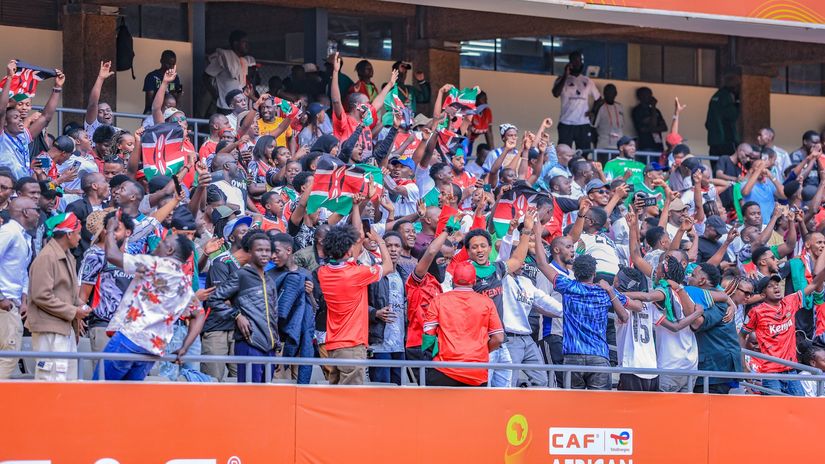
Kenya stunned African Nations Championship (CHAN) joint-record winners Morocco with a disciplined and tactically mature 1-0 victory at a packed Kasarani Stadium, edging closer to a quarter-finals berth.
Follow our WhatsApp channel for more news
The result was even more impressive given that Kenya played the entire second half with 10 men following Chrispine Erambo’s first-half red card.
Head coach Benni McCarthy, working with a base 4-2-3-1 system, made several changes to his starting XI, handing first tournament starts to Siraj Mohamed, Lewis Bandi, Mike Kibwage, and Ben Stanley Omondi.
The changes were not just about fresh legs as they brought different tactical attributes that shaped the entire approach.
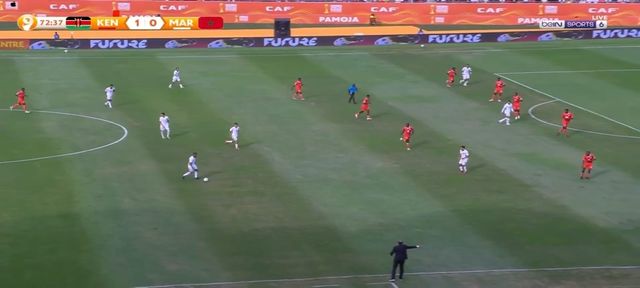
From kick-off, it was clear that McCarthy’s plan was to concede possession in non-threatening areas, keep the defensive block narrow, and hit on the counterattack.
Morocco, as expected, sought to dominate possession and circulate the ball centrally, but Kenya’s double pivot of Manzur Okwaro and Chrispine Erambo repeatedly cut off vertical passing lanes, forcing the North Africans into wide areas.
In possession, Kenya’s build-up was quick and direct, with Boniface Muchiri as the primary outlet. His pace and willingness to attack the Moroccan left-back created several early incursions.
Muchiri either delivered low crosses into the path of Ogam and arriving midfielders or took on direct shots from the edge of the box to test the goalkeeper.
Ogam’s role was equally vital in the first phase of pressure. When Kenya dropped out of possession, he joined Omondi to form the first line in a compact 4-4-2 defensive block, pressing whenever there was a backward pass or a poor first touch by the Moroccan centre-backs.
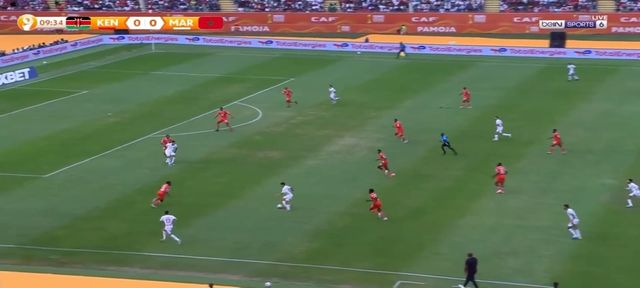
Kenya's Original 4-4-2 shape
Kenya’s defensive shape was a textbook example of mid-block organisation. The back four held a flat line while the midfield pivot screened aggressively, keeping Morocco away from zone 14, the most dangerous central attacking space.
Any Moroccan attempt to play between the lines was met with an immediate collapse of two or three Kenyan players, making forward progression risky.
Forcing Morocco wide was deliberate. Once the ball was shifted to the flanks, the Kenyan full-backs closed down quickly, supported by a near-side midfielder to prevent easy cut-backs.
The aerial presence of Kibwage and Owino meant that floated crosses were largely ineffective, while low deliveries were intercepted thanks to Okwaro’s anticipation in front of the box.
The match took a dramatic turn late in the first half when Chrispine Erambo was sent off after a reckless challenge. Losing a central midfielder could have destabilised the structure, but McCarthy reacted decisively.
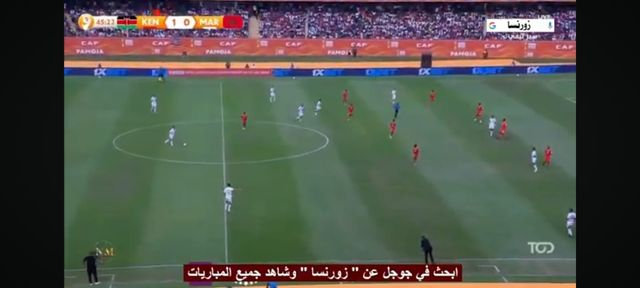
Kenya shifted into a 4-4-1 after the sending off of Erambo
Edward Omondi was sacrificed for Alpha Onyango, a more defensively disciplined midfielder. This ensured that Kenya could retain a double pivot to screen the defence even with reduced numbers.
The shape shifted to 4-4-1 without the ball, maintaining compactness while accepting that counterattacks would now be less frequent and more dependent on individual pace.
With Morocco intensifying their attacks in the second half, McCarthy made another tactical adjustment in the 64th minute. He introduced Alphonce Omija and David Sakwa for Boniface Muchiri and Ryan Ogam, changing the shape to 3-5-1.
Kenya's 5-3-1 with the introduction of Omija
Omija joined Kibwage and Owino in the back line, while Bandi and Siraj became wingbacks.
This adjustment, which McCarthy later credited to Portuguese manager Jose Mourinho from his FC Porto days, achieved two objectives.
It provided defensive width to prevent Morocco from isolating full-backs in one-on-one situations and created counterattack outlets through wingbacks who could carry the ball forward after regains, giving Sakwa an option to run in behind Morocco’s high defensive line.
In the defensive phase, the team dropped into a 5-3-1 block, further reducing space in the final third. Morocco’s attack became predictable, consisting mainly of crosses from advanced wide areas, which Kenya’s back three and goalkeeper dealt with comfortably.

In the 77th minute, McCarthy brought on Abud Omar and Daniel Sakari for the tiring Siraj Mohamed and Ben Stanley Omondi.
Omar’s experience and composure allowed him to retain possession under pressure, while Sakari added vertical athleticism in midfield to contest loose balls and close down Moroccan midfielders before they could turn.
By the final whistle, Kenya had six natural defenders among the nine outfield players, reflecting McCarthy’s clear intent to preserve the lead at all costs.
Manzur Okwaro: The Midfield Anchor
Manzur Okwaro’s role was central to Kenya’s defensive success. Operating as the deepest midfielder, he maintained positional discipline in front of the centre-backs, screening passing lanes into Morocco’s advanced midfielders and forwards.
His positional intelligence meant he was always in the right place to intercept diagonal switches or vertical through balls.
When Morocco overloaded the flanks, Okwaro shifted laterally to support the full-back or wingback, ensuring no two-versus-one situations occurred in dangerous areas.
In transition, he was calm under pressure, recycling possession when necessary rather than forcing low-percentage forward passes. This ball retention was crucial after the red card, allowing Kenya to reset their shape and draw Morocco into areas where they could be pressed safely.
Okwaro also demonstrated a strong understanding of defensive spacing, at times dropping into the backline to form a temporary back five, which gave centre-backs the freedom to step out and engage higher without leaving exploitable gaps.
His reading of the game, combined with disciplined movement and efficient distribution, made him arguably the unsung hero of the night.
Bryne Omondi: The Last Line of Defence
Harambee Stars goalkeeper Bryne Omondi played a decisive role in securing the victory. He made six crucial saves, each one denying Morocco the momentum they sought to build.
His command of the penalty area was exceptional, claiming four high balls with a perfect 100 per cent success rate, which completely neutralised Morocco’s aerial threat.
In addition, his seven runouts were all successful, showing his sharp decision-making and anticipation in cutting off through balls and sweeping up danger before Moroccan forwards could pounce.
These contributions were vital in a match where Kenya spent long periods without the ball, particularly after going down to 10 men. Omondi’s assured handling under pressure calmed the backline, while his quick distribution after regains helped launch rare counterattacks.
His presence and consistency gave the defence confidence to hold a deeper line, knowing they had reliable cover behind them.
Jose Mourinho-Inspired Performance
Kenya’s win was the product of tactical discipline, adaptability, and individual brilliance in key moments. McCarthy’s willingness to shift systems, drawing inspiration from his time under Mourinho, ensured that the team maintained defensive stability while posing a counterattacking threat.
Okwaro anchored the midfield with positional mastery, Bryne Omondi safeguarded the result with decisive interventions, and the entire side executed the game plan with remarkable unity.
In a match that demanded both strategic clarity and mental resilience, Kenya delivered a masterclass in how to outthink and outfight a technically gifted opponent.