


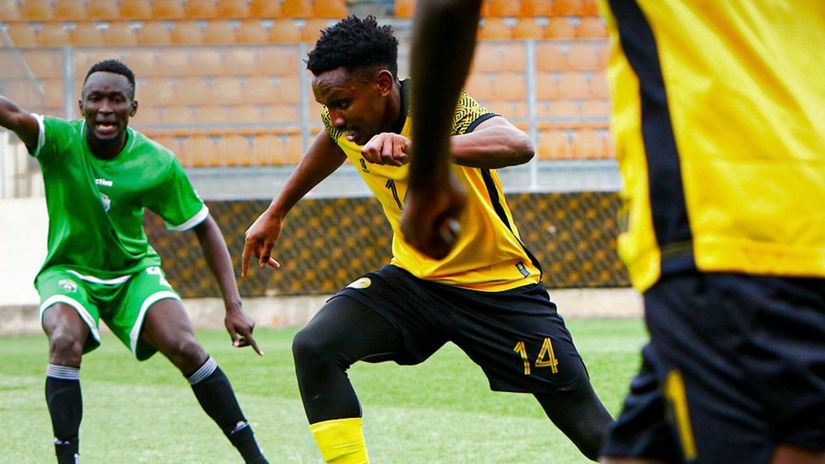
TACTICAL ANALYSIS: A look into Nairobi United's comeback against Sofapaka






Reading Time: 5min | Fri. 05.09.25. | 12:15
For both managers, the game provided critical insights into squad depth, structural strengths, and weaknesses that will shape their preparations for the competitive season ahead
The Elite Pre-Season Cup clash between Nairobi United and Sofapaka was a fascinating contest of tactical contrasts, shaped by aggressive pressing, calculated rest defense structures, and constant adaptation across both halves.
Follow our WhatsApp channel for more news
Batoto ba Mungu started on the front foot and struck first through Roy Okal’s penalty, but Naibois showcased resilience, tactical flexibility, and clinical use of substitutions to stage a comeback and secure a 3–1 victory.
Sofapaka’s Early Control: central progression and left-side overloads
From the opening minutes, Sofapaka dictated the rhythm with a patient build-up anchored by Roy Okal as the pivot. Their centre-backs, Charles Junior and Victor Odhiambo, alongside goalkeeper Edward Olak, initiated possession sequences before funnelling the ball through Okal, who switched play wide, particularly towards the left flank.
Left-back Michael Otieno provided consistent overlaps, combining with winger Adrian Oloo, who often dropped inside as an inverted forward.
This structure gave Sofapaka multiple attacking options. They were able to progress centrally through Okal, drawing Nairobi’s midfield press, while left-side overloads created situations where Adrian and Japheth Mzungu outnumbered Nairobi’s right-back.
In addition, direct long passes bypassed Nairobi’s high block, targeting the runs of Douglas Kibet and Joseph Kuloba behind the defensive line.
The strategy nearly paid off in the 28th minute, when Kuloba found himself 1v1 with Nairobi’s goalkeeper, only to squander the opportunity with a rushed finish.
Sofapaka’s ability to manipulate central and half-space channels was evident, but inefficiency in execution limited their lead to a single goal.
Nairobi’s Response: high block press and wide outlets
Out of possession, Nairobi deployed a 4-2-4 high block press, looking to disrupt Sofapaka’s central build-up and force turnovers.
They emphasised man marking at corners, with one defender stationed at the front post and another in the six-yard box to nullify aerial threats.
In possession, Nairobi’s attacking plan revolved around directness and wide exploitation. Michael Karamor was the focal point for long balls, either holding play or drifting wide to connect with fellow forwards.
On the right, full-back Adam Nyambane pushed high and rotated with midfielders to create overloads, while midfield triangles around Lesley Owino and Benard Ouma generated third-man combinations that linked defense to attack.
This blend of direct long passes and quick passing rotations gave Nairobi a balance between pragmatism and control. A notable passage of play in the 12th minute saw them execute rapid triangles through midfield, displacing Sofapaka’s lines.
Though they trailed after Okal’s penalty in the 41st minute, Nairobi had already established patterns that would become crucial later.
The Opening Goal: Sofapaka exploit the half-spaces
Sofapaka’s breakthrough came from their structured left-side overloads. In the 39th minute, Adrian dropped into the right half-space to receive the ball before slipping it to Kuloba, who dribbled inside the box and found Kibet. The forward was fouled, earning a penalty.
Okal stepped up and calmly converted, placing the ball low to the right in the 41st minute to give Sofapaka a 1–0 lead. The sequence highlighted Sofapaka’s fluidity: wide overloads transitioning into central penetration through half-spaces, with Adrian and Daniel Ng’ang’a instrumental as inside forwards from both wings.
Second Half: shifts in rest defense and transitional battles
The second half brought clear tactical adjustments. Sofapaka shifted into a 2+1 rest defense, protecting against counters while committing numbers forward. However, their directness increased, as they began bypassing midfield in search of quick transitions.
Nairobi, meanwhile, alternated between zonal and hybrid man-marking on set pieces. Centre-back Prince Bugerya often stepped aggressively out of the line to intercept and recycle possession, ensuring that Sofapaka could not sustain territorial dominance.
The early stages of the half were transitional, with both teams trading quick attacks. Nairobi sought to exploit Sofapaka’s high line through vertical passes and turnovers, while Sofapaka probed with long diagonals.
In the 58th minute, Shami Mwinyi Kibwana had a clear chance for Nairobi, but Olak intervened decisively. Moments later, Sofapaka nearly doubled their advantage when Kuloba again broke the high line, but his attempt was parried.
The Equaliser: central progression and wide exploitation
Nairobi’s persistence paid off in the 61st minute. Midfielder Enock Machaka orchestrated play with sharp central progression, combining with Lesley Owino before releasing him on the flank.
Owino finished with composure to restore parity at 1–1, rewarding Nairobi’s reliance on third-man combinations, half-space manipulation, and efficient wide passing triangles.
Sofapaka had a golden opportunity to retake the lead almost immediately. A handball by Nairobi’s Benard Ouma gifted them a second penalty, but this time Kevin Oduor was denied by a brilliant save, and Lenoxx Ogutu cleared the rebound.
That moment proved pivotal, with momentum shifting firmly toward Nairobi United.
The Impact of Substitutions: fresh legs, new shape
The defining moment of the match came in the 77th minute, when Nairobi introduced Charo Majaliwa, Frank Ouya, Ashraf Thaire, and Gideon Omondi, replacing key starters Shami Mwinyi, Chris Opondo, Lesley Owino, and Michael Karamor.

The changes completely transformed Nairobi’s structure and attacking thrust. Out of possession, they re-shaped into a 4-1-4-1, ensuring compactness and midfield protection. In possession, they shifted into a 4-3-3, with Ouya as the central target man.
Second-ball recoveries became vital, as Gideon and substitute Brian Magare (on for Machaka) pushed wide to collect aerial duels and drive transitions.
This injection of energy revitalised Nairobi’s attack, particularly through the flanks, where they now carried a far greater threat.
The Comeback: Gideon and Majaliwa seal it
The turnaround was completed in the 81st minute from a corner sequence. A loose ball fell to Ashraf, who dribbled past a marker before laying it off to Gideon.
The substitute struck low and decisively, putting Nairobi ahead 2–1 and underlining the success of the tactical gamble.
Sofapaka struggled to adapt. Their 4-1-3-2 defensive shape left them vulnerable in transitions, and their earlier advantage in wide overloads faded under Nairobi’s renewed intensity.
The game was sealed in the 90th minute when Majaliwa received possession on the right, drove into space, and unleashed a powerful strike from outside the box.
His goal encapsulated Nairobi’s superiority in the second half: direct wing play, dynamic dribbling, and clinical finishing.
Conclusion
This pre-season contest served as a valuable tactical exercise for both sides. Sofapaka showcased a structured build-up, fluid inside forwards, and dominance in left-side overloads, but inefficiency in front of goal and a missed penalty undermined their efforts.
Nairobi United, by contrast, demonstrated adaptability, resilience, and superior second-half game management.
From an early 1–0 deficit, Nairobi completed a 3–1 comeback, powered by tactical flexibility, smart substitutions, and clinical wide play.
For both managers, the game provided critical insights into squad depth, structural strengths, and weaknesses that will shape their preparations for the competitive season ahead.