


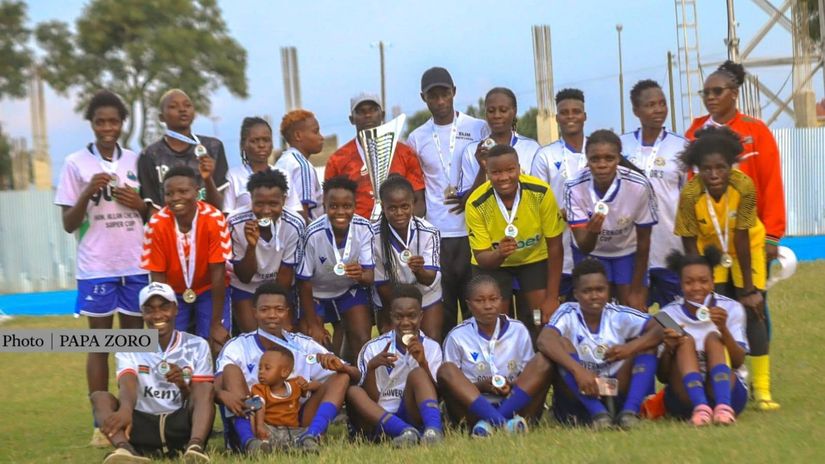
Why Elim White Ladies' historic promotion revives memories of Trans Nzoia Falcons







Reading Time: 6min | Tue. 16.06.26. | 10:01
Their promotion marks the return of league football to Kitale, a venue once dreaded by visiting teams when Trans Nzoia Falcons were at the peak
In football, clubs die and dreams disappear. Projects collapse under the weight of financial strain, poor administration and the unforgiving realities of modern sport.
But every so often, a football story refuses to end.It simply changes its name.
Download our Mozzart Sport App for more news
As White Ladies celebrate promotion to the FKF Women's Premier League, many- especially outside Trans Nzoia are asking a question that grows louder with every passing victory: are they, in many ways, the reincarnation of Trans Nzoia Falcons?
The answer is complicated.
Officially, they are different clubs. Different management structures. Different histories.
Yet on the pitch, where football's deepest truths are often revealed, the similarities are impossible to ignore.
A few years ago, Trans Nzoia Falcons were carrying the flag for women's football in the county.
They were tough, disciplined and fiercely competitive.
Opponents dreaded trips to Kitale. Falcons teams rarely possessed the biggest budgets or the most glamorous names, but they played with a grit that reflected the region itself. Then came the decline.
Financial struggles, administrative challenges and player welfare issues gradually pulled the club apart.
What had once been one of Kenya's most respected women's football institutions found itself fighting battles away from the pitch. Eventually, relegation followed.
For many football lovers in Trans Nzoia, it felt like the end of an era. But nature abhors a vacuum, and in football especially, it rarely lasts long.
As Falcons faded from the national spotlight, Elim White Ladies began their spirited ascent.

At first, few outside the county paid much attention. Women's football in Kenya is filled with ambitious projects attempting to climb the pyramid. Most struggle to sustain momentum. Elim was different.
There was a clear identity from the beginning. The team was organized, physically imposing and remarkably difficult to break down.
They pressed aggressively, defended collectively and attacked with purpose. Shabana Queens, overall champions of the Women’s Super League, couldn’t ward Elim off during their two league ties.
In Kisii in fact, the champions almost succumbed to the Trans Nzoia girls.
Before long, Elim were winning games. Then they started winning consistently.
Now, after overcoming Gor Mahia Queens in a promotion play-off, they are Premier League-bound.
For anyone who watched Trans Nzoia Falcons during their best years, there is an unmistakable sense of familiarity.
The intensity. The work ethic. The refusal to be intimidated and the overall belief that a team from western Kenya can compete with anybody.
For years, Falcons served as a launching pad for some of Kenya's finest female footballers.
Players who would later earn Harambee Starlets recognition helped establish the club as one of the country's most respected talent factories.
From Martha Amunyolete, Violet Wanyonyi, Ruth Ingosi, Tumaini Waliaula, the list is huge.
It is as if the football culture that once powered Falcons never truly disappeared. Instead, it found a new home.
Perhaps the strongest argument that Elim White Ladies are carrying forward the legacy of Trans Nzoia Falcons lies not in the badge, but in the players themselves.

For years, Falcons served as a launching pad for some of Kenya's finest female footballers.
The club produced players who would go on to represent the Harambee Starlets and compete at the highest level of the domestic game. Their success established Trans Nzoia as one of the country's most reliable talent factories.
Today, a new generation is emerging. Just as Falcons once built teams around fearless young footballers determined to make a name for themselves, Elim White Ladies are doing the same with players such as Sharon Mato, Monicah Naswa, Noel Oruko, Monica Etot and Ezrah Mandila.
Mato has become one of the most exciting midfield prospects in the region, combining pace and directness in a manner reminiscent of the fearless forwards who once wore Falcons colours.
Naswa's intelligence on the ball and ability to dictate play has made her one of the team's most influential performers throughout their promotion campaign.
.png)
Oruko and Etot have embodied the physical and competitive qualities that have long defined football in Trans Nzoia.
Both have developed reputations as players who thrive under pressure and are never afraid of the physical battles that often decide matches in the Women's National Super League.
Meanwhile, Mandila in goal represents the future. Young, ambitious and eager to learn, she belongs to a generation that has grown up hearing stories about Falcons while now creating its own memories with Elim.
The parallels are striking.
Where one generation looked up to Falcons legends, another now looks to the stars of Elim White Ladies.
The names have changed, but the journey remains remarkably familiar.
That continuity is perhaps the clearest sign that women's football in Trans Nzoia never disappeared. It simply evolved.
Falcons produced a generation that inspired a county. Elim White Ladies now have the opportunity to do exactly the same.
And perhaps that should not be surprising. Football clubs are more than badges and registration certificates.
They are communities, traditions and ideas passed from one generation to another. The same county that produced Falcons still produces talented footballers.

The same football-loving communities still fill touchlines. The same coaches continue to nurture young players.
What Elim White Ladies have achieved this season feels less like the creation of something entirely new and more like the continuation of a story that was interrupted.
Their promotion campaign has been built on many of the qualities that once defined Falcons.
They have been resilient in difficult moments, ruthless when opportunities appeared and remarkably consistent throughout the season.
But of course, one will find a few differences here and there. The danger in comparing them too closely with Falcons is that it risks overlooking the remarkable work that has brought them to this point.
Yet comparisons are inevitable because both clubs represent something bigger than football. They represent the resilience of women's sport in Trans Nzoia.
At a time when the collapse of Falcons could easily have discouraged an entire generation of players, another club emerged to keep the dream alive.
That may be Elim's greatest achievement. Not the wins. Not the clean sheets. Not even the promotion.
The greatest achievement may be proving that women's football in Trans Nzoia was never dependent on one club alone.
The spirit survived and it has returned to the biggest stage.
As Elim White Ladies prepare for life in the FKF Women's Premier League, new challenges await.

The competition will be tougher. Expectations will be higher. Every opponent will view the newcomers as an opportunity for points.
But if this season has shown anything, it is that writing off a team from Trans Nzoia is rarely a wise decision.
So, are Elim White Ladies the reincarnation of Trans Nzoia Falcons?
It's a margin call.

But in the way they fight, in the pride they carry and in the hope they have restored to football fans across the county, the connection is impossible to ignore.
Falcons may be gone. Yet their spirit appears to be flying once more.