


TACTICAL ANALYSIS: Understanding how DRC Congo frustrated star studded Portugal to secure historic draw
.jpeg)


Reading Time: 6min | Fri. 19.06.26. | 10:21
Portugal will reflect on missed opportunities and transitional vulnerability, while DR Congo will celebrate a landmark result built on collective discipline and tactical clarity
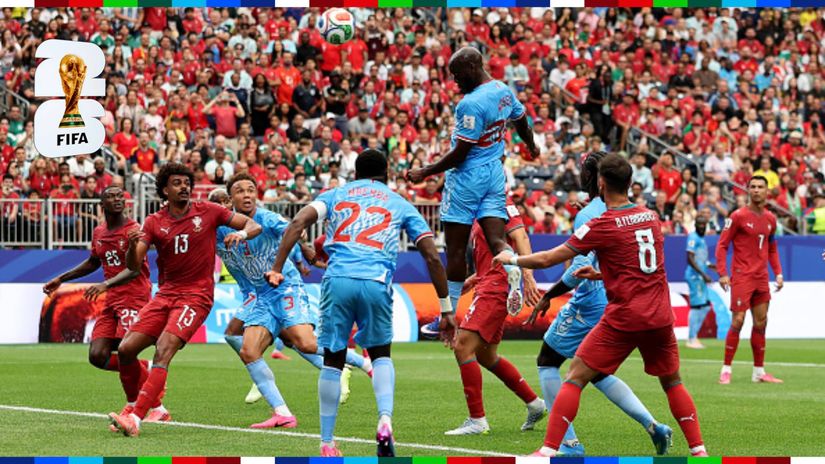
DR Congo earned a historic first-ever World Cup point in dramatic fashion as Yoane Wissa’s first-half stoppage-time equaliser cancelled out João Neves’ early opener to secure a 1-1 draw against Portugal at Houston Stadium.
Download Our MozzartSport App For More News
What was expected to be a controlled Portuguese victory instead turned into a frustrating evening defined by missed chances, structural imbalances in possession, and a disciplined, evolving defensive performance from Sebastien Desabre’s side.
Portugal dominated large phases of possession and territory but were repeatedly denied by DR Congo’s compact defensive structure and aggressive transitional threats.
Portugal began the match in a 4-3-3 structure, with Diogo Costa in goal, a back four of João Cancelo, António Silva, Tomas Araújo, Renato Veiga, and Nuno Mendes.

The midfield trio consisted of João Neves, Vitinha, and Bruno Fernandes, while Bernardo Silva operated from the right wing, Pedro Neto from the left, and Cristiano Ronaldo as the central striker.
In possession, Portugal often resembled a 3-2-5/3-1-6 structure, with Vitinha dropping between the center-backs to dictate tempo, Bruno Fernandes drifting into half-spaces, and Nuno Mendes pushing high on the left flank.
DR Congo, meanwhile, started in a 3-5-2 shape with Lionel Mpasi in goal and a back three of Chancel Mbemba, Axel Tuanzebe, and Kapuadi.
The wing-backs Arthur Masuaku and Aaron Wan-Bissaka provided width, while the midfield trio of Samuel Moutoussamy, Edo Kayembe, and Ngayel Mukau supported transitions.
Wissa operated just off striker Cédric Bakambu. Out of possession, however, DR Congo frequently morphed into a 5-3-2 or even 5-3-1-1, with extremely deep defensive positioning in the early stages to absorb Portuguese pressure.
Portugal sought structured territorial dominance through positional rotation, while DR Congo prioritised compactness, defensive absorption, and rapid vertical transitions.
DR Congo’s defensive identity was split into two clear phases. Initially, they operated in a deep 5-3-2 low block, often dropping into a 5-4-1 structure when necessary.
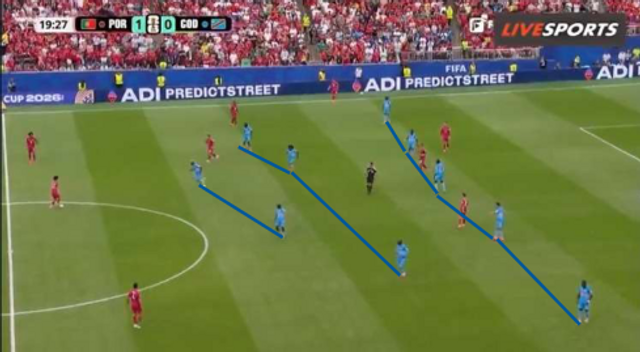
This compact shape prioritised central protection, forcing Portugal into wide circulation. The midfield line remained narrow and deep, reducing space between the lines and denying Bruno Fernandes and Vitinha progressive receiving angles.
However, DR Congo also introduced a man-oriented high press during Portugal’s build-up phases, particularly in the opening and post-hydration break phases. Wissa and Bakambu led the press by curving their runs to block central progression, while midfielders stepped onto Portuguese pivots when the ball entered midfield zones. The intention was clear: force Portugal wide, then collapse the trap using wing-backs and midfield shuttlers.
This duality - deep compact block with selective high pressing - was crucial. While the low block absorbed pressure, the high press disrupted rhythm, preventing Portugal from establishing clean sequences from the back.
Portugal’s build-up was heavily centred around Vitinha’s orchestration. In early phases, he frequently dropped between the centre-backs, forming a temporary back three that allowed João Cancelo and Nuno Mendes to push high. This created numerical superiority in first-phase circulation and allowed Portugal to progress into a stable 3-2/ 3-1 base.
Bruno Fernandes played a hybrid role, often drifting left to combine with Nuno Mendes, while João Neves provided vertical support in midfield. The intention was to create interior overloads and force DR Congo’s midfield three into constant lateral movement.
On the flanks, Pedro Neto and Bernardo Silva provided width and inside runs respectively. Neto’s role was particularly important, as he repeatedly delivered crosses into the box from advanced left-sided positions.
Portugal’s attacking structure therefore relied on width-to-infield transitions, aiming to stretch DR Congo’s back five before attacking central gaps.
However, despite sustained possession (including a dominant 64-pass sequence before the hydration break), Portugal often lacked penetration. DR Congo’s compact block prevented clean entry into central zones, forcing recycled possession and wide circulation.
Portugal controlled possession; DR Congo’s primary attacking weapon was transition play. The wing-backs were key, especially Masuaku on the left, who consistently provided early crosses and progressive wide outlets. DR Congo deliberately targeted wide zones, bypassing midfield congestion and attacking Portugal’s defensive rest structure before it could reset.
Kayembe and Mukau were instrumental in launching switches of play, especially towards Wan-Bissaka’s side, where DR Congo sought isolation scenarios. Bakambu also drifted wide to create overloads and open central lanes for Wissa’s runs.
This approach exposed Portugal’s vulnerability in defensive transitions, particularly when Cancelo and Nuno Mendes pushed high simultaneously.
DR Congo’s strategy was simple but effective: absorb pressure, then exploit the vacated wide channels with direct, vertical attacking sequences.
Portugal’s most persistent issue was their rest-defence structure. With both full-backs advancing and Vitinha dropping deep, Portugal often left space behind their midfield line during attacking phases. DR Congo exploited this by positioning Wissa between the lines, ready to attack second balls or loose defensive clearances.
Even though Portugal maintained a positional advantage in possession, their counter-rest structure lacked compactness. This allowed DR Congo to generate dangerous transitions, including Bakambu’s near-post effort in the first half.
The equalizer itself was a direct consequence of this structural weakness. Following a short corner, Masuaku delivered a deep cross into a destabilized Portuguese box. With Portugal’s defensive line retreating and unbalanced, Wissa found himself unmarked to power a header into the roof of the net.
The match was defined by a clear spatial contrast. Portugal dominated central possession zones but struggled to penetrate DR Congo’s compact mid-block. Zone 14 remained largely congested, with Bruno Fernandes frequently forced into wide or backward passes.
DR Congo, meanwhile, focused their attacking activity in wide zones, particularly through Masuaku’s crosses and Wan-Bissaka’s forward support. This created a direct wide-versus-central tactical contrast: Portugal controlled the middle, DR Congo exploited the edges.
Crucially, DR Congo’s equaliser originated from a wide-zone combination, reinforcing their strategy of bypassing central congestion entirely.
Portugal initially pressed in a 4-1-4-1 mid-block, with structured pressing lanes designed to funnel DR Congo wide.
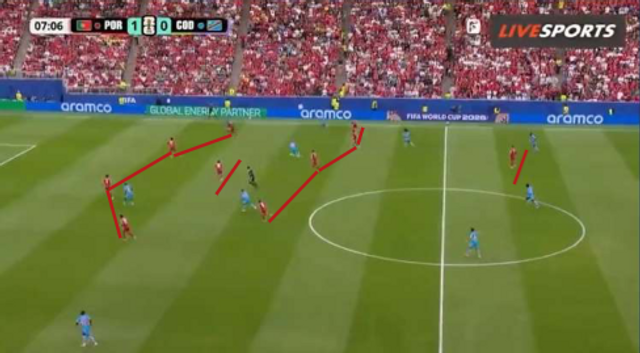
However, after the hydration break, DR Congo adjusted by pressing higher and more aggressively in Portugal’s half, disrupting their build-up rhythm.
DR Congo’s pressing shift forced Portugal into longer passes and reduced their ability to construct controlled sequences. This tactical adaptation was crucial in levelling the game’s momentum.
Portugal also evolved in response, becoming more aggressive in wing overloads. The introduction of Francisco Conceição added direct dribbling threat, while later substitutions of Leão and Semedo increased wide penetration. However, this shift came with increased risk, as Portugal’s defensive transitions became even more exposed.
Portugal’s rest-defence remained structurally fragile throughout. Despite numerical superiority in possession, they often left insufficient coverage behind the ball. DR Congo exploited this by maintaining forward options even when defending deep, particularly through Wissa and Bakambu.
DR Congo’s counterpressing was selective rather than constant. Instead of chasing possession immediately, they often dropped into a 5-3-1-1 mid-to-low block after losing the ball, prioritising shape over immediate recovery.
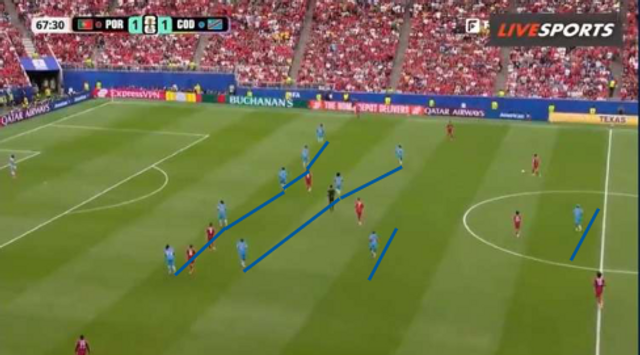
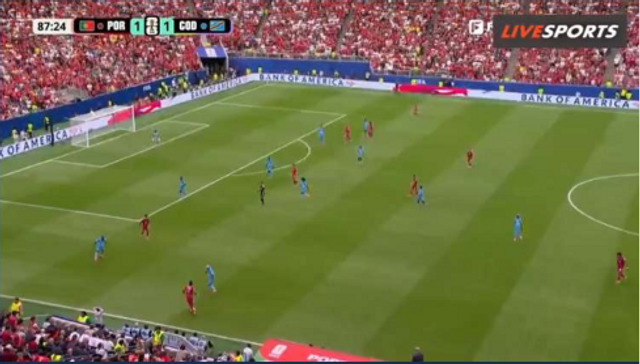
This allowed them to maintain defensive stability while still preparing for vertical transitions.
Portugal, in contrast, struggled to counterpress effectively after losing possession, allowing DR Congo occasional breathing space to reset and launch attacks.
The second half saw Portugal increase attacking intensity through structural adjustments. Bernardo Silva was replaced by Conceição, introducing more direct wing play. Portugal shifted toward wider overloads, third-man runs, and cutback-driven attacks.
However, while these adjustments improved penetration, they also increased vulnerability in transition. DR Congo responded by reinforcing their compact block and introducing fresh midfield legs through Sadiki and later Pickel and Joris Kayembe.
Portugal’s disallowed Cancelo goal highlighted their improved attacking mechanics - deep passes, midfield flicks, and late box entries - but inefficiency in finishing remained a recurring issue, with Ronaldo notably missing two key chances.
DR Congo, meanwhile, maintained discipline and selectively countered, ensuring the game remained balanced despite prolonged Portuguese pressure.
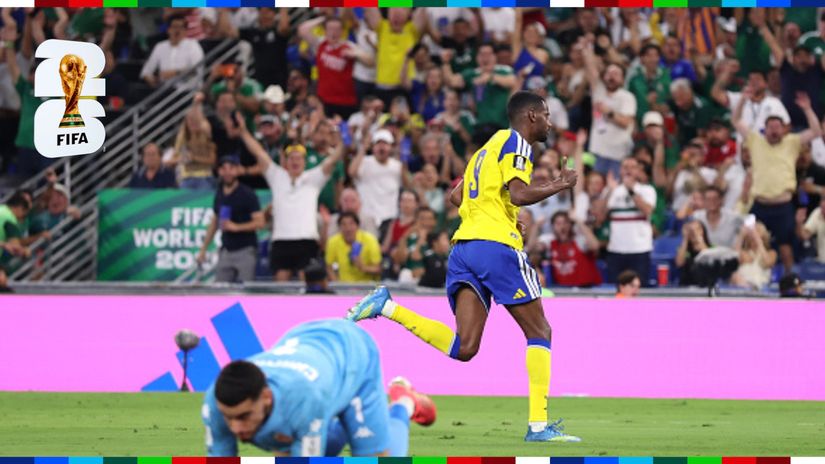
This 1-1 draw was not simply an upset in scoreline but a tactical contest defined by structural contrast. Portugal controlled possession, dictated tempo, and created territorial dominance through advanced positional play, but lacked penetration, efficiency, and defensive rest security.
DR Congo, by contrast, executed a disciplined, adaptive game plan built on compact defensive organisation, intelligent wide exploitation, and clinical set-piece execution. Wissa’s historic goal was not a moment of luck but the culmination of sustained tactical resilience and structural awareness.
Ultimately, Portugal will reflect on missed opportunities and transitional vulnerability, while DR Congo will celebrate a landmark result built on collective discipline and tactical clarity.