


TACTICAL ANALYSIS: The shocking 18-minute stat that destroyed England’s World Cup dream against Argentina




Reading Time: 6min | Sat. 18.07.26. | 12:50
While Tuchel’s side sought to protect a precious second-half lead by retreating into a passive low block, Scaloni’s relentless tactical bravery sparked a late La Albiceleste comeback
Argentina secured a dramatic 2-1 victory over England at the Atlanta Stadium, booking their spot in another World Cup final in a match defined by contrasting tactical mentalities.
While Thomas Tuchel’s England side sought to protect a precious second-half lead by retreating into a passive low block, Lionel Scaloni’s relentless tactical bravery sparked a late Argentinian comeback.
Download Our MozzartSport App For More News
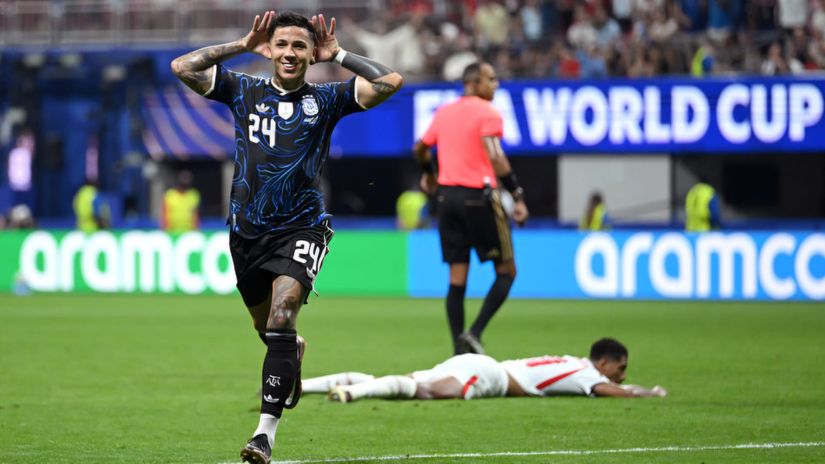
Goals from Enzo Fernández and Lautaro Martínez overturned Anthony Gordon’s opener, illustrating how structural adjustments and proactive in-game management can dismantle even the most organized defensive setups.
Argentina initiated the contest in a nominal 4-4-2 system with Emiliano Martínez in goal, shielded by a center-back pairing of Cristian Romero and Lisandro Martínez. Nahuel Molina occupied the right-back role, while Nicolás Tagliafico provided natural width from left-back.
In midfield, Leandro Paredes acted as the deep-lying playmaker, flanked by the energetic Giuliano Simeone on the right, and Enzo Fernández and Alexis Mac Allister operating as dual central midfielders.
Up front, Lionel Messi assumed a free-roaming role just behind center-forward Julián Álvarez, occasionally drifting to the wide right to search for pockets of space.

England countered with a balanced 4-3-3 shape that could easily transition into a 4-4-2.
Jordan Pickford started between the posts, supported by a back four of Reece James, John Stones, Marc Guéhi, and Djed Spence.
In midfield, Elliott Anderson and Declan Rice operated as double pivots, allowing Jude Bellingham to push higher into advanced areas.
Harry Kane spearheaded the attack, flanked by Morgan Rogers on the right and Anthony Gordon on the left.
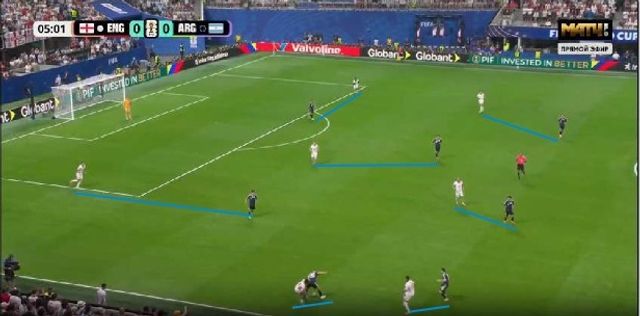
Thomas Tuchel structured England’s out-of-possession phase to prioritize central compactness. In their mid-block, England formed a disciplined 4-4-2 where the wingers, Rogers and Gordon, pressed inward to block central passing lanes to Argentina's creative hubs.
This strategy deliberately left Argentina’s fullbacks free on the flanks, gambling that England could intercept any subsequent passes back inside.
When forced deeper, England’s shape morphed into a highly compact 4-1-4-1/4-5-1, keeping the distance between their defensive and midfield lines incredibly tight.
During the first-half hydration break, Tuchel adjusted England's defensive restarts to mirror a scheme, beginning zonally but transitioning to a man-to-man press.
This was triggered by Reece James jumping to press the receiving fullback while John Stones shifted across to cover the space behind him.
In possession, Argentina constructed their play using a 4-box-2 structure.
Leandro Paredes frequently dropped between or alongside the center-backs to create a back three, allowing fullbacks Molina and Tagliafico to push high up the pitch. Argentina relied heavily on intricate "bounce passes" to bypass England’s first line of pressure.
When Anthony Gordon stepped up to press, an Argentinian midfielder would drop to receive, immediately playing a one-touch layback to a central defender who could then find the spare man.

England’s build-up was equally fluid, characterized by Rice and Anderson alternating duties as the dropping third center-back.
This rotation, paired with Harry Kane/Jude Bellingham dropping into deep midfield pockets, allowed England's fullbacks to push high and establish dominant wide triangles.
However, this fluid structure suffered from a lack of natural balance on the left side, where England utilized all right-footed players, limiting their ability to smoothly switch play.
Argentina countered England’s shifting defensive scheme by manipulating the positioning of Nicolás Tagliafico. To combat Reece James jumping forward to press, Scaloni instructed Tagliafico to drop deeper during build-up phases.
This subtle adjustment significantly increased the distance James had to cover, neutralizing England’s man-to-man transition and allowing Argentina to progress comfortably through the left channel.
Furthermore, Argentina exploited England's asymmetric left-hand side. With four right-footers operating on the left, England struggled to maintain high-tempo connections, often forcing John Stones to recycle possession from promising advanced positions.
While Spence performed admirably in individual duels especially in the first half, England's lack of natural left-sided width ultimately allowed Argentina's defense to remain relatively compact during the first hour of play.
The first half was an incredibly cagey affair, with both teams completely neutralizing each other's central access.
The tactical stalemate resulted in a historic statistical low: there were 19 fouls and absolutely zero shots on target in the first half.
This marked the first World Cup knockout match since 1966 to go without a single shot in the opening 30 minutes, yielding a combined first-half expected goals value of just 0.08.
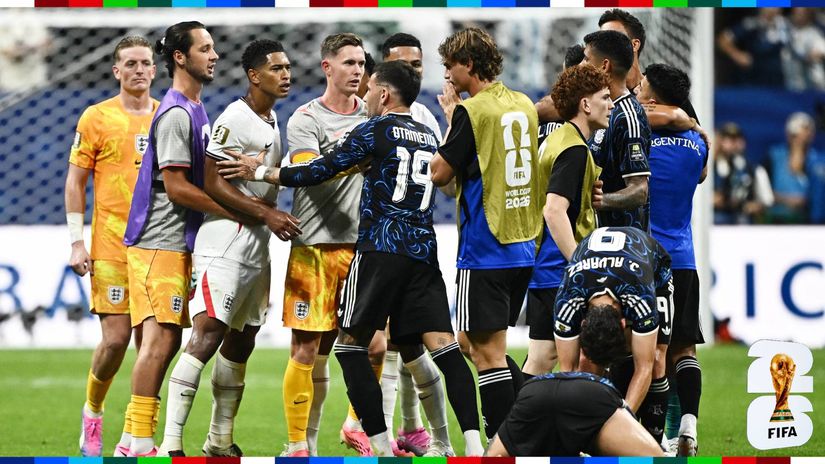
However, the game state broke open in the 55th minute when Lisandro Martínez’s clearance fell to Declan Rice, who found Morgan Rogers. Rogers' delightful cross was swept home by Anthony Gordon to give England the lead.

In response, Scaloni shifted his focus toward dominating the half-spaces and wide channels. By introducing Rodrigo De Paul and pushing Lionel Messi permanently to the right, Argentina successfully overloaded the wide areas.
Argentina's high press was designed to force England into rushed long balls, allowing Argentina's aggressive center-backs to dominate the ensuing physical duels.
When England did manage to bypass the press, Argentina's rest-defence proved elite. Their structural occupation after losing possession completely starved England of transition opportunities.
This counterpressing efficiency was most evident after Gordon’s opening goal.
From the 55th minute to Argentina's equalizer in the 85th, England was suffocated, retaining just 12% possession.
England's absolute passivity was highlighted by a stunning statistic: between the 66th and 84th minutes, England completed only two accurate passes - both of which were simple lateral exchanges between Jordan Pickford and John Stones.
Tuchel’s reaction to Argentina's growing dominance was to retreat into a defensive 5-3-2 shape that later on morphed to a 5-4-1, a decision that probably proved to be England's undoing.
This defensive transition left massive spaces in the wide areas.
Because England’s midfield three were highly reluctant to cover the width of the pitch and the wide center-backs preferred to remain inside the box, Argentina was gifted endless crossing opportunities.
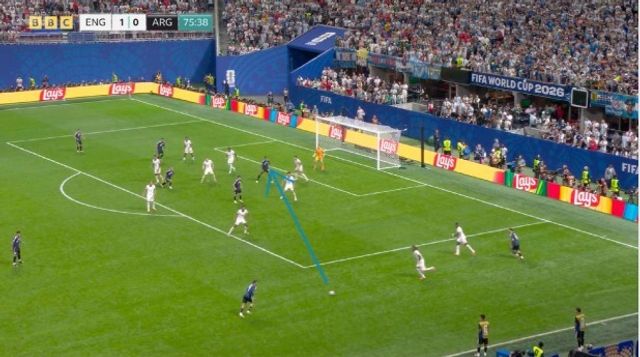
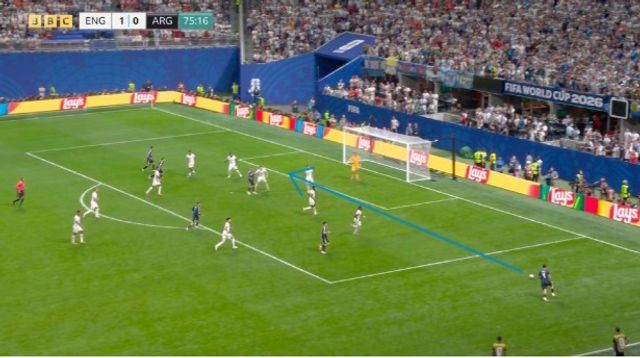
Scaloni capitalized on this by executing a series of incredibly brave, offensive substitutions. He replaced Paredes, moved Enzo Fernández into the single pivot role to open up long-range shooting opportunities, and introduced Rodrigo De Paul to provide energy against the long ball.
In the 85th minute, Enzo Fernández picked up a pass from Messi, bent a superb strike into the far corner, and leveled the score.
Scaloni then sacrificed left-back Tagliafico for striker Lautaro Martínez, pushing winger Nico González to left-back.

This offensive courage was rewarded in the 92nd minute when Mac Allister's rebounded effort was recycled by Messi, who lifted a brilliant cross for the unmarked Lautaro Martínez to head home the winning goal.
Eventually, this World Cup semi-final was decided by a stark contrast in tactical courage. Thomas Tuchel's decision to shift to a passive five-man backline far too early surrendered all control, leaving England without any counter-attacking outlet.
Conversely, Lionel Scaloni’s proactive, attacking substitutions allowed Argentina to dominate the wide areas and overwhelm England's low block.
While Argentina may lack natural wide dribblers, their elite mentality and tactical flexibility - complemented by the timeless brilliance of Lionel Messi, who extended his historic streak by scoring or assisting in his 11th consecutive World Cup appearance - proved decisive.
Argentina's ability to solve complex defensive blocks under immense pressure confirms their status as worthy finalists, while England is left to regret a passive retreat that cost them a place in history.