


.jpeg)
TACTICAL ANALYSIS: How South Africa will set up at 2026 FIFA WORLD CUP


.jpg)
.jpg)
Reading Time: 4min | Thu. 04.06.26. | 13:43
Bafana Bafana possesses the tactical balance required to surprise the footballing world in 2026
South Africa’s Bafana Bafana head into the 2026 FIFA World Cup in North America having secured their fourth-ever tournament qualification. Under the astute guidance of head coach Hugo Broos, they punched their ticket directly by topping CAF Group C, marking their first appearance in the global finals in 16 years.
Download our MozzartSport App For More News
Ranked 10th in Africa and 60th globally, the iconic national side secured automatic qualification after a resounding 3-0 victory over Rwanda in October 2025, pipping continental giants Nigeria to the top spot.
Now drawn into a challenging Group A alongside co-hosts Mexico, Czechia, and South Korea, Broos’ men are primed to bring their signature flair, dance moves, and sophisticated tactical framework to the world stage.
Since returning to international football following the end of apartheid in the early 1990s, South Africa has left an indelible mark on the World Cup stage.
They made their historic debut at the 1998 World Cup, earning draws against Denmark and Saudi Arabia. In Korea/Japan 2002, they delivered their best competitive showing, defeating Slovenia 1-0 but missing the knockout rounds on goal difference.
Finally, as hosts of the historic 2010 tournament, they united a nation with the sound of the vuvuzela, securing a famous 2-1 victory over France despite a group-stage exit.
To navigate Group A, Broos relies on a deeply integrated talent pool heavily drawn from domestic powerhouse Mamelodi Sundowns. Veteran goalkeeper and captain Ronwen Williams anchors the side, bringing immense experience from his standout African Cup of Nations (AFCON) campaign.
The backline features the physical dominance of Mbekezeli Mbokazi (Chicago Fire) and youth prospect Ime Okon (Hannover 96), flanked by experienced full-backs Khuliso Mudau and Aubrey Modiba.
The engine room is controlled by the tactical intelligence of Teboho Mokoena, a 50-cap veteran, alongside Jayden Adams and Thalente Mbatha. Up front, Burnley's Lyle Foster serves as the focal point, supported by the terrifying pace and 1v1 dribbling ability of Oswin Appollis and Relebohile Mofokeng.
When building from the back, Broos employs a fluid system that alternates between a 4-2-3-1 base and an expansive 2-4-4/4-2-4 structure.
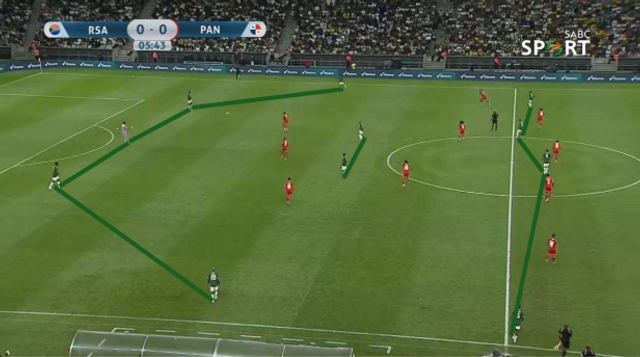
In the low phase, South Africa sets up in a 2-2/2-4 build-up pattern(Low Phase (2-4/5-2 Baiting Structure)). The two central defenders split wide while the double pivot of Mokoena and Adams drops directly in front of them to form a compact bank of four.
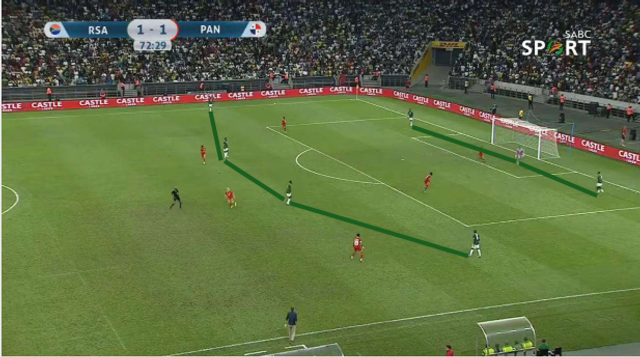
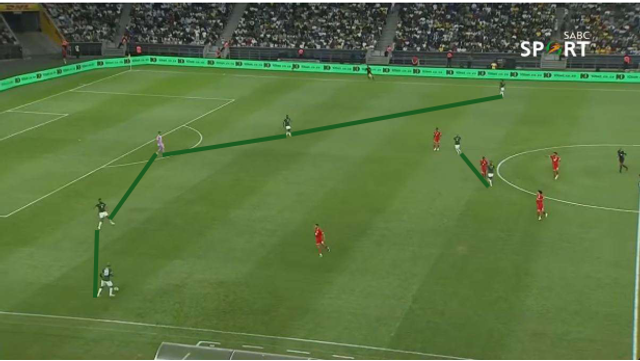
To bypass the opposition’s initial press, goalkeeper Ronwen Williams acts as an extra outfielder. Williams intentionally delays execution, staying on the ball to bait the opposition's press.
Once the opponent commits forward, South Africa utilizes rapid, short combinations through their central midfielders or feeds the advanced playmaker (acting as a mediator between defensive lines) to break the press.
.jpg)
As possession progresses into the middle and final thirds, the structure morphs dynamically:
● Asymmetrical Full-back : One full-back (often Modiba) pushes high into the attacking line, while the opposite full-back stays deeper to form a temporary three-man rest-defense structure.
● Inverted wingers: When a full-back overlaps wide, the corresponding winger ( Oswin Appollis or Mofokeng) immediately inverts into the half-spaces, creating central numerical overloads.
● Tight inside combinations: Bafana Bafana focus on patient circulation, utilizing quick, intricate passing combinations around the opposition penalty box before unleashing late runs from deep midfielders into the box.
Defensively, South Africa organizes into a highly disciplined, compact 4-4-2 mid-block. The primary objective in this phase is to deny the opposition access to central spaces and interior channels, forcing them into wide areas where Bafana Bafana can squeeze the play.
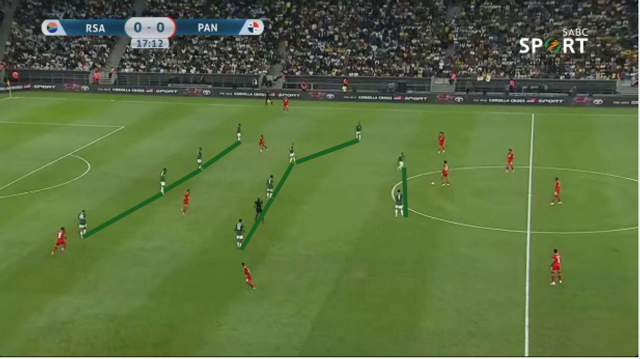
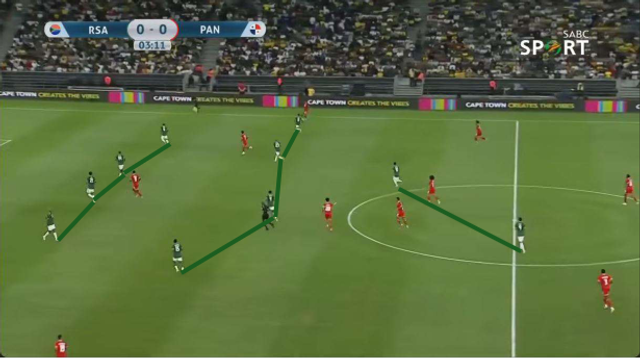
When they choose to press high, South Africa shifts into an aggressive 4-2-4 high-press system. They utilize specific tactical triggers to disrupt opposition low build-ups:
● The Touchline Trap: When the ball is forced wide to an opposition full-back, South Africa uses the touchline as an extra defender, aggressively congesting the space and trapping the ball-carrier.
● Pressing Triggers: An opposition pass from center-back to full-back, a hurried back-pass to the keeper, or a loose ball into an isolated pivot player serves as an immediate signal for the front four to trigger an intense, synchronized counter-press.
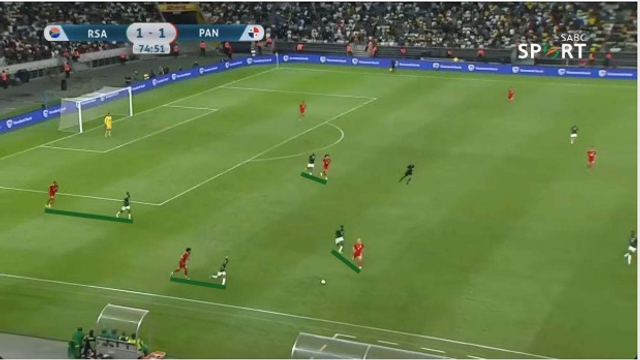
Despite their tactical sophistication, Broos' system carries inherent risks. Because the high press requires high physical commitment close to the opposition territory, it can be vulnerable to direct teams. If the initial pressing wave is bypassed, South Africa's midfield can become stretched, leaving them highly susceptible to rapid defensive transitions.
Additionally, because full-backs are heavily involved in the attacking shape, opposition teams consistently target the vacant spaces left behind them on turnovers.
Finally, South Africa has shown vulnerability when defending crosses from wide areas, a structural weakness that group opponents like Czechia will undoubtedly look to exploit.
South Africa's identity under Hugo Broos is a beautiful marriage of patient positional play and devastating verticality. They are capable of protracted, tiki-taka style circulation, yet they remain highly lethal when exploiting space against a high defensive line using the raw pace of Appollis and Mofokeng.
With an elite rest-defense structure designed to choke opposition counter-attacks at the source, Bafana Bafana possesses the tactical balance required to surprise the footballing world in 2026.