


.jpg)
TACTICAL ANALYSIS : Patterns and strategies to expect from Senegal at 2026 FIFA World Cup


Reading Time: 5min | Tue. 02.06.26. | 14:08
Currently under the guidance of head coach Pape Thiaw - a proud member of that legendary 2002 playing squad - Senegal sits comfortably at number 14 in the global FIFA men’s rankings
Senegal’s relationship with the FIFA World Cup is defined by historic breakthroughs and a rapidly growing reputation as a powerhouse of African football.
Download our MozzartSport App For More News
The Lions of Teranga first burst onto the global stage in 2002, capturing the world’s imagination by defeating reigning world champions France in the opening match and sensationally marching all the way to the quarter-finals.
After a sixteen-year absence, they returned to the tournament in 2018, only to suffer a heartbreaking group-stage exit.
They became the first team in history to be eliminated strictly via the fair-play disciplinary rule after finishing entirely level with Japan on points, goal difference, and head-to-head records.
Redemption and structural consistency followed in 2022, where they navigated the group stage once more to cement their status as a competitive tournament staple capable of going toe-to-toe with elite footballing nations.
Now, having successfully navigated a grueling qualification campaign, Senegal enters the 2026 showcase with massive ambition to emulate and surpass their previous deep runs.
Currently under the guidance of head coach Pape Thiaw - a proud member of that legendary 2002 playing squad - Senegal sits comfortably at number 14 in the global FIFA men’s rankings.
Holding an impressive 1,688.99 points, they remain proudly consolidated as Africa’s second-highest-ranked national team.
Heading into the 2026 group stage, Thiaw's men face a highly competitive Group I line-up featuring heavyweight clashes against France, Norway, and Iraq.
Thiaw’s tactical philosophy relies on a highly dynamic, technically gifted side that balances patient baiting patterns with vertical explosiveness.
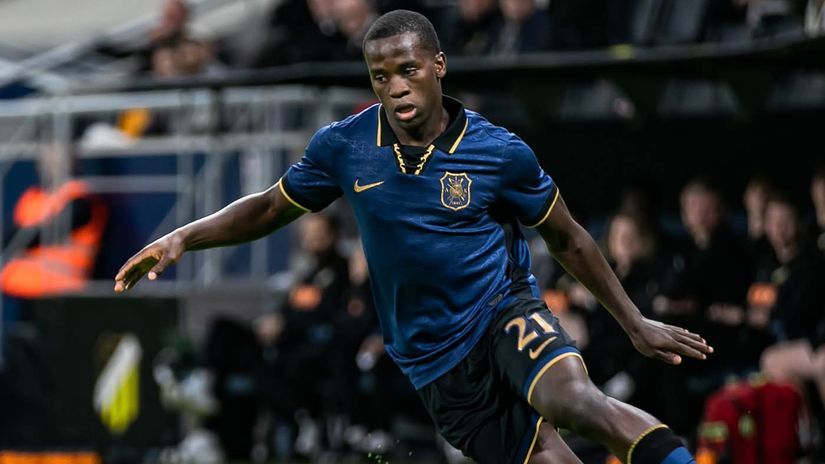
Structurally, Senegal utilizes a flexible base framework that seamlessly shifts from a 4-2 shape in early build-up into a highly aggressive, asymmetrical 4-2-4 matrix when occupying the opposition's half.
The fundamental principle of their build-up phase relies on structured verticality.
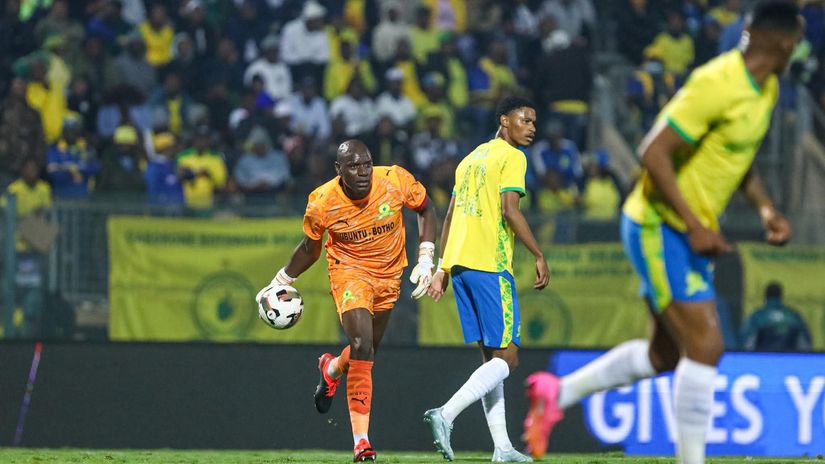
Operating from the back, Senegal routinely utilizes their goalkeeper as an active extra outfielder, effectively generating an artificial numerical superiority to completely escape the opposition’s initial line of press.
The structural mechanics of this system heavily leverage a dynamic double pivot in midfield, where Lamine Camara/Pape Gueye/Pape Sarr are given the tactical freedom to act as a dropping pivot alongside the center-backs.
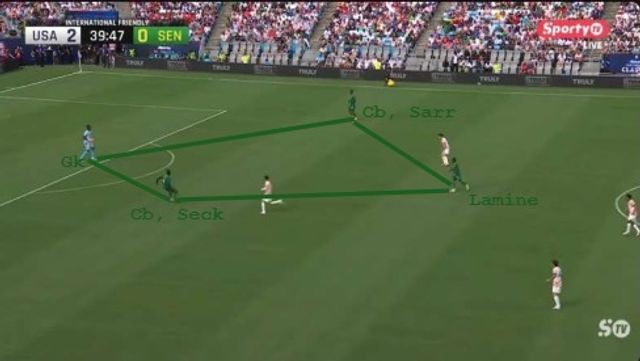
This orchestrated dropping movement serves a dual purpose: it lures the opposition forward into an aggressive high press, while simultaneously acting as the signal for fullbacks Ismail Jakobs/El Hadj on the left and Krépin Diatta on the right to push incredibly high and wide up the touchlines to join the last line of attack.
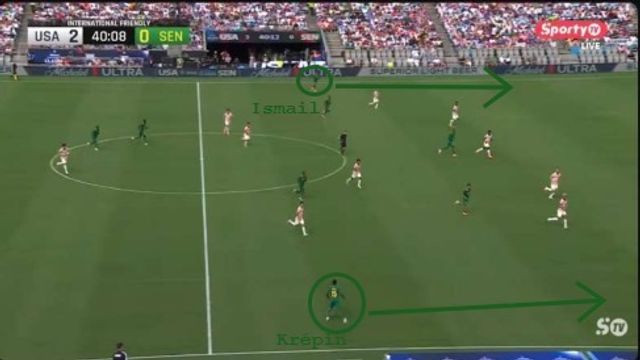
Both of Senegal's central midfielders are completely comfortable on the ball, allowing the team to maintain a calm, press-resistant rhythm during these dangerous low-phase circulations.
Once the opposition is drawn out through intricate low-circulation sequences, Senegal exploits the generated space by orchestrating slick flank-to-halfspace combinations.
A primary pattern of play revolves around third-man runs to cleanly overload wide areas.
These are executed via quick triangle passing sequences: winger into central midfielder, midfielder out to the flying fullback, and the fullback driving directly into the box.
When the fullbacks occupy the extreme wide channels to provide maximum horizontal stretch, wingers like Sadio Mané and the creative Iliman Ndiaye brilliantly invert into the halfspaces.
Acting as inside forwards, they make piercing runs in behind the opposition's defensive line, targeting depth instantly.
Alternatively, if the underloaded central spaces are compressed, the side relies on wide combination play to create crossing situations into the box, maximizing their offensive variety through a dynamic front four that utilizes raw pace to terrorize backing-off defenders.
While short, intricate circulation is their default mechanism, Senegal masterfully employs long direct restarts as an efficient alternative weapon to unbalance the opponent's defensive block.
When facing an aggressive, high-smothering press that restricts ground progression, the goalkeeper skips the midfield lines entirely by launching direct aerial passes toward striker Nicolas Jackson.
Jackson is specifically tasked with contesting grueling fifty-fifty aerial duels against opposing center-backs.
His primary objective is to win these physical battles and cleanly knock the ball down into the paths of the fast-charging inside forwards like Mané or Ndiaye and even late arrivals from midfielders.
This route instantly transforms a deep restart into an immediate, high-tempo final-third transition, bypassing a structured block in a matter of seconds.
When out of possession, the Lions of Teranga fundamentally aim to dictate the game by aggressively suffocating the opposition within their own territory.
High up the pitch, Thiaw deploys a coordinated 4-2-4 high press that smoothly transitions into a fluid 4-3-3 ball-side defensive trap as the opponent pushes out to either flank to build their play.
This aggressive front line is designed to completely close down passing lanes and isolate deep ball-carriers.
If the primary high press is broken, Senegal quickly transitions into an incredibly disciplined and compact 4-4-2 mid-block.
The core principle here is forcing immediate turnovers, heavily relying on the relentless work rate of the two central midfielders who do immense amounts of defensive running to shadow, harass, and intercept passing lanes.
A defining, high-risk feature of their defensive system is the role of the fullbacks during the opponent's low build-up.
To ensure the opponent cannot establish a rhythm, Senegal's fullbacks aggressively step up out of the defensive line to track dropping opposition wingers.
To protect against the space vacated by these tracking fullbacks, the far-side wingers are required to make deep defensive recoveries, dropping to support the backline and maintain structural integrity.
.jpg)
Despite their immense defensive discipline, Senegal's aggressive tactical commitment frequently exposes their rest defense. Because both fullbacks push remarkably high to join the four-man attack in the last line, massive spaces are naturally conceded in wide areas.
Fast, counter-attacking opponents can routinely exploit these vacated channels, leaving isolated center-backs heavily exposed to dangerous, wide-area transitions.
The success of this balanced style ultimately rests on Senegal's robust talent pool.
The supreme defensive awareness of veteran leaders like Kalidou Koulibaly and Moussa Niakhate is vital to surviving those risky, isolated moments at the back.
In midfield, the dual-profile engine room of comfortable, press-resistant central midfielders ensures smooth ball retention under intense pressure.
Crucially, the player heavily tipped to influence their general style of play across this tournament run is Iliman Ndiaye.
Blessed with blistering pace, electric dribbling, and elite creativity, Ndiaye provides the technical spark required to unlock low blocks.
His dual threat as both an excellent crosser from wide areas and a clinical finisher in the halfspaces makes him Senegal's premier creative outlet, perfectly tying together an ambitious tactical blueprint designed to take the 2026 World Cup by storm.