


TACTICAL ANALYSIS: How France made light work of Morocco to advance to World Cup semi-final

Reading Time: 8min | Sat. 11.07.26. | 13:39
Despite failing to convert an early penalty and registering a staggering 1.87 first-half expected goals (xG) - the highest scoreless opening half of the tournament - France never panicked, relying on their elite rest-defense to completely stifle Morocco's tactical variations
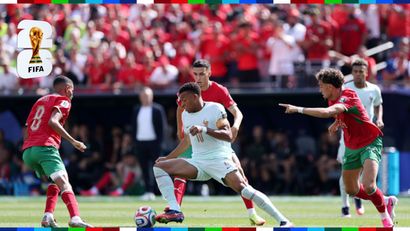
Kylian Mbappé delivered a definitive masterclass in decisive execution as France overcame Morocco 2-0 in an absorbing FIFA World Cup quarter-final tie at the Boston Stadium.
Download our MozzartSport App For More News
This high-stakes encounter, loaded with individual subplots - including Mbappé’s relentless Golden Boot duel with Lionel Messi - was far more than a mere showcase of individual brilliance.
It was a structural battleground that pitted Didier Deschamps’ patient, rest-defense-heavy system against Mohammed Ouahbi’s technically sophisticated, press-resistant outfit.
While the history books will note that Mbappé rebounded from a first-half penalty miss to score a dazzling opener and subsequently set up Ousmane Dembélé to punch Les Bleus' ticket to the semi-finals, the real narrative lay beneath the surface.
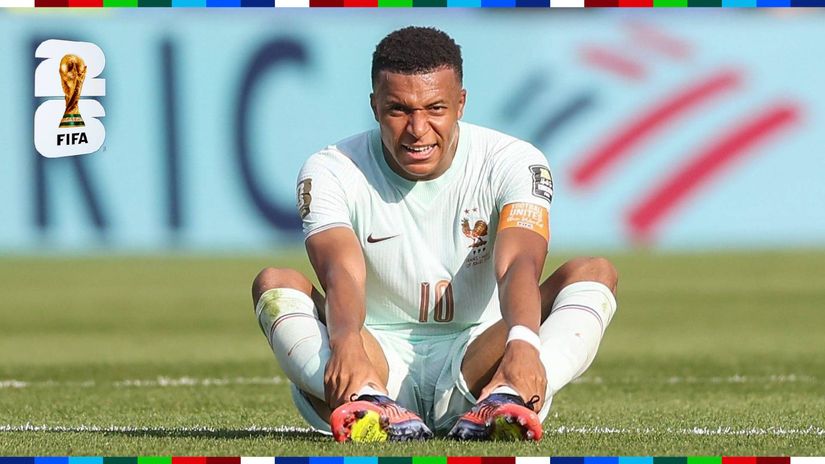
Deschamps deployed France in a nominal 4-2-3-1 reference formation that prioritized balance, physical dominance, and structural security.
Mike Maignan started between the posts, shielded by a center-back pairing of Dayot Upamecano and William Saliba.
Jules Koundé assumed the right-back role, while Lucas Digne occupied the left flank.
In the engine room, Adrien Rabiot partnered with Manu Koné in a conservative double pivot.
The attacking triumvirate behind the striker featured Ousmane Dembélé hugging the right touchline, Michael Olise pulling the strings as the central attacking midfielder, and Désiré Doué operating as the left winger.
Mbappé led the line as the nominal striker, though his interpretation of the role was highly dynamic.
.jpg)
Conversely, Morocco matched their European counterparts with a starting 4-2-3-1 alignment, albeit built around an entirely different tactical philosophy. Yassine Bounou guarded the net, supported by central defenders Issa Diop and Noussair Mazraoui. Achraf Hakimi provided explosive elasticity at right-back, while Anis Salah-Eddine locked down the left.
The double pivot consisted of Ayoub Bouaddi and Neil El Aynaoui, tasked with anchoring the midfield.
Bilal El Khannouss and Chemsdine Talbi occupied the right and left wings respectively, flanking the creative Azzedine Ounahi, while Brahim Díaz started as a fluid, nominal center-forward in a lineup completely devoid of a traditional, recognized striker.
Out of possession, Morocco dropped into an exceptionally compact, disciplined 4-4-2 mid-block specifically engineered to starve France of central spaces and deny them access to interior channels.
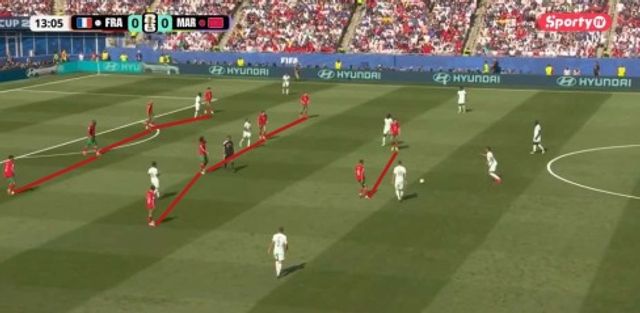
Ouahbi’s side prioritized vertical and horizontal compactness, forcing France to circulate possession harmlessly on the periphery.
However, from France's goal kicks and deep restarts, Morocco aggressively altered their defensive behavior, executing a bold, man-to-man high press.
In these phases, Brahim Díaz would invert to lead the first line, while Achraf Hakimi stepped significantly high out of the defensive line to back the press up.
Following the first-half drinks break, Morocco introduced an intricate structural tweak: Neil El Aynaoui began dropping deep directly into the defensive line during settled possession to form a temporary back three, splitting the center-backs. Simultaneously, full-backs Hakimi and Salah-Eddine alternated inverting into the midfield pivot alongside Bouaddi to create a fluid 3-2 base build-up.
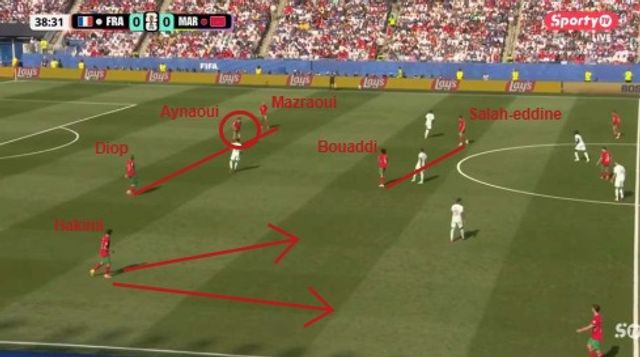
While this structural adaptation was technically elegant and designed to bypass France’s initial pressing lines, it inadvertently lured Morocco into a dangerous trap, exposing them to catastrophic central turnovers.
When establishing possession, France attacked via a rigid yet highly functional 3-2-5 structure. Jules Koundé pushed aggressively into the right half-space, which effectively opened a direct vertical passing lane to Ousmane Dembélé on the flank.
To maintain rest-defense equilibrium, Lucas Digne stayed considerably deeper on the left, acting as a nominal third center-back.
Michael Olise operated with total creative license, routinely dropping deep into the second line of build-up to organize play and pull Moroccan midfielders out of position.
The primary rotational mechanism occurred in the forward line, where Doué and Mbappé swapped spaces, with Mbappé consistently occupying the left half-space to isolate Moroccan defenders in 1v1 scenarios.
Crucially, France’s double pivot of Rabiot and Koné remained deeply disciplined, staying anchored ahead of Saliba and Upamecano.
They consistently faced forward and rarely made vertical runs into the opposition box, ensuring that Les Bleus always maintained a hefty five-man structure behind the ball to neutralize potential transitions.
France’s offensive blueprint was defined by extreme patience, intentionally conceding possession to exploit Morocco's inherent structural risks.
While Morocco's overloads - specifically on the right flank where Díaz, El Khannouss, and Hakimi heavily combined - allowed them to advance into the final third, they struggled to generate high-value opportunities, accumulating a microscopic 0.04 expected goals (xG) in the first half during the slow-tempo opening phases.
France actively invited Morocco to commit numbers forward, waiting for technical errors in central areas.
The opening goal in the 60th minute served as a textbook case study of exploiting these central transition vulnerabilities.
Following a poor turnover from El Aynaoui, Désiré Doué produced an explosive ball-carrying action through the middle third, slipping an incisive pass through the legs of the recovering midfielder to find Mbappé on the edge of the box.
The superstar forward opened his body and whipped a sensational curler past Bounou, illustrating how quickly France could punish structural expansion.
France systematically dominated the wide areas and half-spaces by creating lethal isolation scenarios for their elite individual profiles.
While Morocco's mid to low-block defense excelled at reducing France’s settled attacks to hopeful crossing sequences early on, they could not contain Les Bleus once the half-spaces became fractured in transition.
Mbappé continuously haunted Morocco within the left half-space, a zone from which he won a 25th-minute penalty after driving past a poorly positioned Moroccan rest-defense, only to see his effort saved by Yassine Bounou - who recorded his fourth career World Cup penalty save.
Furthermore, France’s second goal in the 66th minute beautifully illustrated total spatial manipulation.
After receiving a lay-off from Mbappé, Dembélé advanced toward the edge of the area.
Mbappé immediately executed a brilliant, selfless overlapping run toward the left, dragging multiple Moroccan defenders with him and completely vacuuming the defensive coverage to one side.
This created an immediate pocket of space for Dembélé to cut infield and fire a low drive into the bottom corner, proving how gravity-altering off-the-ball runs can thoroughly dominate vital shooting zones.
While France were content to sit in a passive 4-4-2 mid-block during open play, their approach during opposition restarts was fiercely aggressive.
From Morocco’s goal kicks, France shifted into an intense, man-to-man pressing structure, utilizing their superior physical and athletic profiles to suffocate Morocco's short build-up.
The front line used curved pressing runs to deliberately herd Morocco’s technical ball-carriers into wide traps along the touchline.
This high press forced Morocco into a critical tactical capitulation just before the first hydration break: the North Africans completely abandoned building low from the back, opting instead to go long in an effort to prevent catastrophic turnovers near their own box.
However, Morocco’s players generally lacked the physical profile to consistently win defensive duels or dominate long balls in open space against Saliba and Upamecano, turning the remainder of the match into a second-ball optimization exercise for France when Morocco restarted play.
France’s rest-defense was an absolute masterclass in tactical control, rendering them nearly impossible to hurt on the counter-attack.
Because Rabiot, Koné, and Digne consistently stayed behind the line of the ball, France always possessed a numerical and physical superiority in central corridors.
During the rare sequences when France lost possession high up the pitch, their immediate proximity to the ball allowed them to counter-press with immense ferocity.
At the start of the second half, France deliberately increased their defensive risk-taking, counter-pressing with greater intensity to break the 0-0 deadlock.
Although Morocco occasionally bypassed the initial wave of counterpressure to break into transition, Saliba and Upamecano proved completely unbeatable when forced to defend large spaces backward, routinely stepping out to pinch the ball or forcing the play wide to allow the defensive block to seamlessly reset.
As the game state evolved, both managers attempted to alter the match's tactical complexion via crucial personnel changes.
On the hour mark, trailing 1-0, Morocco made an aggressive double substitution, withdrawing El Khannouss and Bouaddi to introduce Sofyan Amrabat and Sofyan Rahimi, aiming to inject verticality and physical robustness into a possession structure that had grown largely sterile.
This adjustment briefly improved Morocco's lateral ball circulation, yielding their first shot on target in the 82nd minute when a short free-kick from Hakimi released Ounahi for a long-range drive saved by Maignan.
Deschamps countered by replacing Kone with Warren Zaire-Emery in the 71st minute, and later withdrawing Mbappé for Jean-Philippe Mateta as a precaution following an ankle scare.
These changes disrupted France's fluid attacking dynamics and caused them to sit in a deeper block for the final ten minutes, but the structural trade-off yielded absolute defensive stability, safely seeing out the match while surviving a late El Aynaoui header that flashed wide.
When forced into a deep defensive phase without the ball, France's passive 4-4-2 block transformed into a rigid, low-lying wall that suffocated any semblance of diagonal central progression.
Les Bleus were entirely comfortable defending inside their own penalty box, trusting their superior aerial capabilities and physical profiles to absorb pressure.
Morocco's technical players were allowed to pass around the periphery of the block, but any attempt to penetrate the interior channels was met with aggressive stepping triggers from Rabiot or the center-backs.
Ultimately, the 2-0 scoreline was a fair reflection of a match where structural efficiency completely neutralized possession.
Mbappé’s historic evening, which saw him become only the second player in tournament history to reach 20 overall World Cup goals alongside Messi, underscored France’s devastating individual superiority when afforded space to run into.
For Morocco, a tournament defined by superb positional ideas and press resistance ends with a harsh lesson in final-third risk-taking and physical disparity.
Didier Deschamps’ blueprint once again proved that in elite tournament football, structural control and transition optimization will almost always triumph over low-tempo possession dominance.