


-min.jpg)
TACTICAL ANALYSIS: How Benni McCarthy's plot backfired in friendly defeat

.jpg)
.jpg)
.jpg)
Reading Time: 4min | Sat. 15.11.25. | 12:59
Harambee Stars showed flexibility but their opponents leaned on game management strategies in the final stages to squeeze out a narrow win
The friendly encounter between Kenya and Equatorial Guinea in Turkey unfolded as a highly tactical contest defined by contrasting structures, pressing schemes, and in-game adjustments.
Follow our WhatsApp channel for more news
Both sides lined up in a 4-3-3, but their interpretations of the shape presented two very different dynamics, with Equatorial Guinea emphasizing controlled build-up and midfield rotations, while Kenya focused on compactness, transitional threats, and coordinated pressing traps.
Kenya opened the match in a 4-3-3 but shifted into a disciplined 4-4-2 mid-block out of possession.
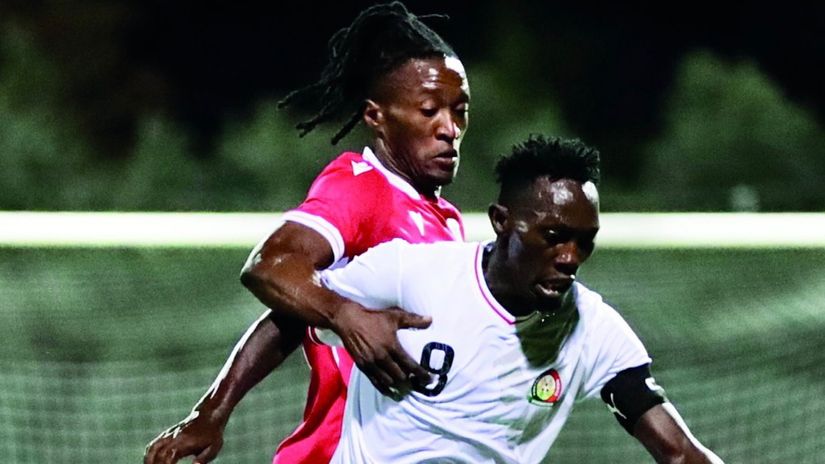
Ryan Ogam and Jonah Ayunga alternated intelligently between dropping into midfield and holding the last line, providing Kenya with flexibility when engaging Equatorial Guinea’s double pivot.
The wide pairing of William Lenkupae and Boniface Muchiri supplied width in possession, while Duke Abuya and Marvin Nabwire anchored central spaces. The backline of Rooney Onyango, Kevin Otiende, Michael Kibwage, and Sylvester Owino remained compact, prioritizing vertical security and aggressive pressing cues.
How we line up💪#HarambeeStars pic.twitter.com/oOCkOZ3kYM
— Harambee Stars (@Harambee__Stars) November 14, 2025
Kenya’s pressing triggers were clear: once the ball entered the feet of Equatorial Guinea’s double pivot - Mascarel Omar or Pablo Ganet - or once the first line of pressure was bypassed, one Kenyan midfielder would step out with intensity, locking play onto one flank.
This forced Equatorial Guinea into rushed decisions, long balls, or turnovers, especially by the 22nd minute where Kenya’s aggressive coordination significantly reduced the opponent’s ability to progress centrally. Stars also used early diagonals from Otiende toward Ayunga as an out-ball, exploiting the visitors’ high defensive line.
Equatorial Guinea played in a 4-3-3 with a more possession-oriented shape.
Their build-up relied on the fullbacks stretching wide and the center-backs staying close, creating a stable base for progression. The double pivot of Mascarel and Ganet constantly dropped to offer numerical superiority in deeper zones, while Pedro Mba Obiang operated as the advanced midfielder - often dropping into the second phase to knit play together.
Wide players Santiago Eneme and Jose Miranda provided directness, while central striker Miguel Luismi Nlavo frequently dropped off to combine, destabilizing Kenya’s center-backs.
Out of possession, Equatorial Guinea defended in a 4-1-4-1 high block, but dropped into a 4-4-2 mid-block when Kenya established sustained possession.
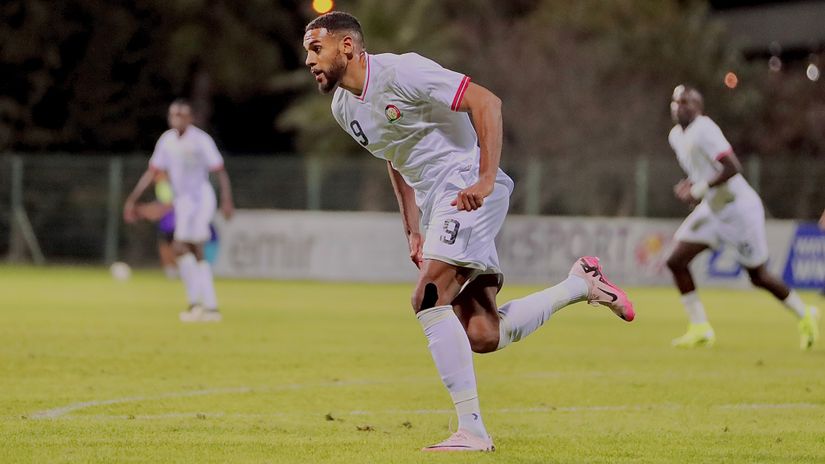
They also implemented a mixed marking scheme on set-pieces, using two zonal players at the near post, and several man-markers elsewhere, supported by an edge-of-the-box controller for second balls.
A major theme of their first-half strategy was the right-back’s high, wide positioning - becoming a primary target for long switches whenever Kenya forced them into stretched situations. Their high defensive line also served to trap Kenya’s forwards offside, particularly Ayunga who attempted to time runs behind from diagonal balls.
Despite Kenya’s well-coordinated press, Equatorial Guinea enjoyed periods of controlled circulation, manipulating space with their triangles in midfield.
Their breakthrough came moments before halftime: in the 44th minute Rooney Onyango fouled Jose Miranda in the box, and he converted the resulting penalty in the 46th minute, giving Equatorial Guinea a 1-0 lead into the interval.
.jpg)
Kenya returned from the break with a stronger grip on the game, particularly in their build-up structure.
Lenkupae frequently dropped inside to create an extra midfielder, generating overloads that eased vertical progression.
Abuya and Nabwire alternated deeper roles, sometimes sliding between the center-backs, or beside them to provide an additional passing lane and create a plus-one against Equatorial Guinea’s first pressing line.
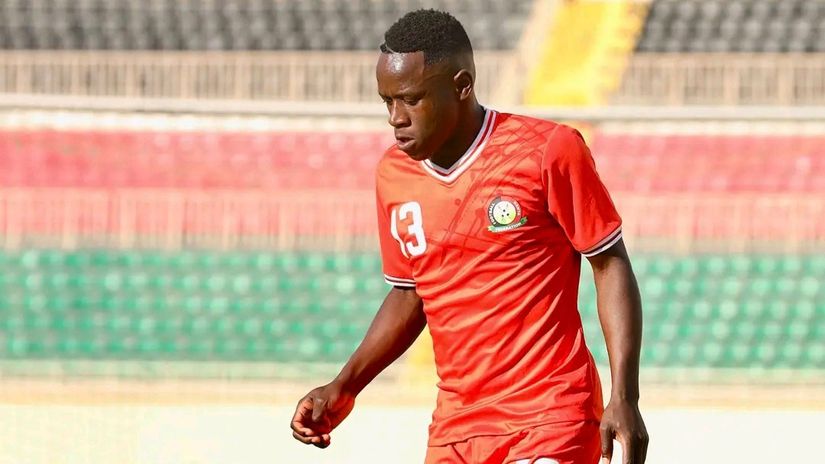
The result was a more controlled and composed Kenya, with increased tempo and more aggressive pressing higher up the pitch.
Their attempts to push Equatorial Guinea deeper were visible in their willingness to commit multiple players forward, even at the risk of leaving space behind their defensive line.
A double substitution in the 70th minute introduced Ovella Ochieng and Austin Odhiambo for Lenkupae and Muchiri, injecting pace, creativity, and sharper vertical threat. Kenya’s intensity grew increasingly pronounced, and Equatorial Guinea resorted to balls over the top to exploit the higher defensive line Kenya adopted in pursuit of an equalizer.
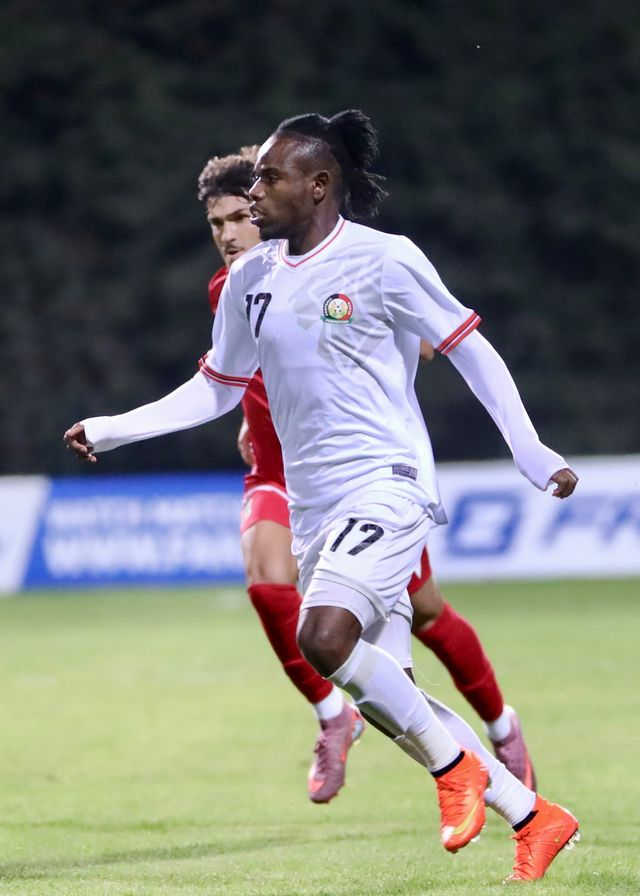
As Kenya’s control continued to grow, Equatorial Guinea leaned on game management strategies in the final stages.
Their shifts in tempo, increased ball retention, and calculated fouls successfully disrupted Kenya’s rhythm. By slowing the game and maintaining longer spells of possession, they controlled the closing minutes and protected their narrow 1-0 lead.