


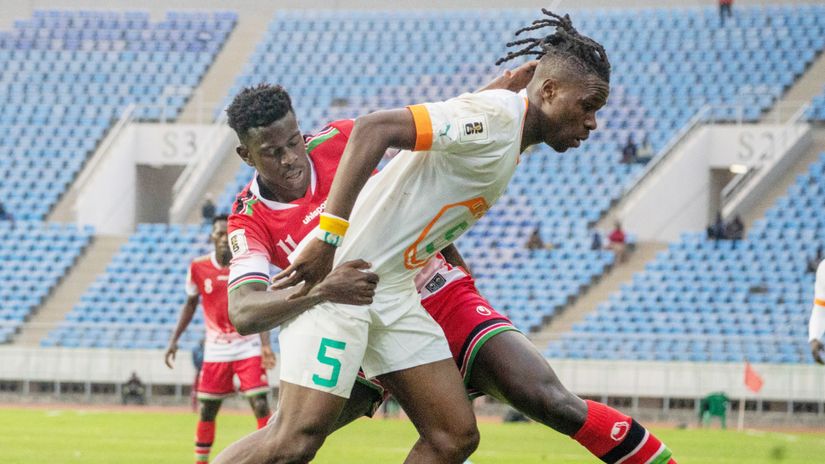
TACTICAL ANALYSIS: How and where Ivory Coast could trouble Harambee Stars

.jpg)
.jpg)
.jpg)
Reading Time: 4min | Tue. 14.10.25. | 12:38
Defensively, Kenya’s fullbacks must be sharp in 1v1 duels against their wingers, while the backline as a whole must anticipate their striker’s aerial lay-offs and second balls
Côte d’Ivoire approach their 2026 World Cup qualification match against Kenya as a tactically cohesive and physically imposing unit structured around a well-balanced blend of European-based experience and local athleticism.
The Elephants lead the group with 23 points, one ahead of Gabon, who are scheduled to play Burundi.
Follow our WhatsApp channels for more news
Côte d'Ivoire's base shape often resembles a 4-3-3, but they are tactically flexible, adapting to different phases of play and opposition strengths.
At their best, they combine structured wide-area dominance with explosive transitions.
Their defining attributes lie in the intensity of their pressing, physicality in duels, and high-level execution in transitional moments.
Tactical identity and structures
Out of possession, Côte d’Ivoire defends in a compact 4-1-4-1, with an emphasis on pressing in the wide zones.
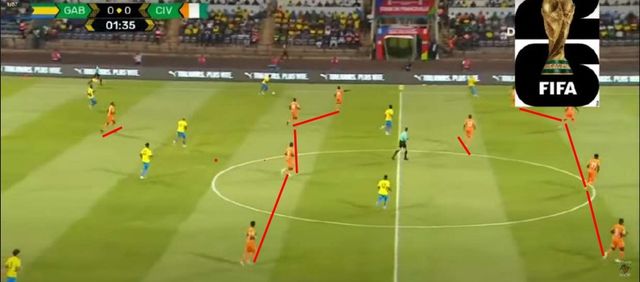
Ivory Coast in a 4-1-4-1
Their pressing traps are triggered by back passes, moments they use to aggressively put pressure on the ball carrier.
In these situations, their striker, likely Sébastien Haller, typically leads the press, while one of the advanced midfielders steps forward to temporarily create a 4-4-2 pressing shape, helping maintain vertical compactness and prevent midfield from being bypassed.

When pushed deeper, particularly when under sustained pressure, they shift into a 5-4-1 low block, dropping the pivot into the back line.
This compact defensive shape congests central spaces but leaves some vulnerability on the flanks, where Kenya can potentially exploit these wider zones, especially in transitions or quick switches.
In attack, the Ivorians transition into a 3-2-5/3-4-3 shape, with one fullback joining the front five while the other remains tucked or deeper depending on game control.
Their primary progression tool is the wide channel, where they consistently form triangles -fullback, winger, and a supporting midfielder - to move the ball up the pitch and drag defensive lines wide.
Their build-up phase often starts in a diamond-like structure, involving the goalkeeper as an outfield option at the base, with the centre-backs positioned wide, a single pivot at the top, and fullbacks pushed high.
This system is designed to bait the opposition press before launching long diagonals to the flanks.
When under intense pressure, they are not hesitant to bypass midfield altogether, opting for direct balls toward the striker, who acts as a physical target man to win aerial duels and connect with advancing runners.
Key players and offensive threats
The wide duo of Amad Diallo and Nicolas Pépé is central to their attacking identity.
Both wingers thrive in 1v1 isolation scenarios, often receiving early or diagonal balls into space.
Pépé, with his physicality, is regularly targeted for long passes and is effective at shielding the ball and drawing defenders in, allowing teammates to exploit the resulting space.
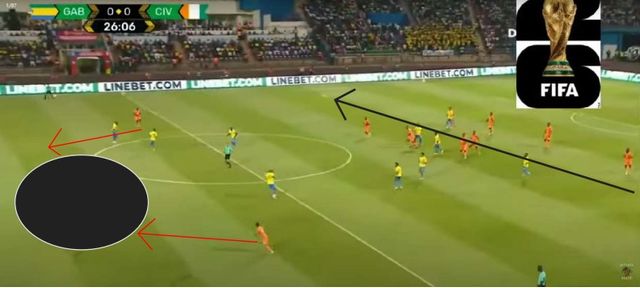
Côte d’Ivoire’s rest attack set: Amad and Pépé positioned wide, ready to attack the space behind the opposition defence as the ball is launched in transition.
Diallo, on the other hand, offers sharp dribbling and quick combination play in tight areas.
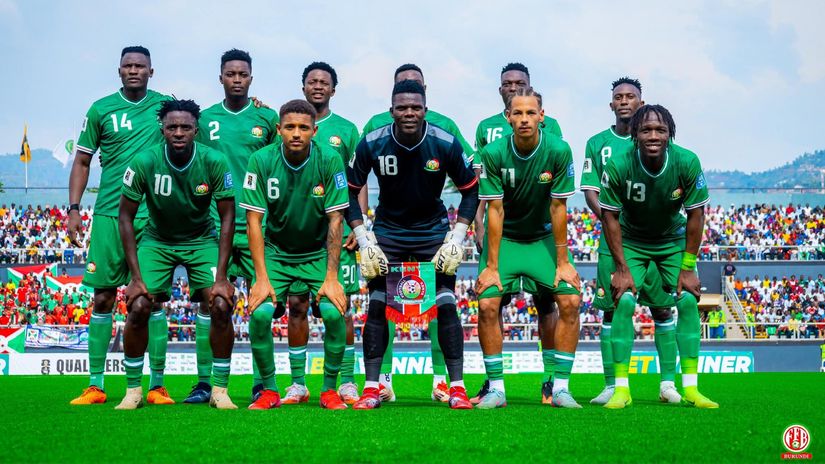
Haller remains pivotal - not only for his aerial dominance but also for his hold-up play.
He frequently drops into the half-spaces to link with midfielders and initiate diagonal switches to wide players.
His ability to pin centre-backs and play quick lay-offs makes him essential in transitioning from buildup to final-third penetration.
Côte d’Ivoire also pose a serious threat from set-pieces, especially corners.
Their routines focus on in-swingers aimed at the back post, with a hybrid defensive marking setup: zonal coverage at the near post and second six-yard box, combined with man-marking to nullify aerial threats.
Defensive vulnerabilities
Despite their structure, several tactical vulnerabilities present opportunities for Kenya.
First, their high line can be punished in transition - especially just after they have regained possession and are momentarily disorganized.
If Kenya breaks quickly through the flanks, they can exploit the large spaces left behind by advancing fullbacks.
Their midfield, while physically dominant, can be overloaded.
The lone pivot in their 4-1-4-1 shape can be exposed if Kenya creates central overloads - drawing wide pressure and then switching sharply into the middle.
Côte d’Ivoire also shows inconsistency in defending crosses, particularly early or diagonal switches from wide areas.
Additionally, their midfielders tend to commit tactical fouls in risky areas, sometimes lacking intelligent aggressive discipline - this presents an opening for Kenya to win dangerous set-piece situations in and around the box.
Defensively, Kenya’s fullbacks must be sharp in 1v1 duels against their wingers, while the backline as a whole must anticipate their striker’s aerial lay-offs and second balls.
Côte d’Ivoire enters this game needing a win to retain control of their qualification.
Their approach will be proactive, with no room for complacency. Kenya, although not in contention, will look to finish the campaign with pride and tactical discipline.
If they remain organized, exploit transitions wisely, and execute set-pieces with purpose, they can frustrate the Ivorians and potentially force an unexpected result.