


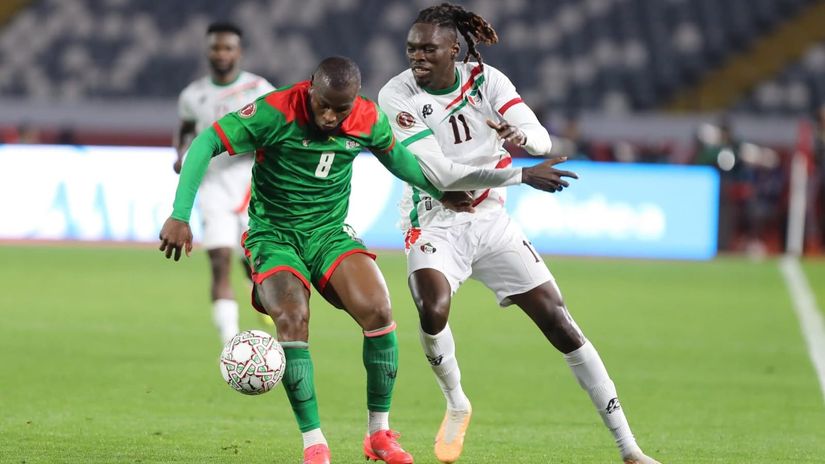
TACTICAL ANALYSIS AFCON 2025: How Burkina Faso outmaneuvered Sudan to cruise into Round of 16
.jpg)
.jpg)
Reading Time: 5min | Thu. 01.01.26. | 17:44
Sudan showed organisation, effort, and flashes of creativity, but their lack of cutting edge and the missed penalty proved costly. Burkina Faso, more composed and tactically flexible, capitalised on critical moments and managed the game intelligently to secure qualification
Burkina Faso sealed their passage from Group F with a disciplined and ultimately decisive 2–0 victory over Sudan at the Stade Mohamed V in Casablanca.
The a result underlined their tactical maturity and game management in a match rich with structural detail and contrasting approaches.
Although the scoreline suggests control, the contest itself unfolded in phases, with Sudan enjoying moments of promise, particularly in the first half, before Burkina Faso’s superior organisation, patience, and execution told in the decisive moments.
Follow our WhatsApp channel for more news
This final group game carried different pressures for both sides.
Sudan arrived with momentum after a narrow 1–0 win over Equatorial Guinea, while Burkina Faso were seeking redemption following a 1-0 loss to Algeria.
Both coaches opted for heavy rotation, Sudan making ten changes and Burkina Faso seven, a clear sign of squad management but also an indication that tactical balance and cohesion would be tested early.
Sudan set up in a 4-2-3-1 in possession, with Abooja Mohamed in goal behind a back four of: Zaid Awad, Abaker Altayeb, Hakeem Kesra Mohamed, and Mohamedein Mazin.
The double pivot of Alhassan Adil and Awad Yaser anchored midfield and shielded the defence while progressing the ball forward.
Ahead of them, Aamir Abdallah operated as the advanced midfielder, floating between the lines as the creative hub.
Mozamil Yasir and Algozoli Nooh provided width on the flanks, while Mano John led the line as a physical aerial outlet.
Out of possession, Sudan dropped into a compact 5-3-2 low press, prioritising central protection and transition opportunities.
Burkina Faso, by contrast, demonstrated greater structural fluidity.
They built in a 3-2-5 shape, with Koffi Herve in goal and a back line that often morphed into a three as Simpore Saidou dropped between centre-backs Edmond Tapsoba and Issoufou Dayo.
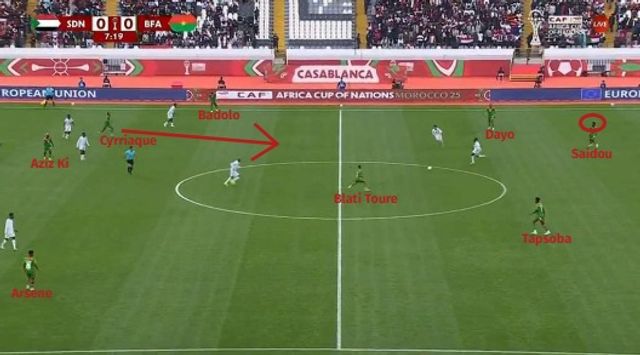
Burkina Faso’s early build-up shape
Cedric Badolo and Arsene Kouassi provided width, particularly on the left where Kouassi was given licence to push high.
In midfield, Ibrahim Blati Touré balanced progression and recovery alongside Simpore, while Aziz Ki operated higher, linking midfield to attack.
.jpg)
The front three of Georgi Minoungou, Irie Cyriaque, and Lassina Traoré stretched Sudan vertically and horizontally.
The opening exchanges were disjointed, with neither side settling into rhythm within the first four minutes.
Sudan’s early approach was direct, repeatedly going long from goal kicks towards Mano John, using him as an aerial reference point and hoping to pick up second balls through Abdallah.
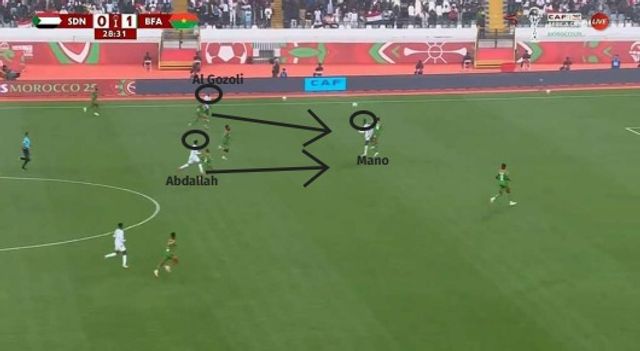
Sudan’s direct approach: long balls aimed at Mano as the target, with a winger and Abdallah positioned nearby to collect second balls and drive play into the attacking third
Burkina Faso, meanwhile, were more measured, recycling possession and drawing Sudan’s block deeper, before attempting to progress through the wide channels.
Sudan’s attacking threat came largely through transitions.
Their wingers looked to break quickly when possession was regained, while Abdallah positioned himself intelligently to collect loose balls after long passes.
Defensively, Sudan were initially well organised, tracking Aziz Ki’s late runs and closing passing lanes around the box.
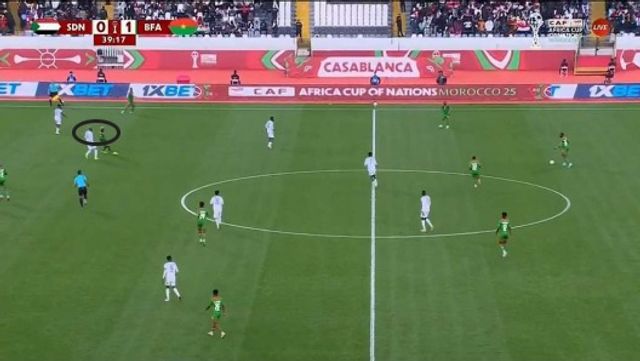
Dominant in duels(8), Alhassan Adil conducted a tight tracking of Aziz Ki between the lines, denying him space to receive on the half-turn in the first half
Alhassan Adil stood out in this phase, winning duels and disrupting Burkina Faso’s rhythm, while Hakeem Kesra showed composure in one-on-one defending.
The breakthrough came in the 16th minute, and it was a moment that encapsulated Burkina Faso’s opportunism.
A lapse in Sudan’s defensive structure allowed Minoungou to dispossess his marker on the left, releasing Aziz Ki on the right.
His precise delivery found Lassina Traoré, who rose unchallenged to head home.
The goal rewarded Burkina Faso’s territorial dominance and highlighted Sudan’s vulnerability when their compact shape was momentarily breached.
Sudan were handed a golden opportunity to respond soon after.
Burkina Faso briefly switched off in possession, playing a risky back pass that invited pressure.
Algozoli chased aggressively, forcing the goalkeeper off his line and drawing a foul that resulted in a penalty.
However, the moment became a critical turning point.
Algozoli’s effort lacked conviction, drifting wide with little power or placement.
That miss not only denied Sudan parity but also shifted psychological momentum firmly in Burkina Faso’s favour.

Despite the setback, Sudan continued to show discipline. Abdallah remained central to their creativity, drifting between lines and drawing fouls, while Alhassan Adil tracked Aziz Ki diligently.
Burkina Faso maintained control of possession, ending the half with 71%, but Sudan defended resolutely, limiting them to just one shot on target.
Statistically, Sudan even edged the expected goals at halftime, largely due to the missed penalty, finishing the half with 1.03 xG compared to Burkina Faso’s 0.79.
Tapsoba and Dayo were standout performers for Burkina Faso in the first period, with the former excelling in distribution and chance creation, and the latter leading all players in tackles.
The second half began with disruption as Burkina Faso were forced into an early substitution, Koffi Herve leaving injured and replaced by Kylian Nikiema.
Sudan adjusted their out-of-possession shape to a flatter 4-4-2, but their attacking transitions lacked tempo.
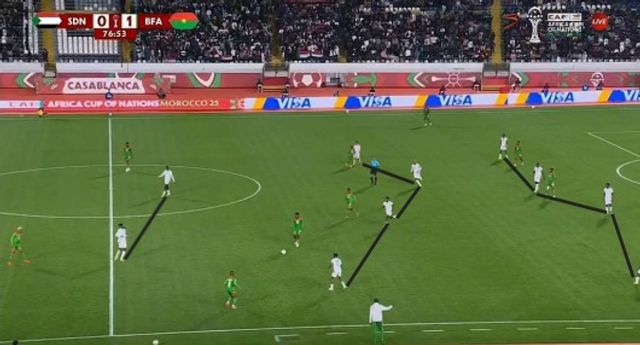
Sudan’s compact 4-4-2 out-of-possession shape, closing central and interior passing lanes
While they succeeded in luring Burkina Faso’s press and going long, the speed of their forward movement was often too slow to capitalize.
Burkina Faso introduced fresh legs around the hour mark, reinforcing their attacking intent, while Sudan replaced Mano John with Asad Mohamed in search of renewed energy up front.
The left flank remained Burkina Faso’s primary outlet, with Minoungou repeatedly isolating defenders and combining with Kouassi.
Sudan’s defensive unit continued to resist, with Kesra in particular reading danger well until his withdrawal late on.
The decisive second goal arrived in the 85th minute and was a direct consequence of structural disruption.
With Kesra off and defensive gaps appearing, Ouattara Dango slipped a through ball into space, releasing Kouassi, who finished low past the goalkeeper.
It was a reward for Kouassi’s relentless two-way performance and highlighted how even brief lapses at this level can be ruthlessly punished.
By full time, Burkina Faso’s efficiency told the story.
They finished with three shots on target from an xG of 1.22, while Sudan managed only one shot on target despite accumulating 1.65 xG through set plays and the penalty.
Kouassi emerged as one of the match’s standout performers, winning all his duels and contributing at both ends, while Lassina Traoré and Blati Touré impressed with clinical finishing and midfield control respectively.
For Sudan, Alhassan Adil and Aamir Abdallah stood out despite the defeat, the latter finishing as the most fouled player and the one most willing to take responsibility in attack.
Ultimately, this was a match defined by key moments and tactical nuance.
Sudan showed organisation, effort, and flashes of creativity, but their lack of cutting edge and the missed penalty proved costly.
Burkina Faso, more composed and tactically flexible, capitalised on critical moments and managed the game intelligently to secure qualification.