


.jpg)
Roofing works begin at Talanta Stadium as completion date nears [VIDEO]
.jpg)
.jpg)







Reading Time: 3min | Fri. 26.09.25. | 12:09
In the latest photos, the proposed design of the facade and steel works is taking shape
After a long wait, the structural roofing works at Kenya’s Talanta Sports City Stadium are set to proceed with speed after the completion of erection of the roofing tension cable.
The computerized hydraulic tension cable took approximately two months to erect but that has since been completed and is now about 51 meters high, two meters shy of the full stadium height.
Follow our WhatsApp channel for more news
The Talanta Sports City Stadium is a brand new ultra modern stadium being constructed by the Kenyan government as part of the broader agenda to improve the country's sporting industry.
According to a Facebook Reel by Uniloq Nairobi, the tension cable has now been successfully erected, paving way for the commencement of other works including the roofing steel.
The latest stadium construction technology had only been used in four other stadiums worldwide, and Talanta will now join the elite club by being the fifth to implement the engineering invention.
The erection of the cable is a highly complex and specialized task that largely takes a longer time due to engineering, logistical as well as safety procedures.
The complex engineering design required precision in the cable structures, which relies on perfect tensioning as any slight error compromises structural integrity.
🟩Progress update : Roofing
— Construction Today Kenya🇰🇪 (@Constafrica) September 21, 2025
Talanta Stadium https://t.co/NkqknPYKjm pic.twitter.com/r8RqfO6cjX
The cables, connectors and masts are also custom made which increases the time.
Still on engineering, the weather patterns including wind and seismic loads are considered and plans must be made to accommodate such.
The hydraulic tension cables also require proper foundation and anchor point preparation as tension cables exert massive forces on the anchor points, requiring deep foundation works like piles and reinforced concrete.
The installation sequence and tensioning also takes time as cables are hoisted and not all cables can be tensioned at once as they must be gradual and in sequence to avoid imbalance.
![Kenya's Talanta Stadium set to become 5th arena worldwide with new engineering technology [PHOTOS]](https://cdn3.mozzartsport.co.ke/upload/825x464/News/Image/2025_09/1757586117571_G0ibY5QWEAA4LFh_(1).jfif)
Additionally, cable erection is sensitive to weather changes such as wind, rain and temperature and would stop during extreme conditions for safety reasons.
Safety protocols involving work at height and such environments involve inspection, rechecking tensions and alignment monitoring. While the whole safety protocol takes some more time, they are non-negotiable.
The roof is assembled on the ground in phases and this reduces the work done at height and reduces labor. The roofing also appears very light and elegant as it requires minimal amount of structure for support.
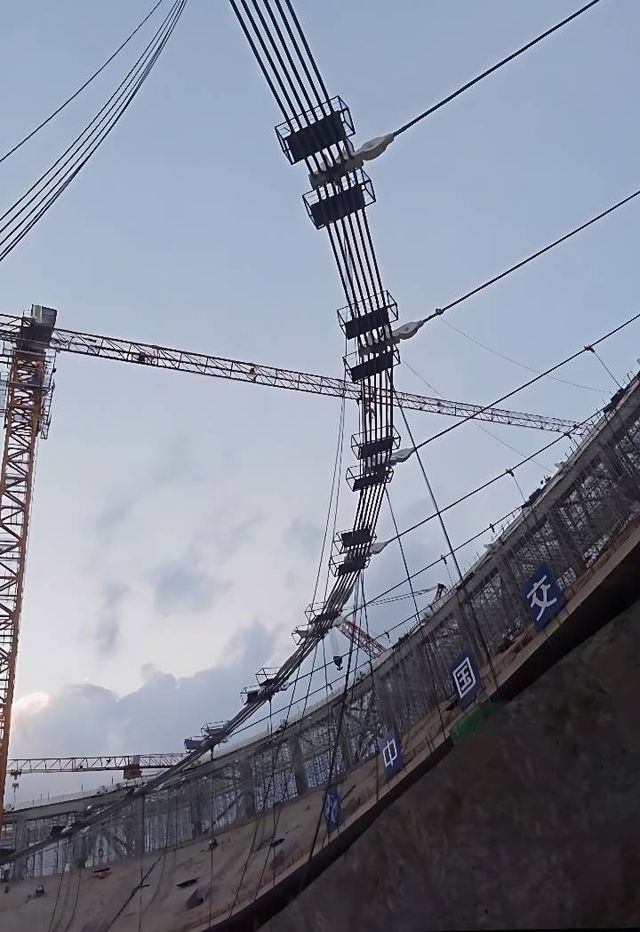 Kenya Stadiums/Facebook
Apart from the roofing, steel works at the facility's facade have also progressed well and are nearing completion, at least according to photos shared online by Kenya Stadiums.
In the latest photos, the proposed design of the facade is taking shape as works continue simultaneously with the roofing works.
Just like in the roofing, the majority of steel works for the facade is done on the ground before hoisting by a crane, again to reduce work done at height as dictated by safety protocols.
Behind the stands, partitioning of rooms is continuing in earnest with some even at plastering level. The stadium is expected to contain several rooms as it will also be home to a number of state-of-the-art facilities, rare in the region.
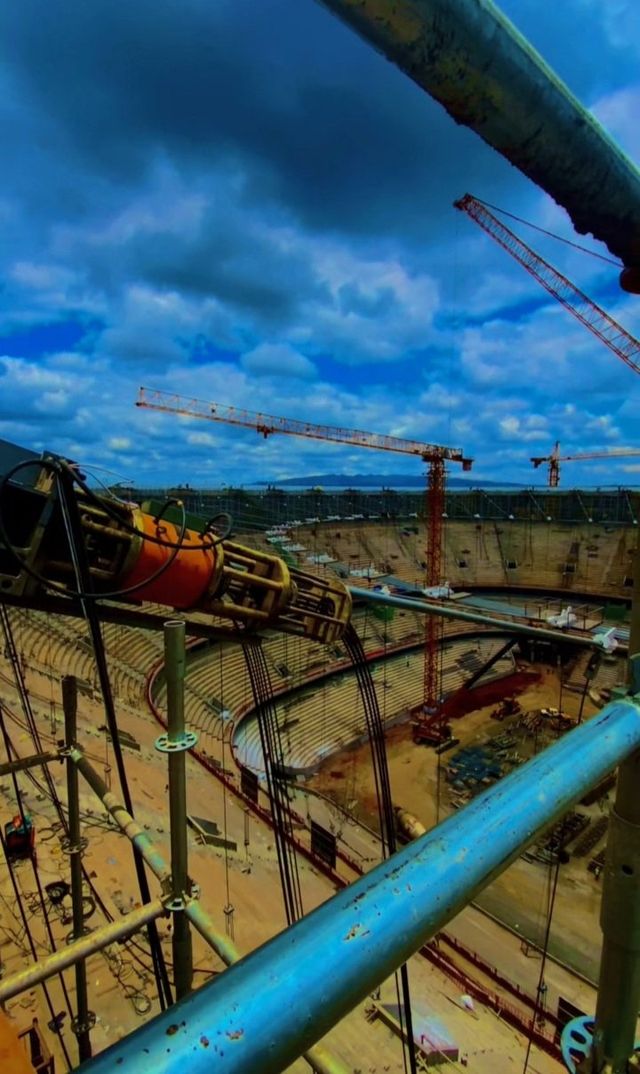 Kenya Stadiums/X
Talanta will have among other, seven changing rooms, a Video Assistant Referee (VAR) room, medical room, modern media center as well as 52 sky boxes among others.
Construction works at the proposed 60,000-seater stadium began in March 2024 in a ground breaking ceremony presided by President William Ruto. The facility is expected to be ready by 31 December.
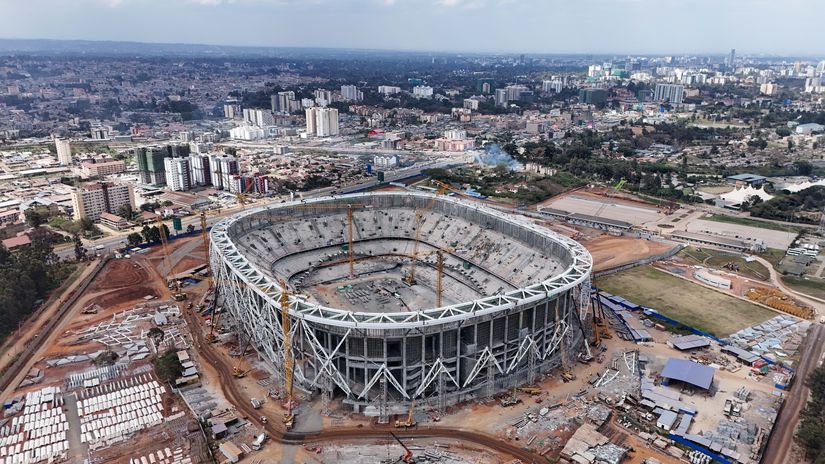
The Chinese firm, China Road and Bridge Corporation (CRBC) were assigned the construction duties that are supervised by both the Ministry of Defense and the Ministry of Sports.
As opposed to other major stadiums in Kenya and the East African region, Talanta Stadium will be a football-specific facility as it will not have a running track. This will in turn increase fan experience by bringing them closer to action.
In the end, Talanta Sports City will cost $344.5 million (approximately Ksh44.7 billion) upon its completion which is scheduled for 31 December.