


New completion date for Talanta Stadium announced as construction reaches 66% [VIDEO]









Reading Time: 4min | Thu. 20.11.25. | 19:28
The ultramodern facility will have six changing rooms, a VAR room, a doping room, 52 VVIP sky boxes, as well as several lounges, among other special features that all have to be considered during partitioning
The completion and operationalisation of the Talanta Sports City Stadium has now been pushed forward to February 2026, even as construction works progress.
Follow our WhatsApp channel for more news
The Talanta Sports City Stadium is a flagship project by the Government of Kenya to build a brand new ultramodern stadium in readiness for hosting the 2027 Africa Cup of Nations (AFCON) and, most importantly, to improve the sporting infrastructure in the country.
Construction of the Ngong’ Road-based 60,000-seater facility began in March 2024 in a groundbreaking ceremony presided over by President William Ruto during the tenure of former Sports CS Ababu Namwamba.
.jpg)
Talanta Stadium is Kenya’s biggest sporting infrastructure project in almost four decades since the construction of the Moi International Sports Centre, Kasarani, in 1987, and Nyayo National Stadium four years earlier.
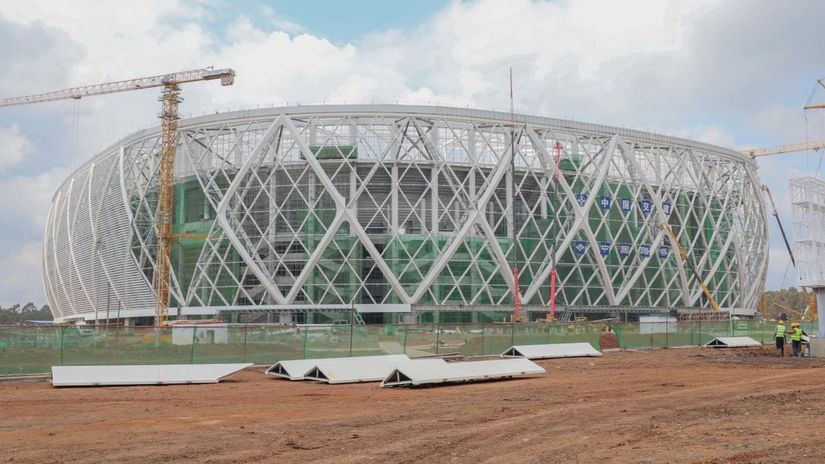
Construction works at the facility continue in earnest, and after a tour of the arena, Sports CS Salim Mvurya shared a video and photos of the current state of the facility and thereafter revealed that the stadium is now 66% complete.
As revealed by Mvurya, the stadium will also not be completed by 31 December as earlier anticipated and is now expected to be completed by 28 February 2026.
However, by 31 December, the majority of works, especially in the external parts of the facility, will be complete.
“By the end of December 2025, all exterior and major infrastructural works will be finalised, paving the way for the contractor to commence finishing works in preparation for full operationalisation by February 2026,” said Mvurya.
According to the photos and video shared by the former Kwale County Governor, the facility's curtain walls are almost complete, with major steel framework already done around the stadium.
-min.jpg)
The finishing design and grills work of the curtain wall have also begun in some sections and are all expected to be complete by the end of the year to pave the way for the installation of the media facade lighting, as in Allianz Arena - the home of German club Bayern Munich.
Apart from the curtain wall, the other major part of the construction ongoing currently is the installation of the roofing steel structures that will hold the canopy.
The roofing works began with the installation and raising of the computerised hydraulic tension cable, which involves the use of tension as opposed to compression to stabilise the roof.
A combination of powerful hydraulic jacks was combined with a network of high-strength cables that were gradually fitted as the cable was installed and lifted in phases.
The modern engineering technology then allows the roofing structure to be fixed and held by the cable, which is part of the ongoing work currently.
There is also construction continuing inside the stadium, where partitioning of various rooms and facilities that will be inside the arena.

The ultramodern facility will have six changing rooms, a VAR room, a doping room, 52 VVIP sky boxes, as well as several lounges, among other special features that all have to be considered during partitioning.
Both electrical and plumbing works are also undertaken concurrently, with wiring almost complete in some of the rooms, at least according to recent videos shared by Kenyan Stadiums on YouTube.
In the stands, the concrete works in the three-layer facility are almost done, with the construction of staircases currently ongoing.
Once the major external and concrete works are done, the construction on the playing surface will begin ahead of the February 2026 completion date.
As stated by Mvurya, the facility will call for an inter-ministerial approach as ministries such as that of transport will be undertaking road work, the Ministry of Energy on electricity, and the Ministry of Environment takes care of landscaping.
“In line with the Whole-of-Government Approach, complementary works, including rail connectivity, road upgrades, utilities, and other supporting infrastructure, are progressing steadily to ensure seamless access and enhance the stadium’s wider ecosystem,” stated Mvurya.

The facility, which is undertaken by the renowned China Road and Bridge Corporation (CRBC), will cost about $344.5 million (approximately Ksh44.7 billion), before interest, but will bring great benefits to Kenya.
“The iconic monumental project is a cornerstone in positioning Kenya as a continental and global sporting powerhouse, elevating our capacity to host world-class events while showcasing Kenya’s excellence, ambition, and growing reputation in modern sports infrastructure development,” remarked Mvurya.