


Murder on the pitch - own goal that cost a life
Reading Time: 6min | Thu. 18.09.25. | 18:04
The story of one of the most tragic events in football history, the story of Andres Escobar, a man for whom a goal and the sport he loved most and played cost his life
"Life doesn’t end here. We have to go on. Life cannot end here. No matter how difficult, we must stand back up. We only have two options: either allow anger to paralyse us and the violence continues, or we overcome and try our best to help others. It’s our choice. Let us please maintain respect. My warmest regards to everyone. It’s been a most amazing and rare experience. We’ll see each other again soon because life does not end here”
Colombia captain, Andres Escobar, after elimination from WC 1994 in USA
The story of Andrés Escobar, a Colombian footballer, remains one of the most tragic tales in the annals of sports, particularly due to its connection to the 1994 FIFA World Cup. Here's a detailed thread on it. pic.twitter.com/CTMTHX3aOh
— Akash (@akashd7781) August 22, 2024
Despite what skeptics armed with hindsight might claim, Pele’s prediction that Colombia could reach at least the semi-finals of the 1994 World Cup in the USA was not some reckless guess. The harsh reality, however, would follow later, in the form of six bullets fired in a Medellin nightclub parking lot during the early hours of 2 July 1994.
Those shots reverberated across the globe, shocking millions: the captain of Colombia, Andres Escobar, had been murdered—six times in the back—apparently as revenge for his inadvertent contribution to his own team’s elimination from a World Cup still underway. For no crime more egregious than scoring an own goal, El Caballero del Futbol, the gentleman of football, was gunned down in cold blood.
📆 July 2, 1994
— GOAL (@goal) July 2, 2019
Andres Escobar was murdered in Medellin after his own goal led to Colombia's World Cup exit
Rest in peace 🙏 pic.twitter.com/2Sw0b51Ray
Escobar was the quiet, disciplined leader of a golden generation of Colombian footballers, a squad that had conceded only two goals in the qualifying campaign leading up to USA 94. Pele’s faith was not misplaced: this was a team of genuine contenders. Their credentials were spectacular.
In the final qualifier against Argentina, whose team needed a win to guarantee their place in the tournament, Colombia thrashed the hosts 5-0 in Buenos Aires. The result stunned Argentine fans and earned standing ovations for a team largely unknown outside South America.
In 26 matches prior to the World Cup, Colombia had suffered only one defeat. Coach Francisco Maturana encouraged his players to express themselves fully, and their natural flamboyance paid off spectacularly thanks to gifted individuals such as Carlos Valderrama, Freddy Rincon, Alexis Garcia, and Faustino Asprilla—a mere glimpse of a squad that would later captivate the continent.
Editor's Pick
Yet off the pitch, Colombia was in turmoil. Medellin was still reeling from the reign of terror left by Pablo Escobar—not related to Andres—a namesake who had led the multi-billion-dollar Medellin drug cartel.
Despite his bloodthirsty record, Escobar was adored by many of Colombia’s poor, providing employment and housing. Responsible for the deaths of judges, politicians, over 500 policemen, referees, and thousands of rival cartel members, Pablo had surrendered to Colombian authorities in the early 1990s, avoiding extradition to the United States.
Confined to the self-styled fiefdom of La Catedral Prison, he was promised a reduced sentence in exchange for ceasing drug trafficking. The football team even secretly visited him there for kickabouts on pitches he had built as part of the surrender agreement.
In 1991, Pablo Escobar surrendered and lived in his self-built prison, La Catedral, where he hosted notable visitors, including René Higuita, Diego Maradona, and even Colombia's national team for a friendly match. For Higuita, it wasn’t his first meeting with Escobar. pic.twitter.com/Jmsc8lwlwg
— Football Hub (@FootbalIhub) January 27, 2025
Not everyone handled the association well. Rene Higuita, the flamboyant goalkeeper, once paused to speak with journalists outside the prison during a visit, sparking a scandal that cost him his place at the World Cup.
Andres Escobar, in contrast, was always uneasy about socializing with such a notorious figure. “Maria, I don’t want to go but I have no choice,” he confided to his sister Maria Ester. As Jaime Gavira, his cousin, later explained in The Two Escobars: “When Pablo died, the city spun out of control. The boss was dead, so everyone became their own boss. Pablo had prohibited kidnappings. He ran the underworld with complete order. Anything illegal, you asked for Pablo’s permission.”
Amid this chaos, with bombings and shootings making Medellin a city under siege, Colombia’s footballers traveled to USA 94. “It’s difficult to stay focused, but I find motivation in the good things to come,” said Escobar, 27 at the time, recently engaged to Pamela Cascardo and having accepted an offer to play for Milan the following season.
On this day in 1994, Gheorghe Hagi scored this against Colombia... 🚀pic.twitter.com/h6PhSC3XQJ
— 90s Football (@90sfootball) June 18, 2024
Yet their World Cup campaign could hardly have started worse. At the Rose Bowl in Pasadena, they fell 3-1 to a disciplined Romanian side, marking the beginning of a psychological crisis the team was unprepared for. As Velasquez recalled: “Many gamblers lost big money and there appeared a sort of ‘dark hand’ that was very upset with the team’s performance.”
Threats replaced the customary welcome messages on the players’ hotel TVs, and personal tragedies continued at home: Luis Herrera’s infant son had been kidnapped and returned safely, while his brother was killed in a car accident following the team’s defeat.
The second group match, against host nation USA, arrived under tremendous pressure. “We’d played hundreds of friendlies against the USA and won them all,” midfielder Leonel Alvarez recalled. But Medellin remained in chaos, and death threats reached the team once more.
Maturana, their manager, was warned that if veteran midfielder Gabriel Gomez played, the squad could be killed. Terrified, the players entered the field, frozen with fear. Faustino Asprilla described the pre-match meeting as tense and paralytic, with “nobody saying a word.”
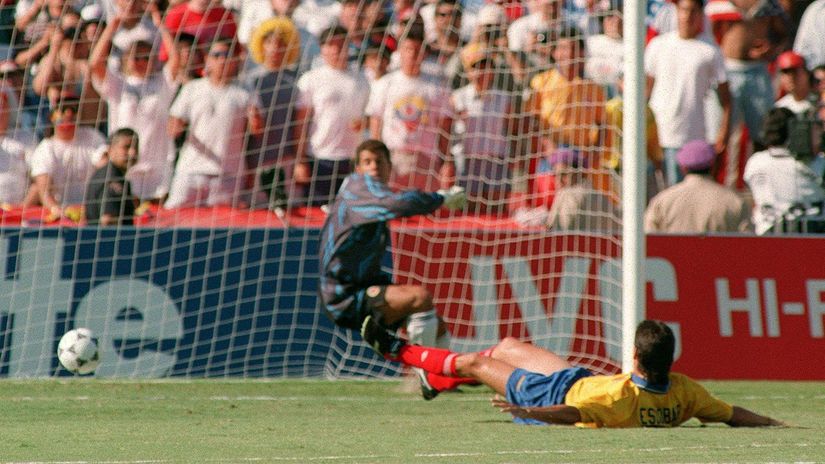
Colombia attacked relentlessly from the start, but luck was absent. In the 22nd minute, Escobar, stretching to intercept a curling cross from John Harkes, inadvertently diverted the ball into his own net. For a few moments, he lay on the ground in disbelief, then rose and walked to the halfway line, concealing any awareness of the deadly consequences that awaited.
In front of 93,000 fans at the Pasadena Rose Bowl, captain Andres Escobar (no relation to Pablo) scored a disastrous own goal in a 2-1 defeat.
— The Upshot podcast (@UpshotTowers) March 29, 2023
Weeks later, the defender was gunned down outside a Medellin nightclub.
Apparently his goal had cost cartel bosses $3m in lost bets. pic.twitter.com/bn8hax18xT
Back in Medellin, Escobar received advice to stay home. “I said ‘the streets are dangerous,’” Maturana recalled. “Here conflicts aren’t resolved with fists. Andres, stay at home.” But Escobar insisted: “No, I must show my face to my people.”
That evening, he went out with friends to El Indio Bar. There, a group verbally abused him over his own goal. Escobar attempted to reason with them in his car, insisting it had been an honest mistake. The confrontation escalated; a gun appeared, and six bullets tore through his back. An ambulance arrived, but less than 30 minutes later, Andres Escobar was declared dead.
After upsetting Colombia at home in the 1994 World Cup, USMNT striker @EricWynalda exchanged shirts with Andrés Escobar...less than two weeks later Escobar was gone 💔
— CBS Sports Golazo ⚽️ (@CBSSportsGolazo) June 11, 2024
A new episode of Kickin' it with U.S. Soccer legend Eric Wynalda premieres Tuesday, June 11 at 8 PM ET on… pic.twitter.com/ErmmGn4hE9
Twenty years on, Escobar is remembered globally as the tragic Colombian footballer who was brutally killed for scoring an own goal. Life, he had written in a valedictory column for El Tiempo, “doesn’t end here.” For him, it ended violently just days later in the confines of a Medellín nightclub parking lot, leaving a haunting legacy that intertwines the brilliance of Colombian football with the darkness of its times.