


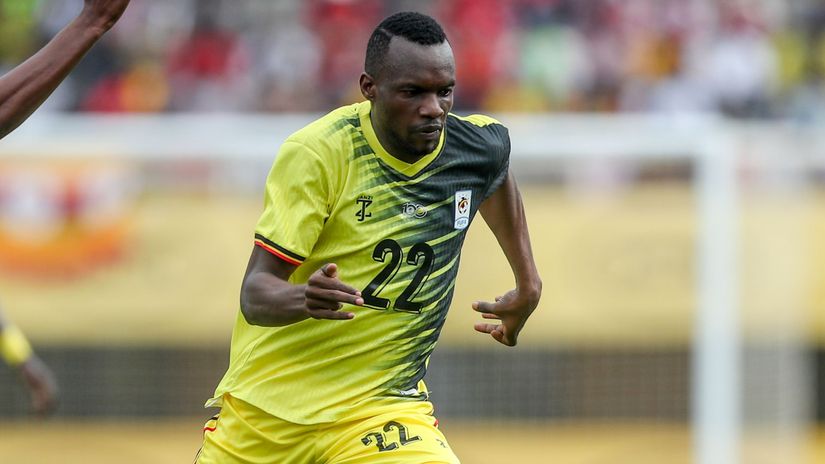
Is Taddeo Lwanga the man to help AFC Leopards end 29-year league drought?





Reading Time: 7min | Sat. 27.06.26. | 21:48
For Leopards, a club that has spent years trying to bridge the gap between potential and silverware, the signing is more than a midfield reinforcement
Some signings simply strengthen a squad, and then there are transfers that quietly speak to ambition. Taddeo Lwanga’s imminent arrival at AFC Leopards feels firmly like the latter.
Download our Mozzart Sport app for more news
Not because he arrives with fanfare alone, and not because his name guarantees headlines across East Africa, but because his career has been shaped by something Ingwe have spent nearly three decades chasing: the habit of winning titles when it matters most.
For Leopards, a club that has spent years trying to bridge the gap between potential and silverware, the signing is more than a midfield reinforcement.
It is a signal. A reminder that the final step in rebuilding a giant is often not about talent alone, but about experience under pressure, about players who know what it takes to cross the line.

And Taddeo Lwanga, a Software Engineer, for all his understated style, is exactly that kind of footballer.
The weight of expectation in Nairobi
AFC Leopards do not suffer from small dreams. They never have.
Few clubs in East Africa carry the same historical gravity. The trophies are real, the legacy is undeniable, and the support base is vast and emotionally invested.
But history, for all its pride, can also become a burden. Every season without a league title since 1998 has added another layer of expectation, another reminder that giants are measured not by memory, but by renewal.
In recent years, Ingwe have flirted with resurgence. There have been seasons where belief returned to the terraces, where Nyayo and Kasarani roared with the sense that something was building again.
Last season, they came closer than they have in years, pushing into a genuine title conversation before falling short by the smallest of margins.
That “almost” is where pressure lives. And it is exactly the kind of environment where experience becomes priceless. A career built on movement, pressure, and adaptation.
Lwanga’s journey to Nairobi has not been linear. It has been a series of climbs, each one steeper than the last.
.jpg)
He emerged in Uganda’s domestic football scene with Express FC and SC Villa, two clubs where expectation is not occasional but constant.
At Villa in particular, the shirt carries history that demands authority. There is no easing in; you either adapt quickly or you are carried by the current.
Lwanga adapted.
It was at Villa that he began to develop the traits that would later define him: positional discipline, defensive intelligence, and an ability to absorb pressure without losing structure.
He was not the type to dominate headlines, but coaches noticed him. Teammates relied on him; opponents, on the other hand, felt him.
From there, his move to Vipers SC marked a turning point. At Vipers, he was not just part of a team; he became part of a machine built to win. The midfield responsibilities grew heavier. The tactical expectations sharpened. The margin for error narrowed.
Then came the silverware.
Captaining and anchoring a side that lifted the Ugandan Premier League title, Lwanga learned the most important lesson of his career: that winning leagues is not about bursts of brilliance, but about surviving the weeks when form dips, when pressure rises, and when everything feels like it might slip away. That education would follow him everywhere.

Simba SC and the culture of winning
If Vipers taught him how to win, Simba SC in Tanzania showed him what a winning culture looks like when it is institutionalised. See, at Simba, expectations are not seasonal; they are structural.
Every competition is approached as a target. Every drop in standards is treated as unacceptable. Every player who arrives quickly learns that second place is not a consolation, but a failure.
Lwanga’s time there placed him in one of the most intense football environments in East Africa. League titles were pursued aggressively. Domestic cups were treated as obligations. CAF Champions League campaigns brought continental pressure that few domestic leagues can replicate.
It is in such environments that players either elevate or fade. The engineer did not fade.
Instead, he added another layer to his understanding of football: how elite teams sustain dominance not just through talent, but through mentality. The discipline required to win repeatedly, season after season, becomes its own skill set. And Lwanga absorbed it quietly.
Later spells in Djibouti with Arta/Solar7 and in Rwanda with APR FC broadened that experience further. Different leagues, different pressures, but the same expectation: And he did win them all.
Few players in East African football have moved through as many winning environments while maintaining a consistent role in midfield structure.
By the time he arrives in Kenya, Lwanga is no longer just a domestic league player. He is a regional football journeyman shaped by multiple systems of ambition.

The Uganda Cranes and the continental stage
Over more than two dozen appearances for Uganda, he became part of a generation that helped the Cranes re-establish themselves on the African stage.
His role was rarely glamorous. He was not the one scoring decisive goals or producing highlight-reel moments. Instead, he provided balance, structure, and defensive stability in midfield.
His inclusion in Uganda’s squad for the 2019 Africa Cup of Nations in Egypt marked a career peak. For many players, AFCON is the highest level they will ever experience, and Lwanga’s participation placed him in matches defined by intensity, tactical discipline, and emotional weight.
Uganda’s campaign saw them progress beyond the group stage, a significant achievement in itself, before bowing out in the knockout rounds to giants Senegal by a solitary goal.
For Lwanga, it was another layer of education: how football changes when the margin between success and failure is razor thin, and every pass carries consequence.
That experience now travels with him to Nairobi.
AFC Leopards and the psychology of “almost”
If there is a single defining emotion in AFC Leopards’ recent history, it’s not failure; it is proximity.
Close to titles. Close to consistency. Close to breaking the long drought. But close is a dangerous place in football, because it creates belief without reward. It builds expectation without closure. That is where Lwanga’s arrival becomes significant.

He is not being signed to solve everything. No midfielder can carry that burden. But he is being signed to change something subtle: how a team behaves when it is close.
Title races are rarely decided in the big matches alone. They are often shaped in the quiet ones, away games that turn scrappy, mid-season stretches where fatigue sets in, moments where discipline matters more than inspiration. This is where experienced winners make their difference.
Lwanga understands those moments. He has lived them in Uganda. In Tanzania. In regional competitions where every point matters. He has seen what it takes to finish seasons as a champion, not just a contender.
The symbolism of the signing
For AFC Leopards supporters, the hope will naturally be immediate. That is the nature of football in Nairobi’s grand old clubs; every signing is interpreted through the lens of possibility.
But beyond optimism, there is symbolism here.
A club that has spent years rebuilding its competitive identity is now recruiting players who have already walked through winning systems elsewhere. It is a shift in strategy, from potential-building to consolidation. From future planning to present urgency. Lwanga represents that shift.
A midfielder who has carried responsibility in title-winning teams. A captain at club level. A player who has seen both domestic dominance and continental pressure. A footballer whose career has been defined less by hype and more by accumulation, of experience, of expectation, of resilience.

The climb ahead
No signing guarantees success. Football does not allow for such simplicity. Injuries, form, tactical shifts and competition all intervene. But what AFC Leopards have done is add a player who understands the climb they are attempting.
Because that is what ending a trophy drought is: a climb. Steep, repetitive, mentally draining. One that tests belief as much as ability. Taddeo Lwanga has spent his entire career climbing. And now, for the first time, he is doing it in a club that is trying to reach the summit it has not seen in nearly thirty years.
For AFC Leopards, the hope is simple: that this time, with the right mix of ambition and experience, the final steps of the climb will not end in “almost.”
They will end in arrival.