


FALSE 10: Dragon's nest is where the legend was born


Reading Time: 7min | Sat. 15.11.25. | 12:05
It was November 16, only 22 years ago, when Estadio do Dragao in Porto was inaugurated. An unbreakable bond was created in less than 20 minutes
Football has long been the most popular sport in Portugal, even though the results during the 20th century often did not match the prestige held by the most important of all the unimportant things, as Pope St. John Paul II referred to this beautiful game.
Yes, the westernmost country of continental Europe did have a representative in as many as eight European Cup/UEFA Champions League finals, and its giants, Benfica and Porto, did win three titles - Damn you, Bella Gutman, the Eagles' fans will say, remembering their team's five lost trophy-matches - but Portugal national team was entirely off the radar.
The generation led by Carlos Manuel, Fernando Chalana, and Rui Jordao did stun Europe, reaching the 1984 European Championship semi-finals and winning third place, just as Eusebio's class had done at the World Cup 18 years before, but those results were only the exceptions that proved the rule. The same goes for (another) Benfica's European final defeat, to Anderlecht in the 1983 UEFA Cup - Portuguese football needed a renaissance.
And the revival process began with a new wave, whose leaders included Luis Figo, Vitor Baia, Fernando Couto, Joao Pinto, Rui Costa, and others. It emerged at the turn of the century, and Portugal's phoenix-like rise began. At the 1996 EURO, the Navigators reached the quarter-finals and everyone knew the national team was ready to make a decisive step forward.
Hence, Portugal bid to host the 2004 European Championship and won, beating the remaining candidates, Spain, Hungary, and Austria (in a joint bid). That tournament was arguably the most heartbreaking disappointment in the history of Portuguese sport - the "injustice" would be corrected 12 years later thanks to Eder's famous goal, which catapulted him straight into legend - but this is not the story of Portugal and their national team.
No, it's a tale of one stadium and partly about a man who once briefly played at it.
Therefore, organizing such a major tournament like the European Championship was a gigantic endeavour, and the country needed better infrastructure, so stadiums sprang up like mushrooms in the rain. That's how one of the heroes of our story - Estadio do Dragao - was born.
Named after Porto's nickname ("The Dragons"), the "Dragon Stadium" was designed by the Portuguese architect Manuel Salgado, and it cost €125 million to build. With a capacity of 50,033 seats, it became the third-largest football stadium in the country, after Benfica's Estadio da Luz (68,100) and Sporting Lisbon's Estadio Jose Alvalade (52,095).
Apart from five matches of the 2004 EURO - including the quarter-final clash between the Czech Republic and Denmark and the semi-final duel between Greece and the Czechs - Dragao would also host the 2019 UEFA Nations League final and the 2021 UEFA Champions League final, in which Thomas Tuchel's Chelsea stunned mighty Man City.
Estádio do Dragão 🐉#UCL pic.twitter.com/OoxITM4D6l
— UEFA Champions League (@ChampionsLeague) February 21, 2024
But this isn't just the story of Dragao. To make it complete, we need to introduce the player mentioned above - one of the first lucky guys to play football on the perfect, intact grass of the brand-new venue in east Porto.
While the stadium was counting its first days, the boy was 16 at the time, and he and his family had left their homeland almost three years before one fateful November day.
That day made him believe that everything was worth it and that he truly had a chance. He knew he'd never forget it, even though the rest of the world would need a couple of years to realize that the date of Dragao's grand opening would remain etched in their memories forever.
The boy didn't even expect he'd play, not at all. He just travelled with his father, mother, and one of his brothers, a bunch of super-experienced first-team players, and a few of his fellow prospects from the youth team, Oriol Riera and Jordi Gomez.
Still, the trio got a chance to present itself to the football world, though our hero would be the only one of the three to be remembered long after.
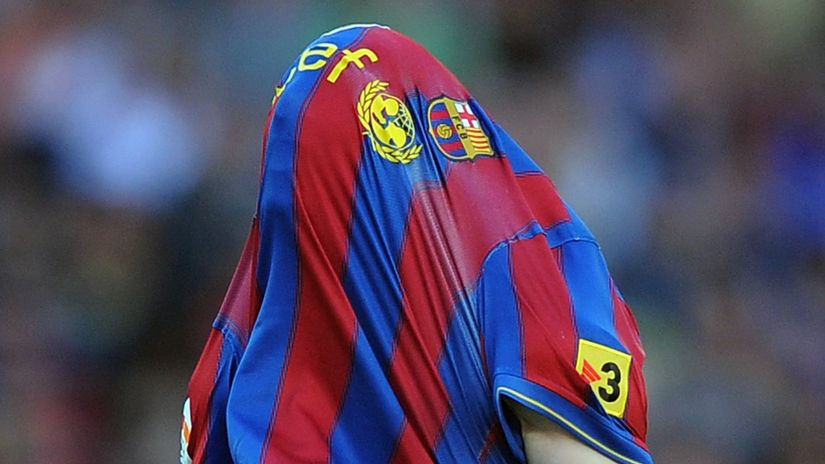
He stepped on the grass of Dragao, wearing his team's jersey for the first time in a "big boy's game." He wasn't just some kid anymore, he was a senior squad player, although, for instance, his captain, some guy named Luis Enrique, was twice his age.
Either way, he replaced Fernando Navarro in the 71st minute, wearing number 14 on his back - sometimes fate is strangely magical, just remember Johan Cruyff - when his crew had already fallen 2-0 down. Derlei from the spot and Hugo Almeida had sealed the deal for the hosts, though the youngster was just thrilled to make his debut for his beloved Barcelona finally.
It didn't bother him that many media outlets referred to him as Messy, misspelling his last name. He couldn't care less about the reports which didn't even mention his name after the match and Barca's 2-0 defeat to Porto.
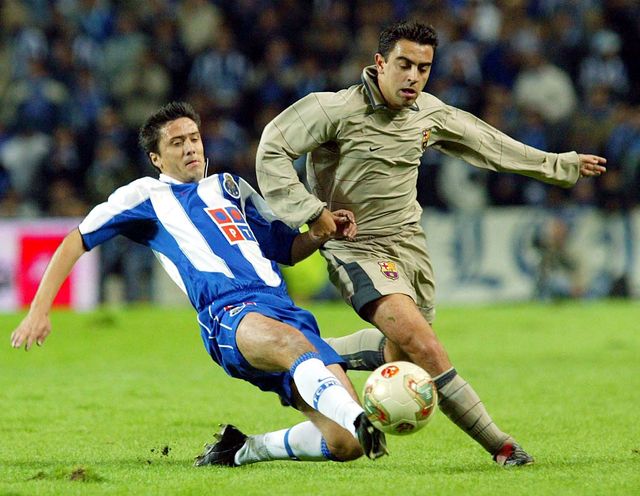 Tiago of Porto and Barcelona's Xavi in action at Dragao's inauguration (©AFP)
Mundo Deportivo wrote that "Barca, with many players from the B team, were defeated in Porto at the inauguration of the new stadium," while Guillem Balague, who'd publish the boy's autobiography ten years later claimed in it that "none of the Spanish or Portuguese newspapers made a single reference to the 16-year-old who had just made his first-team debut."
Only in 2013 would Joan Poqui, a journalist at Spanish Sport, admit the truth.
"No one paid attention to that kid. It was a meaningless friendly match, and almost no one even had a list of the youth players."
But who could blame them? How could they have known that they were witnessing the debut of a boy who would go on to become one of the greatest footballers in history?
Of course, some would later brag that they were aware of the youngster's immense talent from the very beginning, that they saw something no one else did, like, for instance, Porto boss, Jose Mourinho - a familiar name, isn't it? - but the truth is that even Barca manager Frank Rijkard had little idea of what that kid would become, giving a boring, standard statement that usually follows the debut of any young player.
"He only came on for 15 minutes, played very well, and had two scoring chances. His future is very promising," the Dutchman said following the match, as per Goal.com.
The same source reported the player's humble and composed statement, fitting his character, in which he said he "hoped he could play in La Liga someday."
Who would have imagined that that that fragile body, that face with a grin, and forehead covered with a curtain of thick bangs hid an incredible killer instinct, which would radiate from him whenever he ran onto the pitch.
Yes - let's admit there's little mystery left in this text - we are talking about Lionel Messi and his debut, and even though we didn't mention his name until this moment, our hints probably made it clear who we were referring to.
Either way, on November 16, 22 years ago, Estadio do Dragao and the Argentinian legend created an unbreakable bond in just 19 minutes. They were born on the same date - Dragao as an iconic venue and Leo as a professional footballer.
📖 Once upon a time ...
— FC Barcelona (@FCBarcelona) November 16, 2020
... a 16-year-old boy wonder made his Barça debut in a friendly.
This was #Messi, #OnThisDay in 2003 👇 pic.twitter.com/kLjdnS2E7J
Messi, at the same time, stole Dragao's thunder and immortalized its opening with his presence. Who would have ever remembered the date when the maiden match at the iconic Portuguese stadium was played if it weren't also the exact same day one of the football titans made his first baby steps as a pro?
November 16, 2003, became Dragao's birthday and the date of Messi's baptism - by fire, some would add.
Leo went on to play 20 more seasons in Europe, but he never again returned to Dragao, either as a Barcelona player or as a Paris Saint-Germain player. Fate wouldn't let it happen, we can assume, leaving those historic 19 minutes the only link between a man and a stadium, but the link that time cannot sever.
A couple of days ago, Messi returned to his home, to Camp Nou.
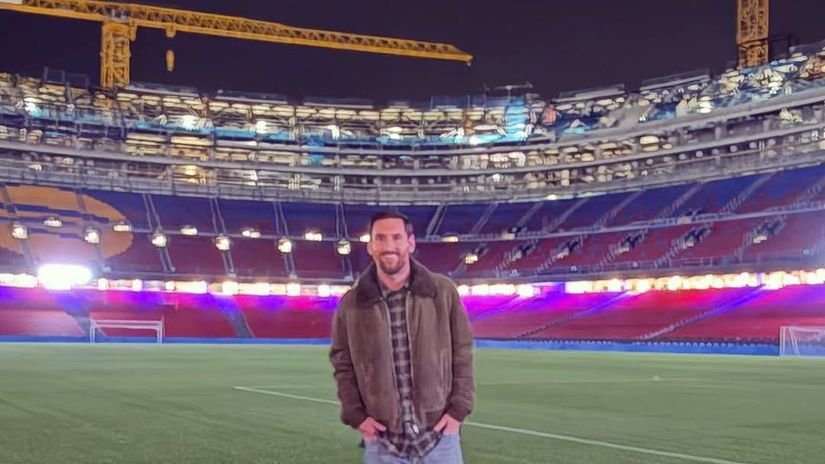
"Last night I returned to a place I miss with all my heart. A place where I was immensely happy, where you made me feel a thousand times like the happiest person in the world. I hope I can come back someday - and not just to say goodbye as a player, as I never got to do it," he wrote on his Instagram account.
Perhaps, one day - soon, hopefully - he will pay a visit to the place where everything began, a place untouched by him for 22 years. He could return because he surely remembers that day, just like the walls, locker rooms, and grass at Dragao remember it as well.
He could return because of the bond forged in eternity, because of November 16, 2003 and those fateful 19 minutes.