


AFCON Tales: Remembering Ndaye Mulamba's improbable AFCON record
.jpg)
.jpg)




Reading Time: 7min | Tue. 04.11.25. | 10:25
The assassin may be gone, but his peak season still comes to life in conversations around goals at the AFCON
The Leopards of DR Congo are a team seasoned at the continental stage, and among the first to represent Africa at the FIFA World Cup.
Even though recently falling short of qualifying for next year’s showpiece set for the United States, Leopards have gradually made a slow comeback after years of near misses, and now can go head-to-head with the current African heavyweights- the likes that arose during the Leopards’ slumber, like Senegal.
Follow our WhatsApp channel for more news
Football in the Congo indeed has deep roots, especially if one goes decades back to their golden eras in the seventies.
One particularly remembers the 1974 squad, the first of its kind at the World stage.
Kakoko Etepe, Maku Mayanga, Kibonge Mafu- the list goes on.
Before the World Cup, however, Yugoslavian coach Blagoje Vidinic had to first conquer the continent. It would not be a walk in the park, but he had a unit chasing their second African accolade, and what's more, he had a secret weapon that not a single one of his prospective opponents at the ’74 AFCON knew about.
Picture yourself playing an international final and having metaphorically carried your team on your back to the ultimate match, you score a brace, but it is not enough.
You’ are told the match is to be replayed. Two days later, you score a brace again, and your country is crowned champions of Africa. A lad from Kananga, Kasai Province in the DR Congo, and playing only his first AFCON championship, would do just that.
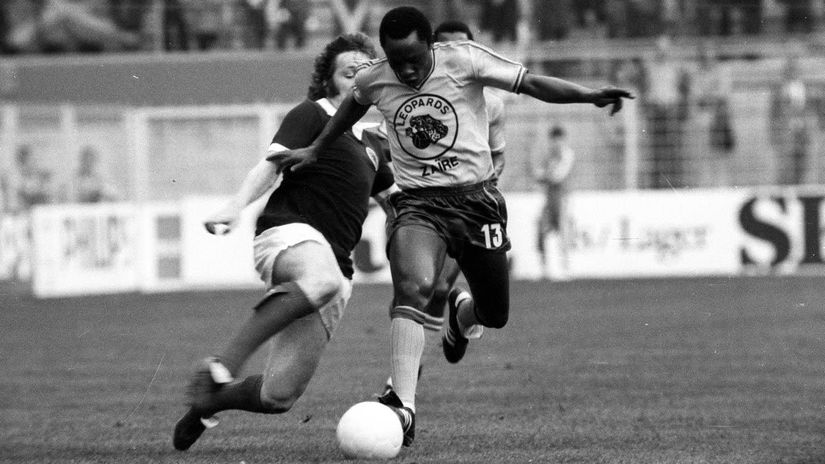
"They do not know who you are. You are not Etepe, you are not Mayanga. Use that and take them on the surprise," Vidinic is remembered for having said this to a young Pierre Ndaye Mulamba before Leopards jetted off to Egypt for the showpiece.
Mulamba, the would-be assassin, had merely cut his teeth with domestic giants AS Vita, winning three domestic doubles before making his mark with the CAF Champions League title the year before AFCON ’74.
For the Leopards, though, he was still a rookie and by comparison to the Etepe’s and Mayanga’s, a nobody in national team colours.
If only they knew how shockingly he was about to shake the order of things, not just for Zaire’s portfolio but also for himself. Half a century later, his riot remains untouched.
Cameroon legend Samuel Eto’o boasts an all-time goal-scoring record of 18 goals to his name at the AFCON during his active years.
Ivorian Laurent Pokou, on the other hand, sits on a comfortable 14 goals, but with a still active record of the most goals in a single match when he sent five past Ethiopia at one time.
Ndaye Mulamba, on the other hand, has just ten, a pale comparison to Eto’o, but what if I told you that he scored nine of those in 1974? And in a tournament format that had no round of 16 knock-out stages and quarter finals, and one only got to play two group stage matches? Yes, already nicknamed Mutumbula (The Assassin) by his Vita following, Ndaye did that in a single tournament, and no one has dared to dream that far to this date.
With the words of coach Vidinic seemingly ringing in his mind, Mulamba’s first casualty was Guinea as Zaire dispatched the West Africans 2-0, a brace from the rookie.
Next came Mauritius, and his solitary strike saw the Leopards make the semi-final.
They would face off with the showpiece hosts, Egypt. A nation equally just making its baby steps in the sport, the Pharaohs proved no match for a free-scoring Mulamba.
He would bag a brace here to see Zaire through to the final. A second title beckoned.
Mulamba and company, for the first time in the tournament, faced an equally talented side when Zambia walked out of the tunnel as their opponents in the final.
The match, too, lived up to its billing. With the odds marginally in their favour, Leopards went down when Zambia drew first blood.
It was game on when the assassin showed up late in the game to draw Zaire level. An additional half hour had to be played, and Mulamba sent his country up for the first time in the game.
All looked sealed until stoppage time, when Zambia rallied back and made it two-all. There would be no penalty shoot-outs and a re-match set for 48 hours later. The assassin had raked in seven goals to this point.
The rematch, played at the same venue two days later, presented a more astute Zaire defensively and a Zambian side that had seemingly not learnt anything from the first match.
Mulamba struck twice. Again. In either half. Zaire had its second AFCON title, and Mulamba wrote his name in the history books- a record only threatened more than forty years later by Cameroonian Vincent Aboubakar with eight goals in 2022.

It is the kind of performance that etches into many fans’ memories regardless of how long the record that comes with it stands.
Returning home as a continental icon, Mulamba and crew still had a colossal task ahead- the FIFA World Cup.
They had never been here before. Zaire fans would have liked to remember the tournament for more awe-triggering performances, but it would instead serve as a stark reminder of how far the African game still had to go to compete at the highest level.
A 2-0 loss to Scotland in their debut match was respectable enough. Scotland, who, after all, had claimed that if they wouldn’t be able to beat Zaire, then they had no business being at the World Cup and would promptly head back home. Zaire, the Kings of Africa, had been reduced to mere underdogs on the world stage.
The worst, however, was yet to come. Mulamba hungrily chased his first goal at the World Cup, but to no avail.
When coach Vidinic faced his countrymen, Yugoslavia, in the second group stage match, a 9-0 humiliation awaited, with Mulamba erroneously sent off in the contest.
Zaire found themselves in a position that one wouldn’t fancy- not when one’s next and final match is against defending champions Brazil.
Zaire, at the time, had the infamous dictator Mobutu Sese Seko at the helm of the country’s political leadership and a close follower of the game.
Just months before, he had rewarded each of the Leopards' unit with a house and a Volkswagen Passat from their AFCON heroics.
Things had drastically changed between then and the World Cup; perhaps not well-acquainted with the sport at a global stage, the dictator had expected similar exploits as in the AFCON, and losing 9-0 to Yugoslavia was far from it.
A proud man himself, his country was being humiliated, and the players were responsible. An ultimatum was set. Lose by more than three goals to Brazil and never come back home.
Mulamba and company had a choice. Ward off a Selecao team that had Jairzinho, Edu, and Rivelino in its ranks, or perhaps forever stay in West Germany. They wanted to go back home.
The scores stood at 3-0 late in the tie when, in a bizarre incident, one replayed over and over again to date, Mwepu Ilunga burst forward from a defensive free-kick wall and kicked the ball as Brazil prepared up for the set-play.
Initially dismissed as naivety from the Zaire side (‘they did not know the rules’ and whatnot), the moment not only exposed the in-house cracks within the Leopards’ maiden World Cup campaign, but also left an indelible mark, the mark of a team clearing the way for future African nations at the World Cup- by whichever means necessary. Mwape had simply not fancied a fourth Brazil goal. They wanted to go back home.
The Leopards arrived home to a tongue-lashing by the president.
A stark contrast in comparison to their arrival from Egypt months before. Soon, and sadly so, they would be forgotten. Egypt no longer meant a thing.

The Confederation of African Football (CAF) honoured Mulamba in 1994, the twentieth anniversary of his 9-goal record.
Having lived a relatively quiet life before this honour, the bounce back into the limelight would bring its share of misfortunes, as soon after, he was shot and injured during a robbery at his home.
His son would die in the very incident. Mulamba, now ailing and feeling abandoned by a country to which he had brought immeasurable glory, sought refugee status in South Africa.
He would live with his South African wife, Nzwaki Qeqe, until his demise in January 2019.
It will be a while before Mutumbula’s 9-goal haul is eclipsed by any striker, no doubt. He did his rout in just six matches, presently- making the AFCON final means strikers get to play an extra match to make it seven.
Aboubakar, playing at home in 2022, got just within touching distance, a once-in-a-lifetime performance.
The assassin may be gone, but his peak season still comes to life in conversations around goals at the AFCON.