


Why men's 800m is set to witness fast times in coming seasons









Reading Time: 4min | Thu. 24.10.24. | 15:33
With a new generation of athletes pushing the boundaries of what’s possible, the race for supremacy in the 800m is expected to get hotter
The men’s 800m event in 2024 has delivered some of the most thrilling and historic performances in track and field, reshaping the all-time rankings and setting the stage for even fiercer competition in 2025.
With a new generation of athletes pushing the boundaries of what’s possible, the race for supremacy in the 800m is expected to get hotter.
As the athletics world looks towards the 2025 World Athletics Championships in Tokyo, all eyes are on the young stars who are inching closer to breaking the longstanding world record set by David Rudisha in 2012.

The chase for Rudisha’s record
Rudisha’s world record of 1:40.91, set during his unforgettable gold medal run at the 2012 London Olympics, has stood the test of time.
He led from gun to tape to win gold in what was acclaimed "The Greatest 800 Meter Race Ever". In doing so, he became the first and, so far, the only runner to break the 1:41 barrier for 800m.
For over a decade, no one has been able to surpass that historic mark. 2024 has however seen a seismic shift, with several athletes coming agonizingly close to dethroning Rudisha.
Among them is Kenya’s 20-year-old sensation Emmanuel Wanyonyi, whose meteoric rise has sparked new excitement in the event.
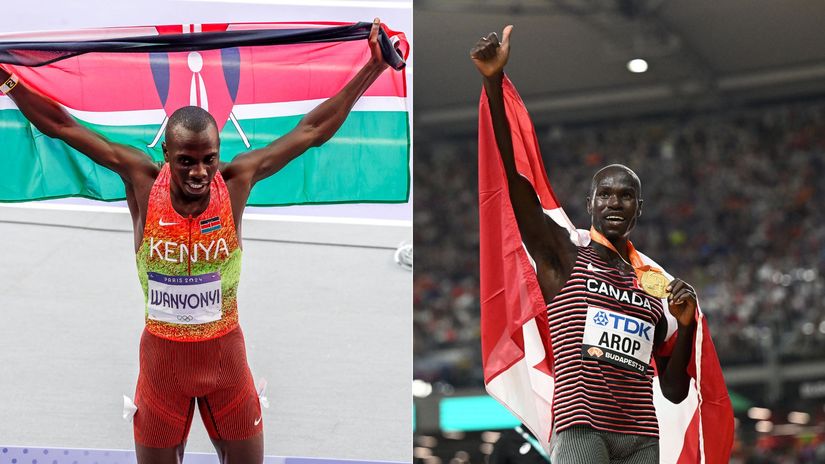
Wanyonyi’s 2024 season was nothing short of spectacular. He won Olympic gold in Paris with a time of 1:41.19, narrowly edging out Canada’s Marco Arop by just 0.01 seconds in what was the fastest Olympic 800m final in history.
Less than two weeks later, Wanyonyi shattered his personal best again, clocking 1:41.11, tying for the second-fastest time ever with Wilson Kipketer, and just 0.20 seconds shy of Rudisha’s record.

This year, 10 men ran faster than 1:42.5, a remarkable feat that places them among the 21 fastest 800m runners in history. Alongside Wanyonyi, athletes like Arop, Algeria’s Djamel Sedjati, France’s Gabriel Tual, and the United States’ Bryce Hoppel have made history.
Wanyonyi (number two all-time), Arop (No.4), Sedjati (No.5), Tual (No.6), and Hoppel (No.7) now occupy half of the top 10 fastest times in the event’s history, setting the stage for even more intense battles in the coming years.
Hoppel, who broke the US national record with a time of 1:41.67, could only manage fourth place in the Olympic final, underscoring the depth of talent in the 800m. His time would have earned gold in every Olympic final except for 2012, but in Paris, it was not enough to secure a medal
What’s driving the speed surge?
The flurry of fast times in 2024 has sparked discussions about what’s fueling this next generation of 800m stars.
Arop believes that improvements in technology, training, and recovery are playing a major role.
"The spikes, the tracks, all of that plays a factor,” Arop said, adding that taking a bicarbonate supplement helped him manage lactic acid and push his limits.

“This is the next generation of 800m athletes, and they’re all entering their primes,” he told World Athletics.
The prime age for 800m runners ranges from their early twenties to late twenties, and with athletes like Wanyonyi, Arop, Sedjati, Tual, and Hoppel all aged between 21 and 28, the upcoming 2025 season promises to be even faster.
As they continue to chase Rudisha’s world record, the competition is expected to reach unprecedented heights.
With the World Athletics Championships in Tokyo set for September 2025, the question on everyone’s mind is whether Rudisha’s record will finally fall.
Even Rudisha himself, while acknowledging the difficulty of breaking his record, is watching with intrigue.
“I believe nothing is impossible. The world records are set to be broken. Anytime we set our world record, somebody is looking forward to seeing how they are going to reach that bar, and with the new technology, the innovation, the good shoes, nothing is impossible.

It tells you that it’s also a very tight world record. I can’t predict who will take down the record. It is hard to say because these guys are in good form.
Let’s see how they are going to progress. This is the year they have shown that they can push themselves to the limit,” he said.
With young athletes reaching their peak and no one willing to back down, the road to Tokyo is likely to be one of the most thrilling chapters in the history of athletics.