


Why majority of Faith Kipyegon's pacers in Breaking4 were men





.jpg)



Reading Time: 4min | Fri. 27.06.25. | 21:12
Male pacers were selected not just for their ability to maintain high-speed endurance, but for the aerodynamic advantage they offered
Triple Olympic 1500m gold medalist Faith Kipyegon came heartbreakingly close to history on Thursday, 26 June, at the Stade Sébastien Charléty in Paris, missing the mythical sub-four-minute mile mark.
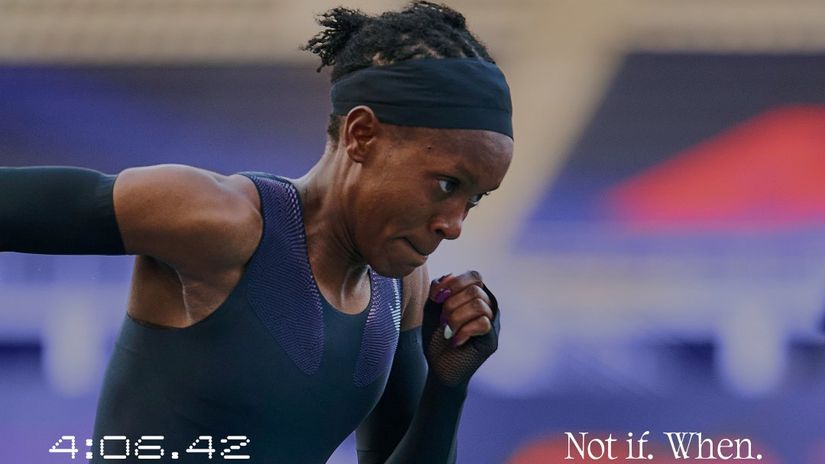
The stargirl clocked an impressive 4:06.42 in Nike’s Breaking4 challenge, a race that was designed to push the limits of human performance.
Follow our WhatsApp channel for more news
However, beyond the spectacle, one detail stood out.
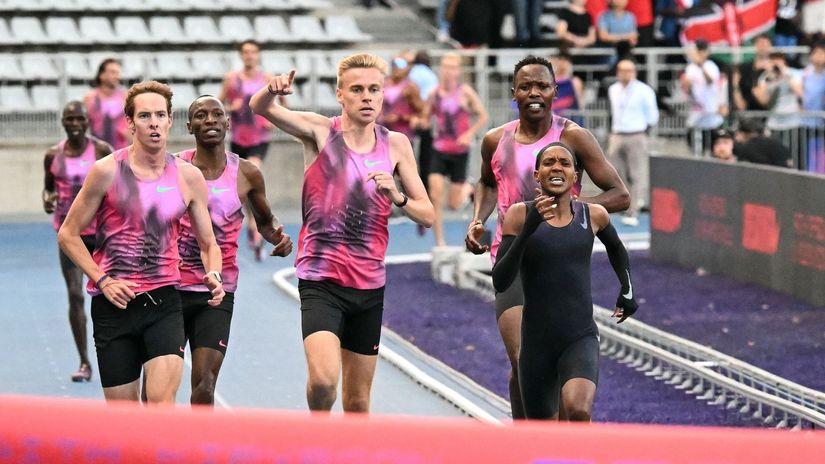
Out of her 13 pacemakers, 11 were men.
Mozzart Sport sought to understand the reason behind this, and as it turns out, it is all based on science and strategy.
Kipyegon is, quite literally, the fastest woman alive over 1500m, and matching her stride for stride, let alone pulling her ahead to break new ground, is no easy task.
Very few female athletes can hold their blistering pace for an extended distance, particularly at the sub-4-minute mile threshold, a feat no woman has ever achieved.
That is where the men came in.
Male pacers were selected not just for their ability to maintain high-speed endurance, but for the aerodynamic advantage they offered.
The 11 male athletes helped create a “wind pocket” around Kipyegon, shielding her from headwinds and reducing drag, hence allowing her to conserve critical energy over the grueling four-lap test.
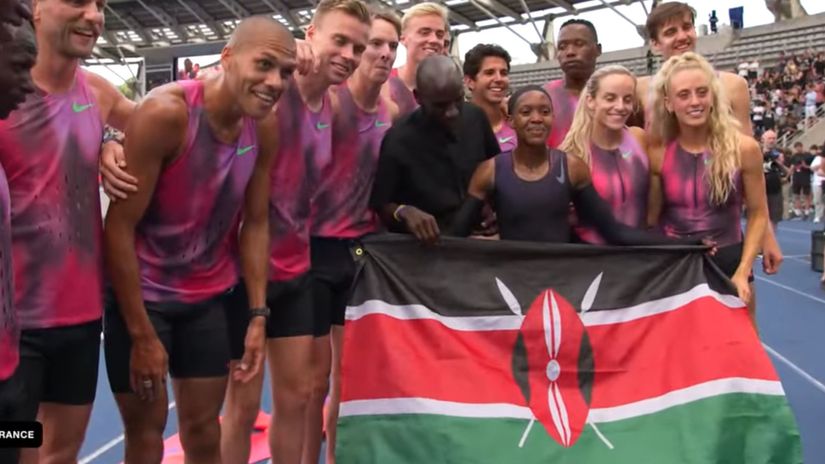
The pacer squad was nothing short of elite. It was led by American Grant Fisher, the world record holder in the short track 3000m and 5000m, who made history at the Paris Olympics by winning bronze in both the 10,000m and 5,000m, becoming the first American to do so.
Joining him were distance specialists like; Cooper Teare (12:54 in 5000m), Craig Engels (3:51.60 mile), Australia’s Stewart McSweyn (3:48.37 mile), Dutch stars Niels Laros (3:29 in 3,000m) and Stefan Nillessen (3:29 in 1,500m), Irishman Cathal Doyle (3:53 mile), and Briton Elliot Giles (3:49.16 mile).
Kenya’s own Wycliffe Kinyamal, the two-time Commonwealth 800m champion with a personal best of 1:42, was also on the list.
The only two female pacers were Paris Olympics bronze medalist Georgia Hunter Bell and Ugandan 800m specialist Halimah Nakaayi (PB 1:57).
The formation was also tactical.
Five pacers fanned out ahead of Kipyegon in the first four lanes, with one leading in lane one while others formed a barrier against headwinds from the sides.
Six more trailed behind her in a compact formation to block any breeze from the rear.
After two laps, three pacers dropped off, most notably the runner in the outermost lane, who had covered the most ground.
One more exited with one lap to go, leaving Kipyegon with three male pacemakers guiding her to the finish line.
The use of predominantly male pacers stirred conversations around fairness, innovation, and the evolution of sport, conversations welcomed by key figures in global athletics.
“Popular or unpopular opinion; as women are trying to do things that have never been done, and we could not have female pacers unless they hopped on and off the track, which we talked about. So, I think as we evolve and women evolve in sport, the rules need to also evolve and reflect that as well,” Diljeet Taylor, the 2024 NCAA Coach of the Year and Nike Swoosh coach, said.
Paris Olympics 800m champion Keely Hodgkinson was in support of the move, noting that if women could not keep up, Kipyegon would undoubtedly need help from the men.
“Faith is aiming to break a barrier. If you are the best woman in your event and trying to chase these new things, and there may not be another woman that can keep up with you or go ahead, you might need some help from the guys to do that,” she said.
On his side, nine-time Olympic gold medalist Carl Lewis noted that sometimes, rules can be bent for special people like Kipyegon.
“Think about it. If you are at the very, very top, you are excellent. Sometimes you have to change the rules for people who are special. That is what tonight is about. You are taking someone special, so we have to find a way to let the world see her excellence,” he said.