

.jpg)
Popular 'Misheveve' Chief unpacks Emmanuel Wanyonyi's early struggles to access education [VIDEO]




.jpg)

Reading Time: 3min | Wed. 01.01.25. | 18:58
He also told of how his late father brought him a pair of training shoes and urged him to chase his dreams
Protus Wachuli commonly known as ‘Misheveve’ Chief, the chief of the Sabaot constituency in Trans Nzoia County, where Paris Olympics 800m champion Emmanuel Wanyonyi grew up, recently opened up on his challenges to access education.
Wanyonyi, who is the fifth born of 11 children, grew up in challenging conditions. It is hard to imagine that he almost did not become an athlete at all.
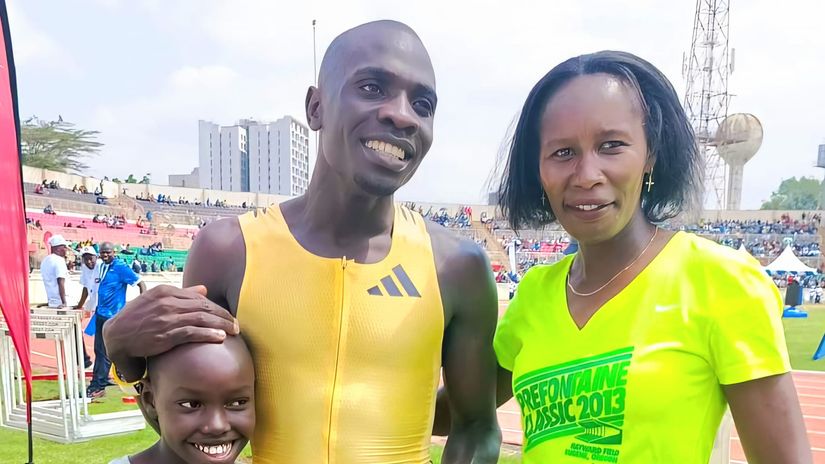
His family barely had enough to get by. By the age of 10, little Wanyonyi was forced to drop out of school, and like many boys in the remote parts of Sabaot, some as young as six years, he sought work as a herd boy.
He looked after cattle as a means of survival for years, and during his free time, he would go running around a track at a local school.
“Emmanuel Wanyonyi was a herder here in Sukwo. One time I met him at the school’s gate wearing a short. The government told me as a chief to ensure mandatory transition in education but Wanyonyi looked old at that time,” the Chief said during a past event attended by Trans Nzoia county governor George Natembeya.
Wachuli went on to explain that Wanyonyi displayed remarkable determination. Despite not having the luxury of a proper uniform, his zeal and passion for running were evident to all who watched him.
Amorim, Man United and Chelsea aside ,Listnen to how misheveve chief hillariously narrated the story of our own Emmanuel Wanyonyi from Kitale. pic.twitter.com/JRpfIt4MWY
— Masika (@Masika_10) December 30, 2024
“Everyone was surprised if Wanyonyi, a herder at his age could do it. It would be like a drop of blood in an ocean. The senior teacher Kalamu accepted to admit him to the school despite the challenges. He became focused with determination and was persistent,” he offered.
After admitting Wanyonyi to the school, his late father brought him a pair of training shoes and urged him to chase his dreams. Wanyonyi’s father unfortunately died in 2018.
“Wanyonyi’s father brought him sports shoes and gave them to him and motivated him to run so that he could make it in the future. That was the blessing he left on Wanyonyi before his death,” he said.
Haunted by his difficult upbringing and the trauma of poverty, Wanyonyi trained harder and ran even faster. His performance in school also improved.
He always made the podium across the track disciplines from the 400m event up to the 5,000m at the county and national county levels.
Wanyonyi’s 2024 season was nothing short of spectacular.
.jpg)
He won Olympic gold in Paris with a time of 1:41.19, narrowly edging out Canada’s Marco Arop by just 0.01 seconds in what was the fastest Olympic 800m final in history.
Less than two weeks later, Wanyonyi shattered his personal best again, clocking 1:41.11, tying for the second-fastest time ever with Wilson Kipketer, and just 0.20 seconds shy of Rudisha’s record.
“If you have a divine calling in life, a permanent motive and purpose, your willpower will cause you to achieve it despite the setbacks. All great men in history faced great opposition and criticism. We often try what we do by finding out what we do not do,” Wachuli concluded.