


.jpg)
 S. Ochieng
Ferdinand Omanyala: The stone that was once rejected but is now Kenya’s athletic cornerstone

Reading Time: 13min | Fri. 17.02.23. | 09:53
Deep down, I believed in myself. I told myself that I had the speed and what people said about me does not matter. It is what is in my heart and what I believe in that matters - Omanyala.
Kenya's trailblazing sprinter Ferdinand Omurwa Omanyala may not be Jesus Christ who was famously rejected by his own Jewish people.
But the 27-year old's story, same like Jesus’, is a perfect reflection of how a reject can quickly turn into the fundamental cornerstone needed in building the most prized of assets.
Gold. 🥇.
— Ferdinand Omurwa OMANYALA (@Ferdiomanyala) August 5, 2022
Lets rise for the national anthem of Kenya. pic.twitter.com/YEZp3g3YUn
For Kenya, at the moment, no athletic folklore can be mentioned without including Omanyala’s name into the fray.
Because for what he has done since 2021 - when he went down into the history book after becoming the first 100m Kenyan athlete to qualify for the prestigious Olympic Games (Tokyo) - you simply cannot rule him out.
🎖| History!
— Mozzart Sport Kenya (@MozzartSportKe) June 17, 2021
The moment Ferdinand Omanyala broke the men’s 100m National Record to qualify for #Tokyo2020 Olympics alongside Mark Otieno who posted 10:05
pic.twitter.com/xTEQxoPV4M
A year later after the milestone achievement, the Friends School Kamusinga alumnus followed it up by setting the African 100m record, clinching the African crown and winning the Commonwealth Games all in a sparkling 2022 performance.
But long before he rose to fame where he now sits as one of Kenya’s athletic greats, Africa’s supremo and among the elite globally in the unfamiliar 100m race that Kenya had not been known for, Omanyala almost gave it all up.
Because, according to him, it had gotten all too much to take.
Rejection
Having started his athletics career in 2016, Omanyala served a 14-month doping ban in 2017 after returning a positive drugs test for a banned substance, which he said was in a painkiller he took.
"I felt I was a victim of circumstance," he explained in an interview with the BBC back in September 2021 when he ran 9.77s at the Kip Keino Classic meeting in Nairobi to become the continent’s fastest man after breaking the 9.85s mark set by South Africa's Akani Simbine in July.
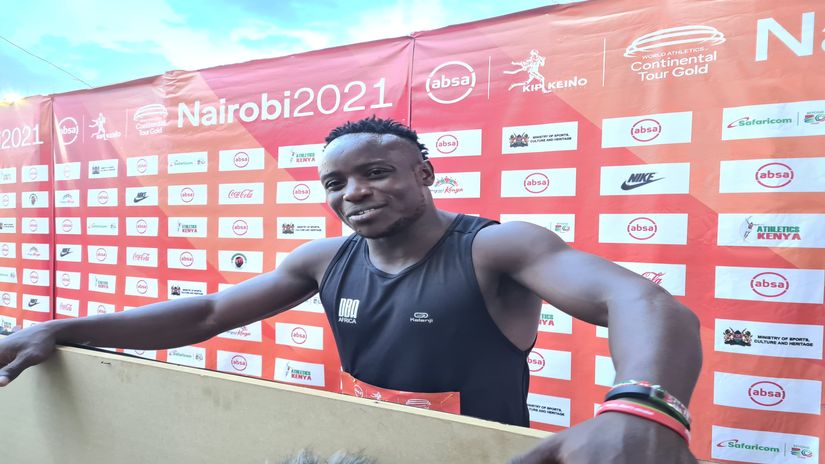
"It was a painkiller and then it turned out it had a steroid in it, and that (experience) is what shaped me to be the person that I am today," he noted.
But upon completing his suspension, Omanyala quickly became an outcast, shunned by the sport’s officials who disingenuously tolerated him in the local meetings for his speed which was hoped would help propel other struggling sprinters, most notably Mark Otieno, to attain the set qualifying standards for the Tokyo Olympic Games.
Around that time, a rising number of high-profile Kenyan athletes failed various doping tests, attracting global condemnation and a very negative spotlight on Kenyan athletics with the western media particularly feral in their coverage.
Thus, a de facto rule was set to bar any athlete who failed a drug test from ever representing Kenya in a championship of any nature.
10.06 💥💥 pic.twitter.com/f71ZA5mshh
— Ferdinand Omurwa OMANYALA (@Ferdiomanyala) May 23, 2021
This was the challenge that confronted a determined Omanyala and threatened to wipe out his budding career even before it had started.
“It got to a point where I said that 2021 would be my last year on track because I saw the fights were really getting out of hand now. People (officials) did not want to accept me back.
I had made up my mind that if it got to the end of June without a change of heart, I would go back to playing rugby,” Omanyala tells Mozzart Sport after his intense morning training at the Moi International Sports Centre, Kasarani.
Saturday mornings pic.twitter.com/nQ5dVDiqTx
— Ochieng' Stephen (@soo_ochieng) January 21, 2023
The fallout from his failed doping test set the tone for a bitter spell as he had engaged Athletics Kenya (AK) officials through lawsuits and media tirades disputing the adverse analytical findings by the Anti-Doping Agency of Kenya (ADAK).
AK officials were particularly irked by Omanyala’s audacity to question, criticize and drag them to court. Thus, the sitting officials vowed to ensure Omanyala never dons Kenya’s famous red vest in a championship of any magnitude.
Cognizant of the fact that he may never represent Kenya at any level despite his massive talent and ever-increasing speed, Omanyala nonetheless started the year preparing like he was already assured of a place in the Olympic team, one of the many instances of his super crazy belief.
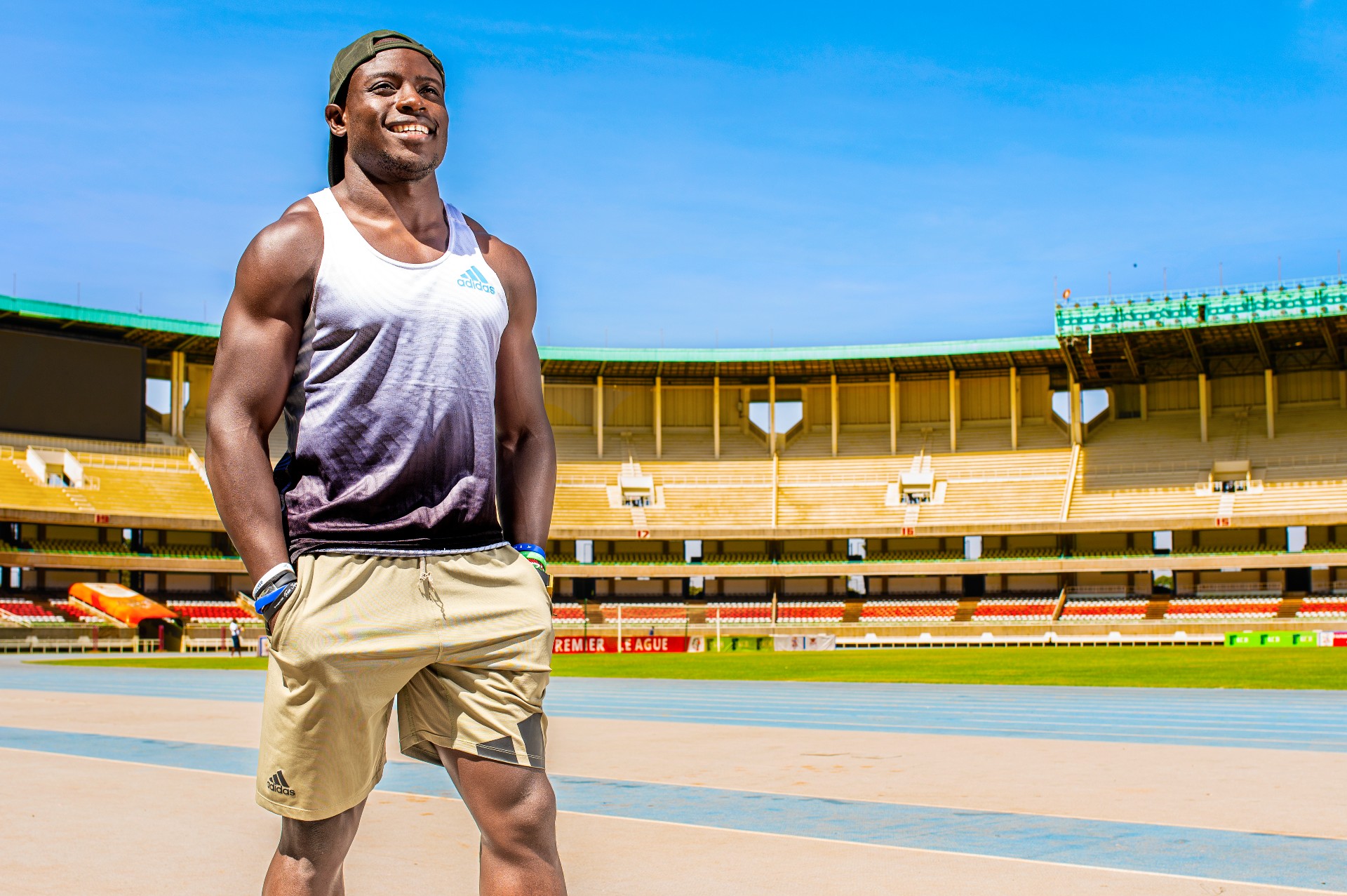 Ferdinand Omanyala © Ian Kwach
During that time, former Kenya Sevens head coach Innocent ‘Namcos’ Simiyu was cobbling up a new strategy of having flying wingers to inject pace in his struggling team.
Omanyala, a rugby player in his high school days, fit his profile.
And just as the Swahili people say, chema chajiuza, kibaya chajitembeza (loosely translated to a good thing does not need too much advertisement compared to a bad thing), Omanyala’s name was thrown into the conversation, and the athlete was invited to train with the team.
Ferdinand Omanyala: I started my sports in Kamusinga High. I was in rugby and I used to run quite fast. I love rugby and joined the team at UoN- Mean Machine…Later I joined Stingers…A friend encouraged me to join athletics#JKLive@KoinangeJeff pic.twitter.com/AxoDIgjfmN
— Citizen TV Kenya (@citizentvkenya) September 22, 2021
“I still had an opportunity waiting in rugby as Namcos had called me to the squad. But I told him to give me a little time to try and sort issues on track. If it fell through, I would link up with them. So, it was kind of a fall back plan that I knew I had,” Omanyala regales.
Under the tutelage of National Olympic Committee of Kenya (NOC-K) A-list fitness trainer Geoffrey Mwangi, who also happens to be in possession of the highest sprints coaching badges, Omanyala hit the ground running very early in the year.
Mwangi had been seconded to Kenya Sevens from NOC-K to aid their preparations. So, both ways, Omanyala would either fit in Simiyu’s team or gain a massive advantage on the tracks having worked with the much sought-after coach.
Concentrate all your thoughts upon the work in hand. The sun's rays do not burn until brought to a focus pic.twitter.com/SklTOpBdeK
— Ferdinand Omurwa OMANYALA (@Ferdiomanyala) July 9, 2021
Things however took a quick twist.
One morning, Omanyala was kicked out of Kenya Sevens training. His close confidants say Athletics Kenya chiefs with influence at NOC-K got him outed.
His world crashed!
From having two promising avenues at the start of 2021 to returning for a confrontation with his athletics demon for a lifeline.
Here's a headliner from the Kenyan Tokyo 🗼Olympic Trials in Nairobi. A new national record 10.02 in 100M for University Student Ferdinand Omanyala.
— Saddique Shaban (@SaddiqueShaban) June 18, 2021
But that's not why this performance stands out. pic.twitter.com/Exrr63zZog
But amidst all the darkness that surrounded him, Omanyala still found some push to keep going against the odds.
His early start with the Kenya 7s had him ripe for track racing by the end of February and well ahead of other sprinters who were only starting serious conditioning.
The Covid-19 lockdowns also left the Olympic Games qualifying window a lot longer than ordinary.

So Omanyala went on with his quest for qualifying time. By then, he was averaging 10.07 seconds over the 100m distance, two milliseconds shy of what was needed to book the Olympic time.
All along, Omanyala remained in a battle with three huge challenges in his quest - broke, increasingly frustrated by failure to get the Olympic qualifying time and worse, the thought of never representing Kenya even if he qualified for The Games.
“It had got to a point that even if I was resilient, I had other things against me. Age was not slowing down, I did not have money and my family was there dependent on me with my son growing fast. What would he eat?”
Every challenge you face today makes you stronger tomorrow. The challenge of life is intended to make you better, not bitter. Persistence and resilience only come from having been given the chance to work through difficult problems.
— Ferdinand Omurwa OMANYALA (@Ferdiomanyala) July 17, 2022
No matter how much falls on us, we keep moving. pic.twitter.com/P4Ea4NT3DW
During the frantic search for qualifying time and with a thinning number of well-organized races, Omanyala was made aware of the 3rd MoC Grand Prix in Lagos, Nigeria.
The race was penciled for 30th March 2021. He secured an invitation but was unable to travel due to lack of funds. Then a sports management company, DBA Africa, run by Lyle Asiligwa, a former Kenya XV’s rugby player, came to his rescue.
DBA Africa funded Omanyala’s travel to Lagos for the 3rd MoC Grand Prix where he broke the Kenyan record as he clocked 10.01 seconds at the Yabatech Sports Complex. That time would also guarantee a first-class ticket to the Olympic Games.
We caught up with 100m African Record holder, Ferdinand Omurwa Omanyala, who spoke to us about how it felt finishing the season with that record, and how the trip to Lagos back in March, to compete at the MoC Grand Prix helped transform his season. #AthleteSpotlight 🇰🇪🇰🇪 pic.twitter.com/qpxp6F77MK
— Making of Champions (@MakingOfChamps) October 5, 2021
Athletics Kenya disown Omanyala
As the news and joy swirled over the first Kenyan to ever attain qualifying time for a 100m race in Olympic Games, Athletics Kenya’s adversarial official quickly dismissed Omanyala’s feat and insisted that he would never get near the Kenyan team.
“What kind of race was that? We do not know if it met the set standards for such times to be recognized and we have not been contacted by Nigerian athletics officials about it. So we do not recognize that time,” dismissive Athletics Kenya Director of Competitions Paul Mutwii told Mozzart Sport then.
Controversy ensued. At that time the Nigerian athletics federation had two factions. One group recognized the race while the other dismissed it. Athletics Kenya eagerly embraced the latter.
Apparently, Kenya won't ratify Ferdinand Omanyala's recent 10.01 over 100m (1.4) in Lagos as a NR but so far haven't managed to find out why.
— Costas Goulas (@LsabreAvenger) April 13, 2021
Omanyala’s efforts and the input of DBA Africa and other support personnel were headed to the trash.
From then on, it is understood that a stroke of luck helped shape Omanyala’s destiny as a stern caller from the Office of the President instructed Athletics Kenya and NOC-K to ensure Omanyala boards the plane to Tokyo, Japan without any more drama.
But still, Omanyala felt he needed to prove himself.
Having given himself till June 2021 to work out his predicaments on track, Omanyala, as if in dreamland, saw the script just fall according to his initial plans.
“Coincidentally, it is during that month of June that we had the national trials for the Tokyo Olympics and it is where I attained the Olympic qualification mark in front of everyone at Kasarani,” he tells Mozzart Sport reflecting to the time he zoomed to a scintillating 10.02s and pulled Mark Otieno with him past the Olympic qualifying time (10.05s).
“It is there that everything opened up because the next day we were on the front pages of all the newspapers having achieved such a historic feat alongside Mark. So there was no way they could refuse,” he reveals.
Noahkipkembo1: RT @athletics_kenya: Ferdinand Omanyala breaks the men’s 100m National Record 10.2 seconds , Mark Otieno posted 10:05 and both qualifies for the Olympics. pic.twitter.com/Dk01YywTRu
— Vincent Odundo (@VinceOdundo) June 17, 2021
It is a moment in time Omanyala always prayed for, always stayed positive but started feeling a bit isolated from considering all the stumbling blocks that had lined themselves before the breakthrough.
“I may not be the most religious person but I believe in God. I grew up in a Christian family and I believe that there is a God because I have seen many miracles happen and we have gotten things we never thought we would overcome. That was one of those moments,” he says.

The revolutionary sprinter would go on to be allowed to travel with Team Kenya and at the Olympic Games, Omanyala breezed into the semis and equaled the 30th March performance by recording his second 10.01s race over 100m.
Having already made history by being the first Kenyan in the Olympic semifinals over the distance, his hopes of advancing to the final as one of the fastest losers were dealt a blow in the third heat when Simbine alongside eventual Italian champion Marcell Jacobs eclipsed his time to qualify ahead of him, albeit with a national record.
Omanyala bows out of the @Tokyo2020 on a high as he break the national record in the men's 100m posting 10.00 in semifinal 1. The journey to @WCHoregon22 is on! Bravo #omanyala pic.twitter.com/DYBnI8hc5K
— Athletics Kenya (@athletics_kenya) August 1, 2021
“I really wanted to make it to the finals and not just make an appearance for the sake of being an Olympian. I ended up getting out of the semis after narrowly missing out by like 0.01 seconds. I never achieved my target but I was proud of myself because I broke the national record twice; in the heats and SF,” he says.
“I left with shoulders high which ignited another fire because I saw that everything was indeed possible. Running in the field alone gives you just the morale. Add to the fact that I was running against people I only saw on the screen. The biggest stars. The fastest sprinters.
Finally, Ferdinand Omanyala’s dream comes true as he sprints and beats Yohan Blake of Jamaica, his role model and sets a new national record of 10:00#TeamKenya #YouAreTheReason pic.twitter.com/plCPzP7jjs
— TeamKenya (@OlympicsKe) August 1, 2021
Just everybody who was anybody was at the Olympics. So, I was so happy to be in the same field with them, the same village with them. When you go to eat you just bump into them, so it was very iconic,” Omanyala smiles as he recollects.
His fame and fortune quickly rose.

But also, his trials through it all tried his mental fortitude.
“My mental strength has definitely grown in leaps and bounds because I have gone through challenges and things that I thought I could not come back from.
But the strong mentality and the strong support system around me, who always believed in me and always encouraged me to keep pushing, helped me a lot,” he discloses.
In his very unconventional journey to the top of his game, where there is still more to come, Omanyala hails his never say die attitude for being ever present. Something which the sprinter says he had to develop in order to pursue his dreams.
Lievin ✅🥇.
— Ferdinand Omurwa OMANYALA (@Ferdiomanyala) February 16, 2023
Big win, new national record and personal best. 6.54!!!
God did it.
Unleashing the heat in the cold weather😎.
Dad's birthday gift😉.
📸: @stadion_actu pic.twitter.com/jQEUG8CU0p
“The resilience naturally came for me because of the challenges I underwent. I slept hungry on some days and furthermore I had a kid who was dependent on me.
There was a time when I was forced to work as a casual labourer just to get 500 shillings to provide for my family. You see in such a situation, you have no option but to be resilient. It comes just naturally,” Omanyala reveals.
Another moment came early in his career when at the University of Nairobi where he had signed up for a Bachelor's Degree in Chemistry.
.jpg) Ferdinand Omanyala © Ian Kwach
Ferdinand Omanyala © Ian KwachAfter clearly dominating in the local meetings in the country, the 27-year-old bounced the idea of deferring his studies to concentrate on athletics to see where it would take him.
It is there where he was met with an early teaser of the winding road ahead of him as some girl in his class called him ignorant.
“You want to do what Kenyans are not known for. Do you think you are (Usain) Bolt?” Omanyala remembers the girl asking her.
Exciting times ahead. #diamondleague2023 #continentaltour2023 #worldchampionships2023 #2023season pic.twitter.com/OFJKMf1k9v
— Ferdinand Omurwa OMANYALA (@Ferdiomanyala) February 5, 2023
While admitting the harsh response got a little bit under his skin, Omanyala states it is everything he needed in setting the foundation of what was to come.
“It is such backlash from early on that made me resilient because of the pile up of challenges.I went and sat down, thought about it and almost reconsidered my position.
Gold. 🥇.
— Ferdinand Omurwa OMANYALA (@Ferdiomanyala) August 5, 2022
Lets rise for the national anthem of Kenya. pic.twitter.com/YEZp3g3YUn
But deep down, I believed in myself. I told myself that I had the speed and what people said about me does not matter. It is what is in my heart and what I believe in that matters,” he remembers telling himself.
And off he zoomed to stardom!
Omanyala is now a Commonwealth champion, an African champion, Africa’s fastest man, Kenya’s fastest man and has his eyes on winning the Olympic Games as well as the World Championships.
Additional reporting by James Magayi