

Why 2025 Enterprise Cup evokes memories of President Iddi Amin’s playing days

.jpg)
.jpg)
.jpg)

Reading Time: 3min | Sat. 26.04.25. | 10:15
A tribute had been planned around the historic Nakuru vs. Nile fixture, evoking memories of a gritty 3–6 contest that defined an era
Did you know that before the world knew him as the iron-fisted Ugandan dictator, Idi Amin Dada was simply a sportsman?
Well, now you know.
Follow Our WhatsApp Channel For More News
As the excitement swells ahead of this weekend’s Enterprise Cup final, Kenyan rugby fans are tangled in a nostalgic yarn. In 1961, Nakuru Athletic Club hosted Nile Rugby Club from Jinja, Uganda, in a semi-final that has since entered East African rugby folklore.
Among Nile’s visiting players was none other than Efendi Idi Amin, then a robust second-row forward and later one of Africa’s most infamous leaders. A versatile athlete, Amin boxed, swam, sprinted, played football, and even drove rally cars.
But that day in Nakuru, it was rugby that brought him to the fore, earning him the distinct honor of being the first African to play on the hallowed turf of the Nakuru Athletic Club. While Amin’s on-field performance was largely unremarkable, the symbolism of his presence was profound.
.jpg)
At the time, rugby in East Africa was still viewed through a colonial lens, and an African competing at such a level disrupted the status quo.
Though myths persist, like him being a last-minute replacement for the East African side in 1955, his legitimate appearances with Nile RFC cement his place in the region’s rugby story.
This weekend, the past will not repeat itself, at least not literally. Amin, who died in exile in 2003, will of course be a no-show. But his ghost, and the memory of that 1961 clash, still lingers in the ethos of the Enterprise Cup.
In a nod to that iconic match, a tribute had been planned around the historic Nakuru vs. Nile fixture, evoking memories of a gritty 3–6 contest that defined an era.
That match remains one of the best-documented early East African rugby encounters.
The Nakuru match day program from the day, kept by the late Bill Harte, a player in that very game, features detailed commentary and even cheeky typos like “lust in the front row” instead of “thrust,” which have become part of local legend. Though Nakuru triumphed to reach their fourth consecutive final, Nile’s fearless fight and players like the tireless Opie earned plenty of respect.
Reports from the day speak of fast-paced, open rugby that thrilled even a sparse crowd and planted the seeds of regional rivalries that still spice up today’s matchups. Nakuru’s connection to the Cup is rich. The last final hosted in Nakuru was on August 8, 1964.
Then, the original Nakuru Athletic Club (NAC), captained by Simon David ‘Lofty’ Reynolds, took on Keith McGuiness’ Kenya Harlequins.
That old NAC side were champions in 1958, 1960, 1962, and 1963. In modern times, Nakuru RFC, with names like Lawi Buyachi, Walter Pete Prinsloo, Hamilton Onsando, and Gibson Weru, lifted the Cup in 2008 and 2014.
The Cup’s history reflects a broader socio-political shift.
Introduced in colonial times, rugby initially served as a bastion of white supremacy, with Australia, South Africa, and Rhodesia (now Zimbabwe) using it as a vehicle for exclusion.
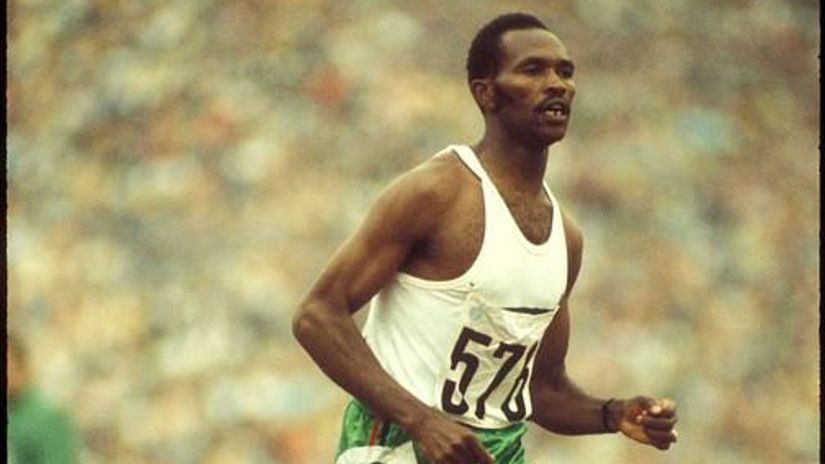
East Africa was no different. But by the 1950s, black players like Mike, and Albert Kaggwa of Uganda RFC (later Kampala RFC) began to break through. Amin was part of this wave.
The true turning point came on August 16, 1969, when Christopher Okong’o-Okwelle became the first black player to lift the Enterprise Cup at RFUEA Grounds in Nairobi. He repeated the feat a year later in Kampala.
This paved the way for legends like Chris Onsotti, John Muhato, and Frank Wanyama Ojiambo of Impala RFC, who led the “Red Men” to dominance between 1970 and 1975.
There were others, too: Mombasa SC clinched the Cup in 1997 with Amer Mwatsahu leading a team that included Edwin Obuya, Andrew Lopokoiyit, Thomas Opiyo, George Adul, and Paul Keir.
Over the years, Nairobi’s giants, Mwamba RFC and Nondescripts, have painted the Cup with passion and persistence.
Mwamba, despite 11 painful final defeats, are an enduring symbol of the sport’s grit. Nondies, now over a century old, lead the title count with a staggering 25 titles.