


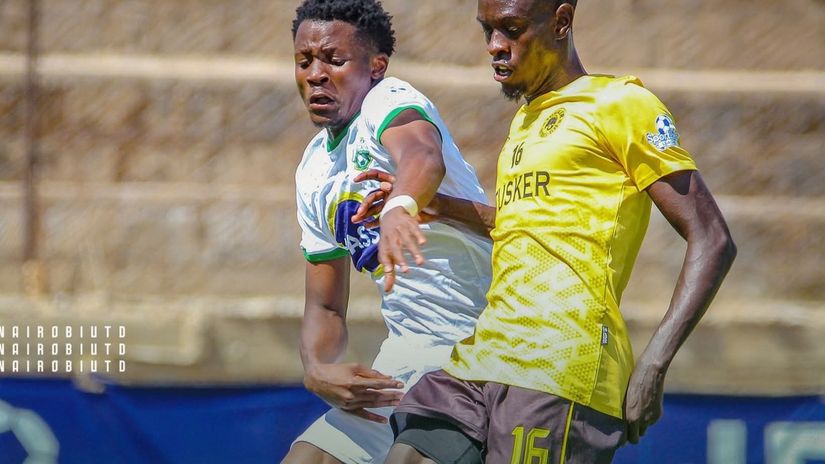
Tactical Analysis:Understanding how Nairobi United set up to down Tusker FC









Reading Time: 5min | Sun. 21.12.25. | 12:58
Nairobi United outsmarted Tusker through superior structure, disciplined pressing, and intelligent manipulation of space
Nairobi United’s victory over Tusker was not built on moments of chaos or individual brilliance alone, but on a clear, well-executed tactical plan that consistently disrupted Tusker’s structure while allowing Nairobi to control key phases of the match.
From the opening exchanges to the disciplined closing stages, Nairobi United demonstrated a strong understanding of game state, spatial control, and risk management, ultimately outsmarting a Tusker side that struggled to translate territorial pressure into clear chances.
Tusker began the match in a familiar 4-4-2 organizational structure, with Brandon Obiero tasked not only with goalkeeping duties but also with initiating play through long distributions and switches of play.
The backline of Eugene Ikutwa, Dennis Wanjala, Momanyi Charles, and Thomas Teka was designed to provide defensive cover at the back, while Vincent Owino anchored midfield as the deep screening presence.
Fabian Adikiny operated higher up the pitch, linking midfield and attack with progressive passing, supported by a narrow attacking shape that saw Ian Simiyu and Cliff Oruko function as inside forwards.
Up front, Dennis Oalo and Thomas Omole offered movement and physical presence, often drifting wide to stretch Nairobi United’s defensive line.

Nairobi United, however, approached the game with a contrasting structure and intent.
Lining up in a 4-1-4-1 in possession, they prioritized patience and control in their build-up.
Goalkeeper Ernest Mohammed was heavily involved, combining with center backs Prince Buregeya and John Otieno to circulate the ball calmly under Tusker’s high 4-4-2 press.
Manzur Okwaro played a pivotal role as the single pivot, constantly offering himself as a passing option, shielding the backline from transitions, and ensuring numerical superiority in the first phase of build-up.
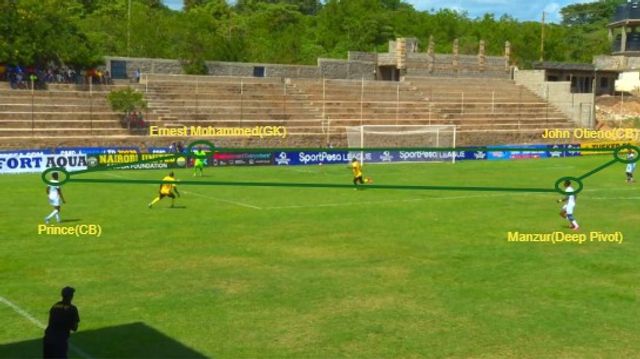
Calm build-up under pressure: Ernest Mohammed, the goalkeeper, supported by the two center backs Buregeya and Otieno, used Manzur Okwaro as the single-pivot outlet to create numerical superiority and play through Tusker’s high 4-4-2 press.
This allowed Nairobi to consistently bypass Tusker’s first line of pressure rather than forcing risky vertical passes.
One of Nairobi United’s most effective tactical adaptations was the intelligent use of their full-backs.
.jpg)
With Okwaro providing security centrally, either Kevin Otiende or Yusuf Mainge could advance into higher zones, creating overloads on the flanks.
These overlapping runs were carefully timed, ensuring Nairobi maintained rest-defense stability even when committing numbers forward.
Out wide, Ovella Ochieng and Duncan Omalla frequently swapped wings, a subtle but effective ploy that unsettled Tusker’s defensive references and disrupted their pressing triggers.
Tusker’s aggressive high press in the opening stages was met with composure rather than panic.
Nairobi United were comfortable circulating possession across their backline before finding Manzur or Lesley Owino between the lines.
Lesley Owino’s dual role was especially important; while he contributed to forward progression, he also dropped deep in defensive phases, effectively turning Nairobi’s shape into a compact 4-4-2 out of possession.
This ensured Tusker rarely found central lanes to exploit during transitions.
The opening goal encapsulated Nairobi United’s tactical clarity, particularly from set-piece situations. Rather than delivering predictable aerial balls, Nairobi opted for short corners designed to draw Tusker’s defensive block out of shape.
In the 11th minute, after a short corner was partially cleared, the ball fell to Kevin Otiende in a deep, central area.

With Tusker’s defensive line momentarily disorganized and Obiero drawn forward, Otiende’s long-range strike proved decisive.
The goal was a direct consequence of Nairobi’s commitment to varied set-piece routines and second-ball anticipation.
As the first half progressed, Tusker attempted to gain control by shifting into a 4-1-3-2 shape in possession, forming a midfield diamond with Owino at the base and Adikiny at the tip.
While this provided a central presence, it also narrowed their attacking focus, making them increasingly reliant on wide deliveries. Nairobi United responded by defending compactly, with Omalla in particular showing strong defensive discipline on the right, frequently tracking back to support Mainge and prevent overloads.
Nairobi’s attacking approach in open play was deliberately vertical but controlled. They often circulated the ball through defense and midfield before playing a single, decisive pass into wide areas.
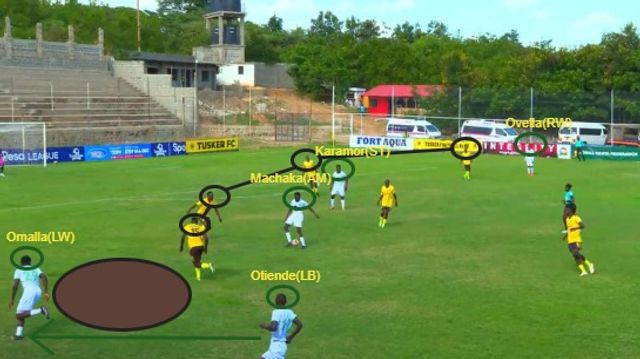
Between-the-lines link: Machaka’s hold-up play stretched Tusker’s back line, opening half-space and wide-channel gaps for Omalla and the advancing Otiende to exploit.
From there, runners such as Omalla and Ovella attacked space aggressively, while Enock Machaka and Michael Karamor made late movements into the box. Karamor’s tendency to drop deep to link play was especially effective, pulling Tusker’s center-backs out of position and creating channels for midfield runners to exploit.

In the second half, Tusker sought to change the dynamic through substitutions, introducing Erick Kapaito and later David Polepole and Douglas Omanga to add pace and width going forward.
Their structure oscillated between a 4-1-3-2 and a flatter 4-4-2, with an increased emphasis on attacking from wide areas. However, Nairobi United anticipated this shift and adjusted accordingly. After replacing Manzur Okwaro with Brian Magare, Nairobi became more direct in restarts, frequently going long to wide zones to bypass Tusker’s midfield press and pin their full-backs deep.
Defensively, Nairobi United’s game management was exemplary in the latter stages. They remained compact, denied central penetration, and forced Tusker into low-percentage crossing situations. Tusker’s zonal and man-marking setup on defensive corners limited aerial threats, but Nairobi continued to threaten through second balls and half-space combinations, preventing Tusker from fully committing numbers forward.
Ultimately, Nairobi United outsmarted Tusker through superior structure, disciplined pressing, and intelligent manipulation of space. While Tusker enjoyed spells of possession and territorial advantage, they were repeatedly funnelled into areas that Nairobi was prepared to defend.
Nairobi’s ability to control tempo, vary their attacking methods, and protect their lead in the closing minutes highlighted a mature tactical performance. Rather than matching Tusker’s intensity, Nairobi dictated the terms of engagement, proving that clarity of structure and game intelligence can outweigh raw pressure and possession.